
Reviewed for accuracy by Muhammad Gulbadin, founder and operations manager at Urban Flooring, 15+ years in UAE flooring.
Epoxy and microcement are both continuous poured floors with no grout lines, but they suit different jobs. Epoxy is the harder, cheaper, more chemical-resistant floor with a high-gloss option. Microcement is thinner, more design-led and matte, and it runs up walls and over worktops for one continuous material. The right pick depends on the look you want, your budget and where it is going.
What are epoxy and microcement, and how do they differ?
They look similar once poured, both continuous finishes with no grout lines, but they are different materials. Epoxy is a plastic resin that cures hard and glossy. Microcement is a cement-based coating trowelled on thin and matte. That difference drives cost, finish, where each can go and how each handles sun and movement.
Epoxy flooring is plastic-based. It is a two-part resin: a resin and a hardener that cure into a rigid, non-porous, plastic-like film bonded to the slab. It is self-levelling, usually 2 to 5mm thick, and most often glossy, though satin and matte are available. In a home it is largely a floor finish.
Microcement flooring is cement-based. It is a polymer-modified cementitious coating, cement, fine aggregates, polymers and mineral pigments, hand-trowelled in thin coats to about 2 to 3mm. It has a natural matte character and bonds over almost any sound substrate. Crucially, it is not floor-only.
Plastic-based versus cement-based is the distinction the rest of this comparison follows from.
Epoxy vs microcement at a glance
The table compares the two across the points that decide a UAE home or commercial interior: cost, thickness, finish, which surfaces each suits, hardness, chemical and UV resistance, crack tolerance, wet-area suitability and install time. Each material leads on roughly half the rows, so read it as a map of trade-offs.
| Feature | Epoxy | Microcement |
|---|---|---|
| Cost (supply and fit) | AED 50-250/sqm (4.6-23.2/sqft) | AED 150-500/sqm (13.9-46.5/sqft) |
| Thickness | 2-5mm, self-levelling | 2-3mm, hand-trowelled coats |
| Finish / look | High-gloss (or satin/matte); solid, metallic, flakes | Matte/satin, natural hand-trowelled character; wide pigment range |
| Surfaces it suits | Floors (largely floor-only in homes) | Floors, walls, showers, worktops, stairs, ceilings |
| Hardness and durability | Harder; very high wear resistance | Softer than epoxy but tough for homes / light commercial |
| Chemical / abrasion resistance | Excellent (non-porous, resists oils and chemicals) | Good (oils, grease, mild cleaners); not aggressive chemicals |
| UV stability (yellowing) | Standard epoxy yellows under UV unless a UV-stable topcoat is specified | Cement-based, does not yellow; UV-stable with sealer |
| Crack resistance (substrate movement) | Rigid; telegraphs substrate cracks | More ductile; mesh/primer system tolerates minor movement better |
| Wet-area suitability (with sealing) | Moisture-resistant; gloss slippery when wet (anti-slip additive) | Waterproof only with a PU topcoat; runs up shower walls |
| Typical install / cure time | Faster, around 1-2 days application | Slower, around 3-5 days multi-coat, longer before full use |
| Best use case | Tough, high-traffic, chemical-exposed, budget, high-gloss | Design-led matte look, thin over-tile reno, one continuous material |
Which costs less, epoxy or microcement?
Epoxy is the cheaper of the two, and microcement is the clear premium. Supplied and fitted, decorative epoxy runs about AED 50 to 250/sqm (about AED 4.6 to 23.2/sqft) depending on the system, from a basic coat up to a decorative metallic or 3D finish. Microcement runs about AED 150 to 500/sqm (about AED 13.9 to 46.5/sqft).
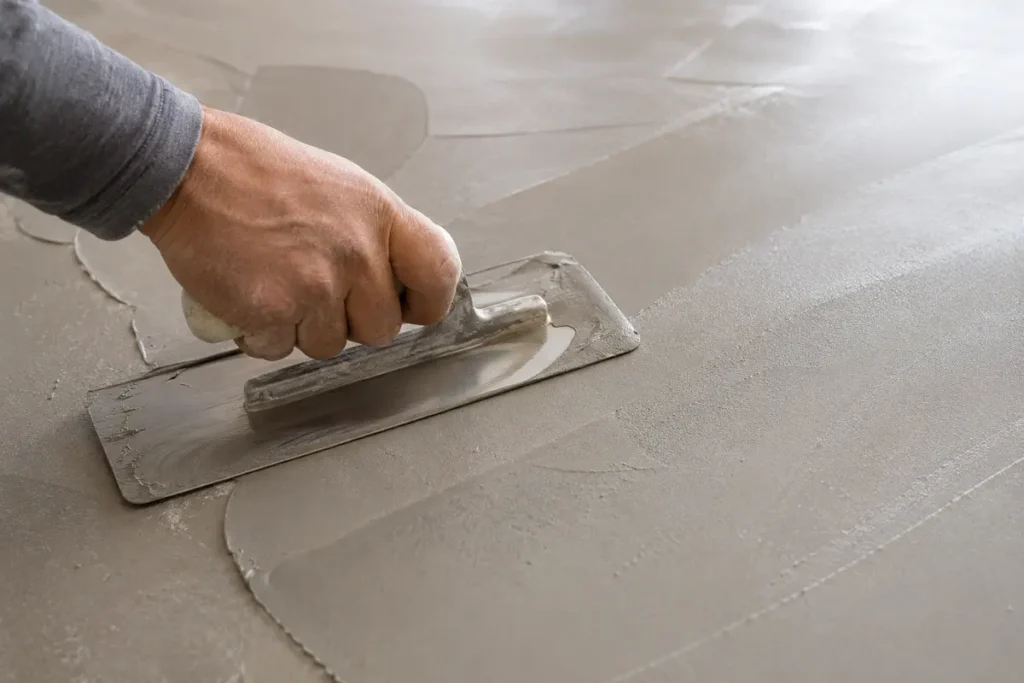
The gap is labour, not materials. Microcement is a specialist, multi-coat, hand-trowelled system applied over a primer and mesh, not a single quick pour, so it takes more skilled time and costs more. If budget leads and you want a tough poured floor, epoxy wins on cost. All figures are indicative, before 5% VAT, and depend on the system, area and substrate prep. For the full breakdown across every floor type, see our flooring cost guide.
How do the finishes compare: glossy epoxy vs matte microcement?
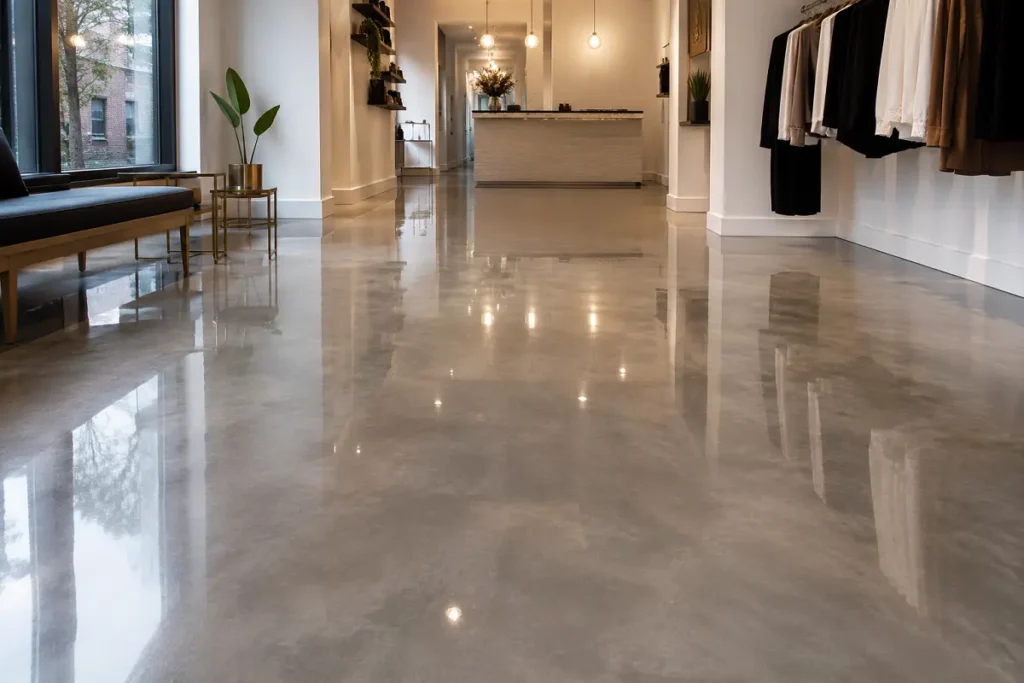
This is where many people decide, because the two finishes read very differently. Epoxy leans glossy and light-reflective. It comes in solid colours, metallic swirls and decorative flake or quartz finishes, which can look striking. In a living space, though, a high-gloss epoxy can read cold or clinical, more showroom than home.
Microcement is matte to satin, with a natural, stone-like, hand-trowelled character and subtle tonal variation. Its pigment range runs from earthy neutrals to bold colours. It is the more design-led, contemporary finish, and it suits warm residential interiors, villas and apartments where you want a soft, modern, natural look rather than a shine.
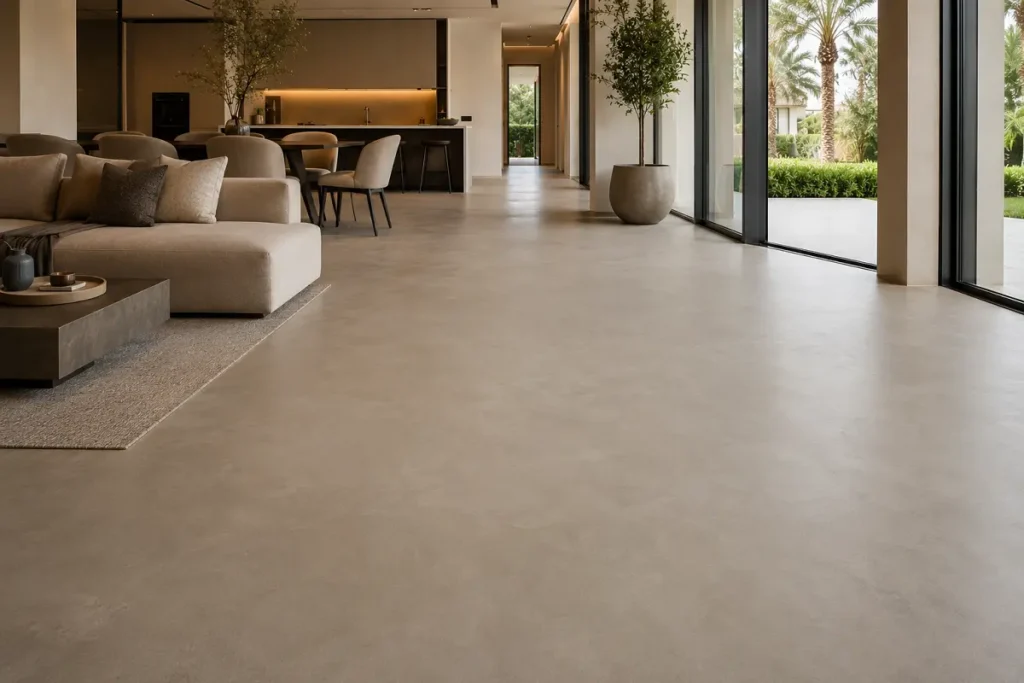
If you want gloss or a decorative metallic effect, epoxy delivers it. If you want a matte, natural, architectural finish, microcement is the look.
How thick are epoxy and microcement, and where can each go?
This is microcement’s standout advantage, and it is worth understanding clearly. Microcement is thin, about 2 to 3mm, and hand-applied, so it bonds over existing tile, concrete, plasterboard or wood without demolition, adding very little height. More than that, it runs continuously across floors, walls, showers, worktops and stairs for one unbroken material and colour. That go-anywhere continuity is something epoxy cannot match.
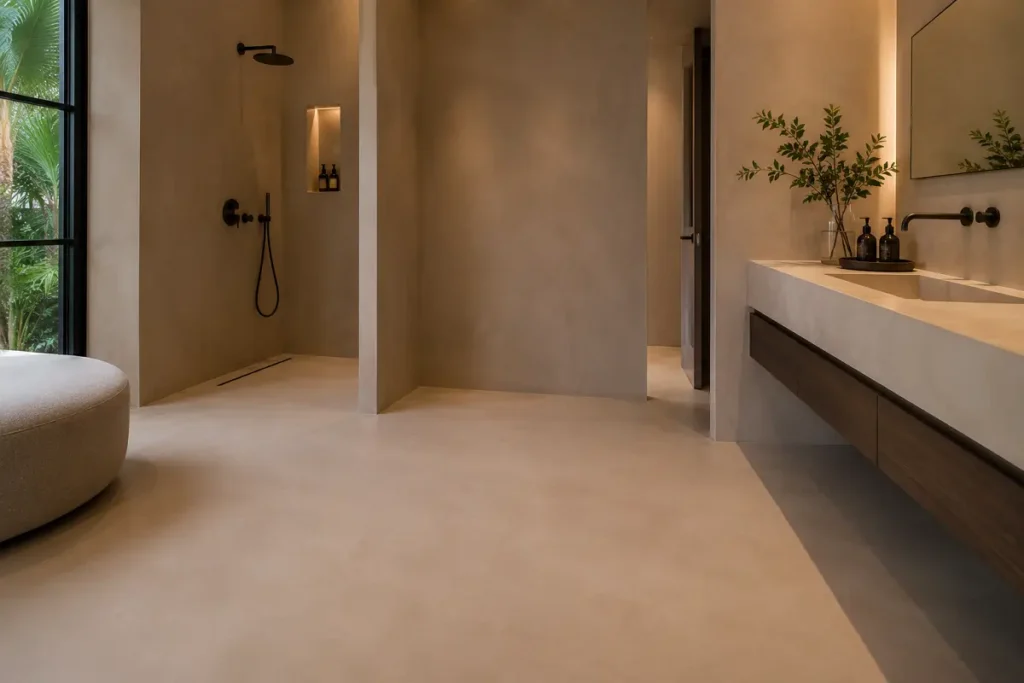
Epoxy is thicker at 2 to 5mm, self-levelling, and needs the concrete ground and prepared first. In a home it is largely a floor finish, horizontal surfaces, not walls or worktops.
So for a thin over-tile renovation, or for one continuous material flowing from the floor up the walls and across a worktop, microcement is the clear choice. For a poured floor alone, either works.
Which is more durable and chemical-resistant, epoxy or microcement?
Both are durable floors for a home, and an honest answer names where each leads. Epoxy is the harder, tougher surface. It resists abrasion, heavy wear and chemicals better, and being non-porous it shrugs off oil and stain spills, which is why it lasts well in busy living areas and retail spaces.
Microcement is softer than epoxy, but it is plenty tough for villas, apartments and light-commercial interiors, and it resists oils, grease and mild household cleaners. It is not the floor for aggressive chemicals, but few homes need that.
Both typically last around 10 to 15 years with proper sealing and care. For sheer hardness and chemical resistance, epoxy; for a thin, design-led finish that is still tough enough for home and light-commercial use, microcement.
Does epoxy yellow in UAE sun, and how does microcement compare?
Here is a genuine microcement win that matters in the UAE. Microcement is cement-based, so it does not yellow in sunlight. Standard epoxy is a resin and can yellow or chalk under sustained UV unless a UV-stable topcoat is specified. Near sun-facing glazing, that is a real specification decision rather than a detail.
Standard, clear epoxy can yellow or chalk under sustained UV and direct sunlight, mainly in clear and off-white finishes. Near sun-facing glazing in a UAE villa or apartment, that is a real consideration. The fix is to specify a UV-stable topcoat, a polyurethane, polyaspartic or aliphatic finish, which resists yellowing. So epoxy can be made UV-stable, but only if the right topcoat is specified up front.
Microcement is cement-based, not a resin, so it does not yellow, and it stays colour-stable in sunny rooms with its sealer. For a sun-flooded room, microcement holds its colour without any special topcoat.
If you want epoxy in a sun-facing room, insist on a UV-stable topcoat; if you would rather not think about it, microcement is the safer pick for UAE sun.
Do epoxy and microcement crack, and which copes with movement better?
This is the limit both share, and it is only fair to state it plainly. Both epoxy and microcement depend on proper substrate preparation, and both can crack if the substrate beneath them moves. Neither will bridge a structurally moving slab indefinitely.
Microcement is the more crack-tolerant of the two. It is applied over a primer and a fibreglass mesh and is polymer-modified and ductile, so it spreads stress and copes with minor substrate movement better. Epoxy is rigid, so it tends to telegraph or mirror a crack that forms in the slab beneath it.
The honest takeaway: prep is everything for both, microcement handles small movement better, and a serious structural crack is a substrate problem that no poured finish alone will solve. A proper assessment of the slab comes first.
Are epoxy and microcement suitable for bathrooms and wet areas?
Both can work in a bathroom, with the right sealer, and neither is waterproof on its own. Microcement becomes water-resistant and mould-resistant once sealed with a polyurethane topcoat, and because it runs across floor, walls and shower as one continuous material, it is a popular choice for a modern, jointless wet room. The topcoat is what makes it watertight, not the microcement alone.
Epoxy is non-porous and moisture-resistant, but in a home it is largely floor-only, and its gloss can be slippery when wet, so an anti-slip additive is added for a bathroom. It does not run up the walls the way microcement does.
Neither is inherently waterproof without its specified sealer or topcoat. For a continuous floor-to-wall wet room look, microcement leads; for a hard, sealed floor, epoxy works with an anti-slip finish.
Epoxy or microcement: which should you choose?
The right answer depends on the look you want, your budget and where the floor is going. Epoxy leads on toughness, chemical resistance and price. Microcement leads on finish, thinness and the ability to run across walls and worktops. The four cases below cover most UAE projects.
- Toughness, chemical resistance, a high-gloss or decorative metallic look, or a tighter budget: epoxy flooring is the harder, cheaper poured floor.
- A matte, natural, design-led finish, a thin over-tile renovation, one continuous material across floor, walls, shower and worktop, or a sun-facing room: microcement flooring is the thinner, go-anywhere, colour-stable choice.
- A busy retail or high-traffic living space on a budget: epoxy, with a UV-stable topcoat if it faces the sun.
- A premium villa or apartment where the look leads and budget allows: microcement, for the architectural finish and the floor-to-wall continuity.
We fit both, and the honest answer often comes down to whether you want maximum toughness at lower cost (epoxy) or a thin, design-led, go-anywhere finish (microcement).
Epoxy vs microcement: frequently asked questions
What is the difference between epoxy and microcement?
Epoxy is a plastic-based resin floor: a resin and hardener cure into a rigid, glossy, non-porous surface bonded to the slab. Microcement is a cement-based coating, hand-trowelled in thin 2 to 3mm layers, with a natural matte finish. Epoxy is harder and glossier; microcement is thinner, more design-led, and can run up walls and over worktops.
Is epoxy or microcement cheaper?
Epoxy is cheaper. Indicatively, supplied and fitted, decorative epoxy runs about AED 50 to 250/sqm (4.6 to 23.2/sqft), while microcement is the premium at about AED 150 to 500/sqm (13.9 to 46.5/sqft). The difference is labour: microcement is a specialist, multi-coat, hand-applied system, not a quick pour, which is why it costs more.
Which is more durable, epoxy or microcement?
Both are durable, in different ways. Epoxy is harder and more resistant to chemicals, abrasion and heavy wear, so it takes more punishment on the floor. Microcement is softer but more flexible, so it tolerates minor substrate movement better and resists cracking. For sheer toughness, epoxy; for a thin, crack-tolerant finish that also goes on walls, microcement.
Can epoxy or microcement be applied over existing tiles?
Microcement is the better over-tile choice. At just 2 to 3mm it bonds over sound, level existing tile, concrete or wood with minimal build-up and no demolition, which makes it ideal for renovations. Epoxy can go over tile too, but needs more grinding and preparation and adds more height. Either way, the existing surface must be sound, clean and stable.
Can microcement be used on walls and worktops?
Yes, and this is where microcement leads. Because it is thin and hand-applied, it runs continuously across floors, walls, shower areas, worktops and stairs for one unbroken material and colour, which epoxy cannot match. Epoxy is largely a floor finish. If you want a single continuous look across several surfaces, microcement is the option that delivers it.
Does epoxy turn yellow in sunlight?
Standard epoxy can yellow or chalk under sustained UV and direct sunlight, which matters near UAE sun-facing glazing, and it mainly affects clear and off-white finishes. The fix is to specify a UV-stable polyurethane or polyaspartic topcoat, which resists yellowing. Microcement is cement-based, so it does not yellow and stays colour-stable with its sealer.
Are epoxy and microcement suitable for bathrooms and wet areas?
Both can be, with the right sealer. Microcement becomes water-resistant and mould-resistant once sealed with a polyurethane topcoat, and it can run across the floor, walls and shower as one surface. Epoxy is non-porous and moisture-resistant but is floor-only and its gloss can be slippery when wet, so an anti-slip finish is added. Neither is waterproof without its topcoat.
Which is better for a UAE villa floor, epoxy or microcement?
It depends on the look and budget. For a hard-wearing, budget-friendlier floor with a glossy or decorative finish, epoxy suits a villa well. For a matte, contemporary, natural finish that can flow from floor to walls to worktops and stays colour-stable in sunny rooms, microcement is the design-led choice, at a higher cost. We fit both and advise on a free site visit.
The bottom line: epoxy or microcement?
Epoxy and microcement are both continuous poured floors with no grout lines, and the right one comes down to look, budget and where it is going. Epoxy is the harder, cheaper, more chemical-resistant floor, with a high-gloss or decorative option, and it is the practical pick for toughness and value, given a UV-stable topcoat in a sun-facing room.
Microcement is the thinner, design-led, matte finish that runs over existing tile and flows across floors, walls, showers and worktops for one continuous material, and it stays colour-stable in UAE sun, at a higher cost. Neither is indestructible or waterproof on its own; both need proper prep and the right sealer. Map where the floor is going, and a free site visit will confirm which suits your space and substrate.
Decide between epoxy and microcement with a free site visit
Choosing between epoxy and microcement for a villa, apartment or retail space in Dubai or across the UAE? Message us on WhatsApp and a specialist will recommend the right continuous floor for your look, budget and substrate, including whether your slab is sound enough and which sealer or topcoat your space needs.
- WhatsApp us: +971 56 689 9831
- Call: +971 56 689 9831
- Request a free site visit and quote across Dubai and Abu Dhabi.
We supply and fit both epoxy and microcement floors across the UAE, with more than 10,000 projects completed by our in-house team since 2013.

Junaid Rana is a content strategist with over 10 years of experience in the interior and fit-out industry, writing on flooring, finishes and fit-out across UAE homes and commercial spaces. His guides are reviewed for accuracy by Urban Flooring’s in-house experts.