
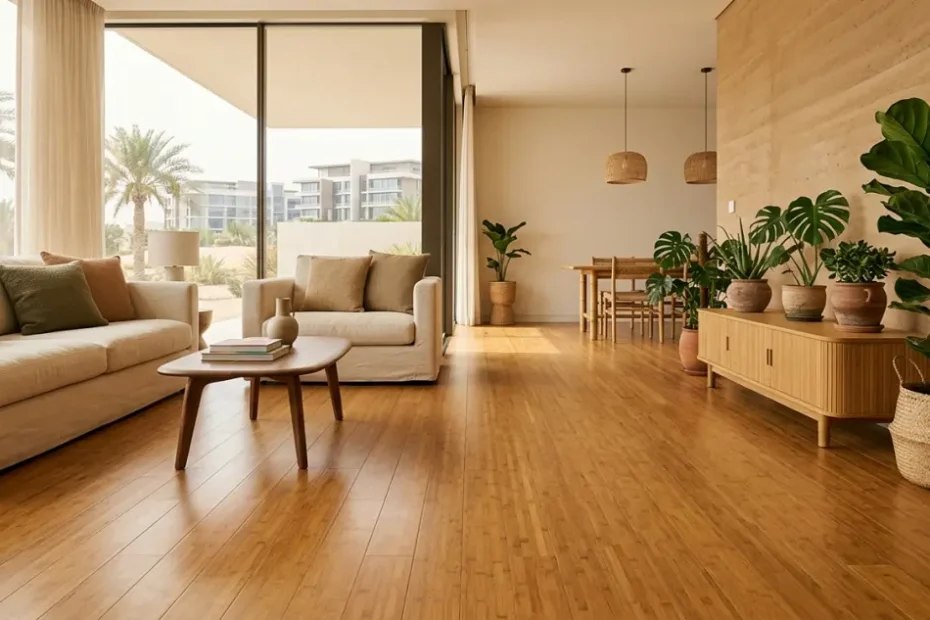
Reviewed for accuracy by Muhammad Gulbadin, founder and operations manager at Urban Flooring, 15+ years in UAE flooring.
Bamboo and cork are both fast-renewing, sustainable alternatives to hardwood, but they are very different floors. Bamboo is a hard, durable, wood-look grass that suits busy living areas. Cork is a soft, warm, quiet bark that suits bedrooms and comfort spaces. Neither is waterproof, so keep both out of wet rooms. Choose by how hard or soft you want the floor.
What is the difference between bamboo and cork flooring?
They get shortlisted together because both are eco floors, but they feel and behave almost nothing alike, and the difference starts with what each one is. Bamboo is a fast-growing grass, milled and compressed under heat and pressure into hard, wood-like planks. That makes it firm, durable and wood-look. Cork is the bark of the cork oak, harvested and processed into a soft, cushioned, air-filled floor.
That makes it warm, quiet and gentle underfoot. So the short version: bamboo is the hard, wood-like eco floor; cork is the soft, warm, quiet eco floor. They share the sustainability story and almost nothing else, which is exactly why they suit different rooms.
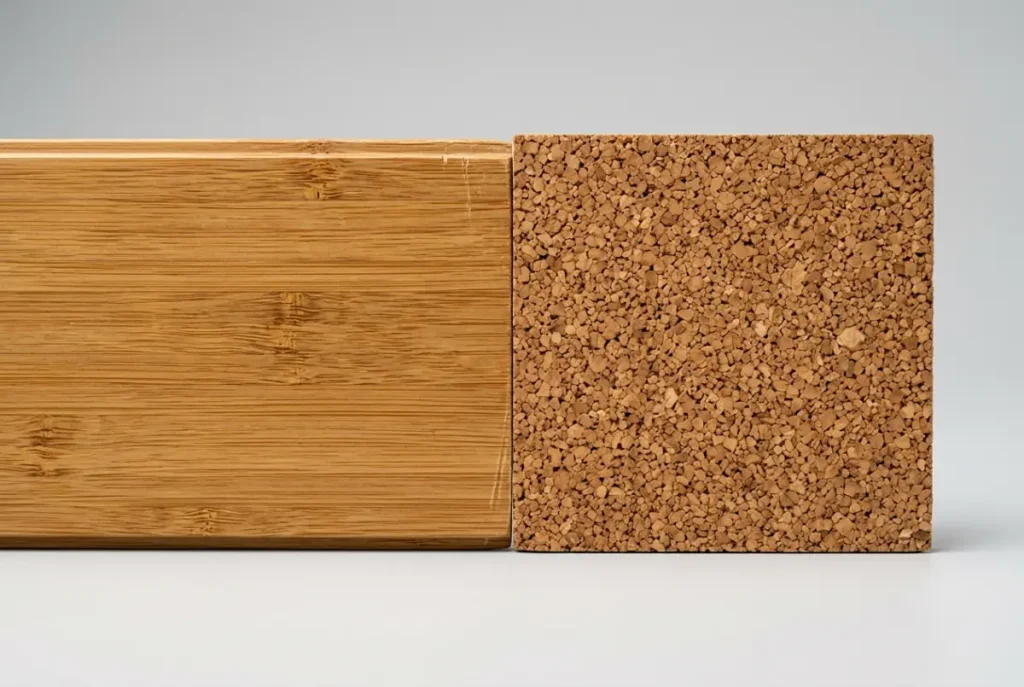
Bamboo vs cork at a glance: the full comparison table
The table sets the two side by side across the things that actually decide the choice: what each material is, feel underfoot, hardness, scratch resistance, acoustics, water resistance, behaviour in UAE humidity, refinishing, sustainability, look and cost. Bamboo leads on hardness, cork on comfort, and they tie on water.
| Feature | Bamboo | Cork |
|---|---|---|
| What it is | Fast-growing grass, compressed into planks | Harvested cork-oak bark |
| Feel underfoot | Hard, firm, wood-like | Soft, cushioned, warm |
| Hardness / durability | High (strand-woven very hard) | Lower, soft surface |
| Scratch resistance | Good (strand-woven best) | Lower (dents, but recovers) |
| Comfort / acoustics | Firm, harder, less quiet | Best: warm, quiet, insulating |
| Water resistance | Not waterproof | Not waterproof |
| Suits UAE humidity | Moderate (organic, can move) | Moderate (organic, can move) |
| Refinishing | Often yes (solid bamboo) | Limited (surface layer) |
| Sustainability | Renews in ~5-7 years | Bark regrows ~9 years, tree lives |
| Look | Clean, wood-like | Distinctive natural grain |
| Cost (supply and fit) | AED 110-300/sqm (10.2-27.9/sqft) | AED 90-250/sqm (8.4-23.2/sqft) |
| Best for | Busy living areas, hallways | Bedrooms, studies, comfort spaces |
How bamboo and cork are made, and why both count as eco floors
The way each floor is made is the reason both earn the eco label, and it also clears up the most common myth about bamboo. Bamboo is a grass, not wood. Its tall stalks are sliced, treated, dried and then laminated or strand-woven under heat and pressure into hard planks.
Because it is a grass, it grows back fast, maturing in about 5 to 7 years against the 30 to 100 years a hardwood tree needs.
Cork comes from the bark of the cork oak, which is peeled by hand roughly every 9 years without cutting the tree down; the tree lives on, regrows its bark and keeps absorbing CO2, and the flooring often uses offcuts from the wine-stopper industry.
So both are genuinely renewable, and that is the honest headline. But green does not mean flawless, and it is worth being straight about the caveats. Some bamboo is bonded with formaldehyde-based adhesives, so look for low-VOC, formaldehyde-free or CARB-compliant boards, which are available in the UAE. Bamboo processing can be energy-intensive, and both floors are imported, so they carry a transport footprint to the region. Both are green when sourced and harvested responsibly, which is the fair way to put it.
Hardness and durability: where bamboo leads
If you want a hard, tough floor, this is bamboo’s territory, and the numbers are striking. Bamboo flooring, especially strand-woven bamboo, reaches a Janka hardness of roughly 3,000 to 5,000, around three times harder than oak, which puts it among the hardest floor surfaces you can buy.
That hardness means strong scratch and dent resistance and the ability to take heavy foot traffic, and solid bamboo can generally be sanded and refinished a few times over its life, much like engineered wood. Cork, by contrast, is soft, so bamboo is the clear pick for busy living areas, hallways and anywhere the floor takes a beating.
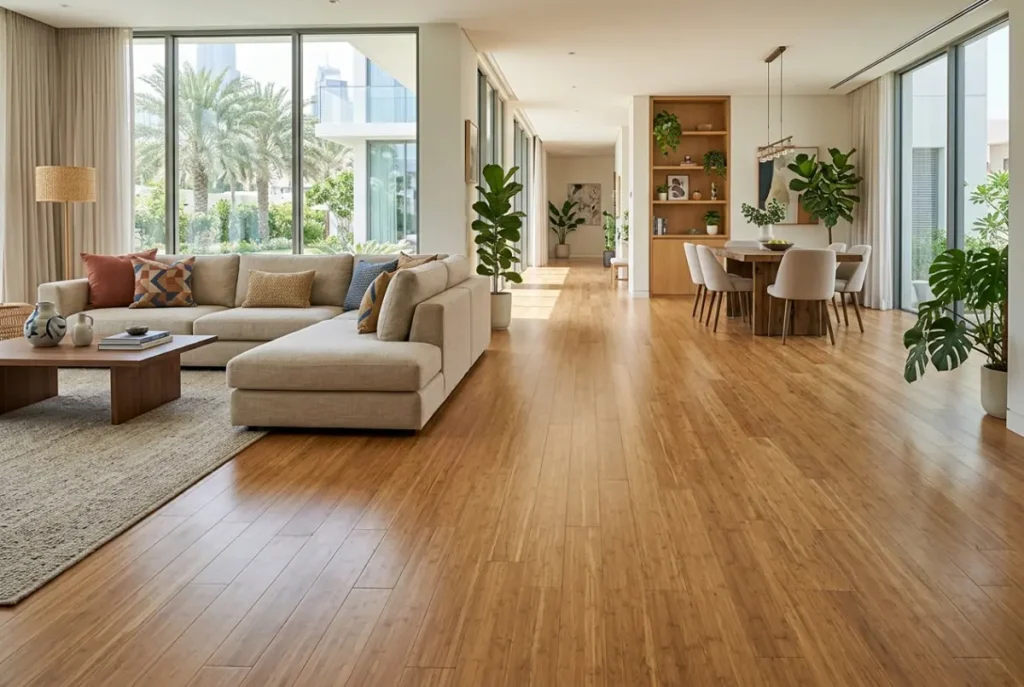
Comfort, warmth and quiet: where cork leads
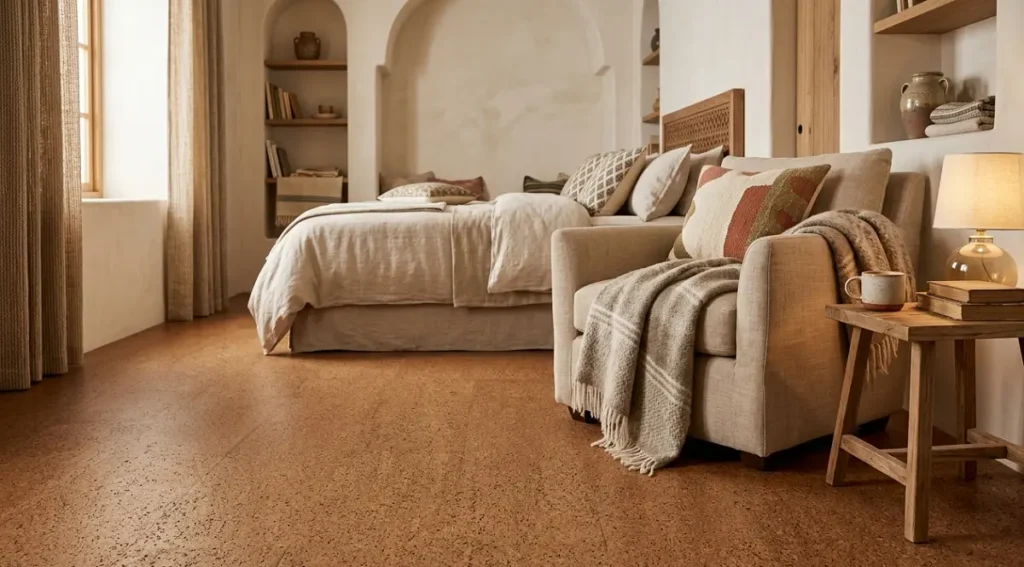
If you want a floor that is kind to stand on, this is cork’s territory, and it wins it comfortably. Cork flooring has an air-filled, closed-cell structure that cushions every step, which reduces standing fatigue, insulates so the floor feels warm rather than cold underfoot, and absorbs sound with a noise-reduction coefficient of up to 0.7, making a room noticeably quieter. It also naturally resists mould and suits children.
Its softness is the trade-off, heavy furniture and heels can dent it, though its elastic structure recovers up to 90% of light indentations within 24 hours, and furniture pads help. Bamboo is firm and wood-like and can feel cold and hard by comparison. For bedrooms, studies and quiet comfort spaces, cork leads.
Water, humidity and the UAE climate: what neither floor will do
Here is the shared honest limit, and it matters in the UAE: neither bamboo nor cork is waterproof. Both are organic materials. They are water-resistant, but standing water will make them swell or degrade, and big humidity swings, exactly what air conditioning creates as it cycles, can make either move, so acclimatisation, substrate moisture testing and proper expansion gaps matter here.
Strand-woven bamboo copes a little better with those cycles, and cork needs sealing and periodic resealing to resist moisture, but neither becomes waterproof. Both can also fade under direct UV through unshaded glazing. The practical rule is simple: neither belongs in a bathroom or wet room. For a genuinely wet area, choose a waterproof vinyl floor instead, and keep bamboo and cork for the dry rooms where they shine.
Sustainability compared: which is the greener floor?
Since eco credentials are usually the reason these two get shortlisted, it is worth comparing them straight, without the marketing gloss. This is the specific bamboo-versus-cork picture; the broader question of which flooring types are eco-friendly overall is a wider topic in its own right.
Bamboo’s green case is speed and yield: it matures in about 5 to 7 years, regrows from the same root system without replanting, and sequesters CO2 quickly as it grows. Cork’s case is that nothing is cut down at all, the bark is peeled every 9 years or so and the tree keeps living, growing and absorbing carbon, cork forests support real biodiversity, and the flooring reuses wine-industry material. Both are strong. The honest caveats decide it more than any headline: check bamboo for low-VOC, formaldehyde-free adhesives, weigh bamboo’s more energy-intensive processing, and remember both are shipped to the UAE. Neither is flawlessly green, but both are genuinely sustainable choices when responsibly sourced, and which is “greener” depends on the specific product and its certifications more than on the material name.
Which eco floor suits which room in your home?
The honest resolution is to match the floor to the room, and many homes use both. Bamboo goes where the floor takes traffic and needs to be hard. Cork goes where comfort, warmth and quiet matter more than toughness. Neither goes anywhere that gets wet, and the three cases below cover it.
- Busy living areas, hallways and high-traffic spaces: bamboo flooring, for its hardness, durability and wood-like look.
- Bedrooms, studies and comfort or quiet spaces: cork flooring, for its warmth, softness and sound absorption.
- Kitchens, bathrooms and wet areas: neither, since neither is waterproof, so choose a waterproof floor there instead.
Both sit within the wider wood flooring category if you want to see how they compare with real timber options.
Is bamboo or cork cheaper in the UAE?
The two overlap on price, so cost rarely decides it. Supplied and fitted, bamboo runs about AED 110 to 300/sqm (about AED 10.2 to 27.9/sqft) and cork about AED 90 to 250/sqm (about AED 8.4 to 23.2/sqft), so cork’s entry can slightly undercut bamboo, but both sit in the mid-to-premium eco tier. Because UAE eco-floor pricing is usually quote-based rather than published, treat these as indicative bands.
The sensible way to choose between them is comfort versus hardness and which room they are going in, not the headline price. All figures exclude 5% VAT and depend on grade and site. For the full breakdown across every floor type, see our flooring cost guide.
Bamboo vs cork flooring: frequently asked questions
What is the difference between bamboo and cork flooring?
Bamboo is a hard, wood-like grass milled into durable planks, suited to busy living areas and hallways. Cork is the soft, cushioned bark of the cork oak, warm and quiet underfoot, suited to bedrooms and comfort spaces. Both are genuinely eco-friendly and fast-renewing, but they are physically very different floors, one hard, one soft.
Which is more eco-friendly, bamboo or cork?
Both are genuinely renewable. Bamboo is a grass that matures in about 5 to 7 years, far faster than hardwood, and sequesters CO2 quickly. Cork bark regrows and is harvested every 9 years or so without felling the tree, and uses wine-industry byproduct. The honest caveats: check for low-VOC, formaldehyde-free adhesives, and both carry import footprint to the UAE.
Which is harder and more durable, bamboo or cork?
Bamboo, clearly. Strand-woven bamboo reaches a Janka hardness of around 3,000 to 5,000, roughly three times harder than oak, so it resists scratches and dents and handles heavy foot traffic. Cork is soft (Janka around 200), though its elastic structure lets it recover from light dents. For busy floors, bamboo; for gentle comfort spaces, cork.
Is cork or bamboo warmer and quieter underfoot?
Cork, clearly. Its air-filled, closed-cell structure cushions the foot, insulates thermally so it feels warm, and absorbs sound with a noise-reduction coefficient of up to 0.7, making it notably quiet. Bamboo is firm and hard like wood, and can feel cold underfoot. For a warm, soft, quiet floor, cork is the natural choice.
Is bamboo or cork flooring waterproof?
Neither. Both are organic materials that are water-resistant but not waterproof, and both swell or degrade if water sits on them or seeps through, and dislike big humidity swings. Neither belongs in a bathroom or wet room. For a genuinely wet area, choose waterproof vinyl instead. Sealing helps cork resist moisture, but it is still not waterproof.
Which suits a bedroom, bamboo or cork?
Cork. Its soft, warm, quiet comfort underfoot suits a bedroom or study, where you want a gentle, cushioned, sound-absorbing floor rather than a hard surface. Bamboo suits busier living areas and hallways, where its hardness and durability matter more. Many homes use both, cork in the quiet rooms and bamboo through the high-traffic spaces.
Is bamboo actually wood?
No. Bamboo is a fast-growing grass, milled and compressed into hard, wood-like planks. That is exactly why it renews so much faster than hardwood, maturing in about 5 to 7 years rather than the decades a hardwood tree needs. It looks and performs like a hard wood floor, but botanically it is a grass, not timber.
Is bamboo or cork cheaper in the UAE?
The bands overlap. Supplied and fitted, bamboo runs about AED 110 to 300/sqm (10.2 to 27.9/sqft) and cork about AED 90 to 250/sqm (8.4 to 23.2/sqft), so cork’s entry can slightly undercut bamboo, but both sit in the mid-to-premium eco tier. Choose on comfort versus hardness and room fit rather than headline price. Prices are indicative and exclude VAT.
The bottom line: bamboo or cork for the UAE?
Bamboo and cork share an honest sustainability story, both are fast-renewing, responsibly-sourced alternatives to hardwood, but as floors they pull in opposite directions. Bamboo is hard, durable and wood-like, the eco floor for busy living areas, hallways and anywhere that takes traffic, and strand-woven bamboo is among the hardest surfaces you can lay.
Cork is soft, warm and quiet, the eco floor for bedrooms, studies and comfort spaces, cushioned and sound-absorbing in a way no hard floor manages. The one thing they agree on is their limit: neither is waterproof, so keep both out of wet rooms and use a waterproof floor there. Choose on how hard or soft you want the floor and which room it is going in, and a free site visit will confirm the right eco floor and check your subfloor and humidity.
Get the right eco floor with a free site visit
Choosing between bamboo and cork for a home in Dubai or across the UAE? Message us on WhatsApp and a flooring specialist will recommend the right eco floor for each room, bamboo for hard-wearing living areas, cork for warm, quiet bedrooms and studies, and check your subfloor, humidity and the low-VOC options before anything goes down.
- WhatsApp us: +971 56 689 9831
- Call: +971 56 689 9831
- Request a free site visit and quote across Dubai and Abu Dhabi.
We have supplied and fitted eco and wood floors across the UAE since 2013, with more than 10,000 projects completed by our in-house team.

Junaid Rana is a content strategist with over 10 years of experience in the interior and fit-out industry, writing on flooring, finishes and fit-out across UAE homes and commercial spaces. His guides are reviewed for accuracy by Urban Flooring’s in-house experts.