
Reviewed for accuracy by Muhammad Gulbadin, founder and operations manager at Urban Flooring, 15+ years in UAE flooring.
There is no single best hospitality floor; it is chosen zone by zone. The dining room wants durable, quieter LVT or carpet tiles, the commercial kitchen needs a slip-rated safety floor (R11 to R12 safety sheet or resin, not ordinary vinyl), bars need slip resistance against spills, and terraces want WPC decking for UAE sun. Hygiene and downtime drive the back-of-house choice.
What does hospitality flooring have to handle?
A hospitality venue is really several floors in one building, each with a different job. The dining room, the kitchen, the bar, the entrance and the terrace are judged on different things, and a floor that suits one can be wrong or unsafe in another. Before choosing anything, it helps to see the full demand list:
- Slip safety, especially in wet and greasy kitchens, bars and toilets, where it is a legal duty of care, not a preference.
- Hygiene, a cleanable, impervious surface in food-prep zones, with no dirt-trap junctions.
- Heavy traffic, chairs dragged, heels, trolleys and constant footfall across dining and circulation.
- Acoustics, restaurants are loud, and the floor is one of the few surfaces that can cut the din.
- Downtime, every closed day costs revenue, so fit-out speed and phasing matter.
- Spills and water ingress, from the bar, the entrance and the weather outside.
No one material does all of this well, which is why the honest answer is zone by zone, not one floor throughout.
Best hospitality flooring by zone, at a glance
The table maps each zone to the floor that suits it, with indicative supply-and-fit costs. Tiles appear as honest comparison context only, the traditional back-of-house and some front-of-house surface, but Urban fits vinyl, resin, carpet tiles and decking, not tiles.
| Zone | Recommended floor(s) | Key requirement | Indicative cost (supply + fit) |
|---|---|---|---|
| Dining / front of house | LVT; carpet tiles for acoustic zoning | Durability under chairs and heels, looks, noise control | LVT AED 45-350/sqm (4.2-32.5/sqft); carpet tiles 35-130 (3.3-12.1) |
| Commercial kitchen / food prep | Safety sheet vinyl (R11-R12) or resin with aggregate, coved | Slip rating + hygiene (HACCP), legal duty of care | Safety sheet ~80-180/sqm (7.4-16.7); resin 50-250 (4.6-23.2) |
| Bar and servery | Resin or LVT (slip-rated where wet) | Spills, slip, heavy footfall | Resin 50-250 (4.6-23.2); LVT 45-350 (4.2-32.5) |
| Entrance and circulation | Barrier matting + LVT or safety sheet | Grit and water ingress, the first 3 metres | LVT 45-350 (4.2-32.5); safety sheet 80-180 (7.4-16.7) |
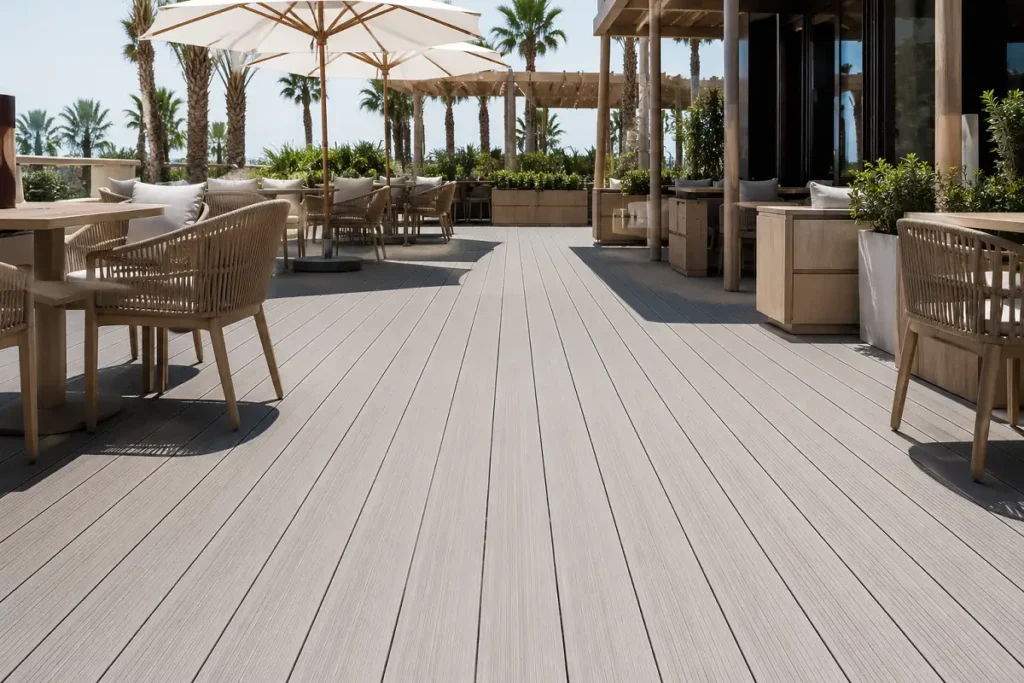
| Outdoor terrace and shisha | WPC decking | UAE sun and heat, weather, slip, shade and board tone | WPC decking 120-400+/sqm (11.1-37.2+/sqft) |
| Toilets | Safety sheet or LVT (slip-rated) | Wet-area slip, hygiene, easy clean | Safety sheet 80-180 (7.4-16.7); LVT 45-350 (4.2-32.5) |
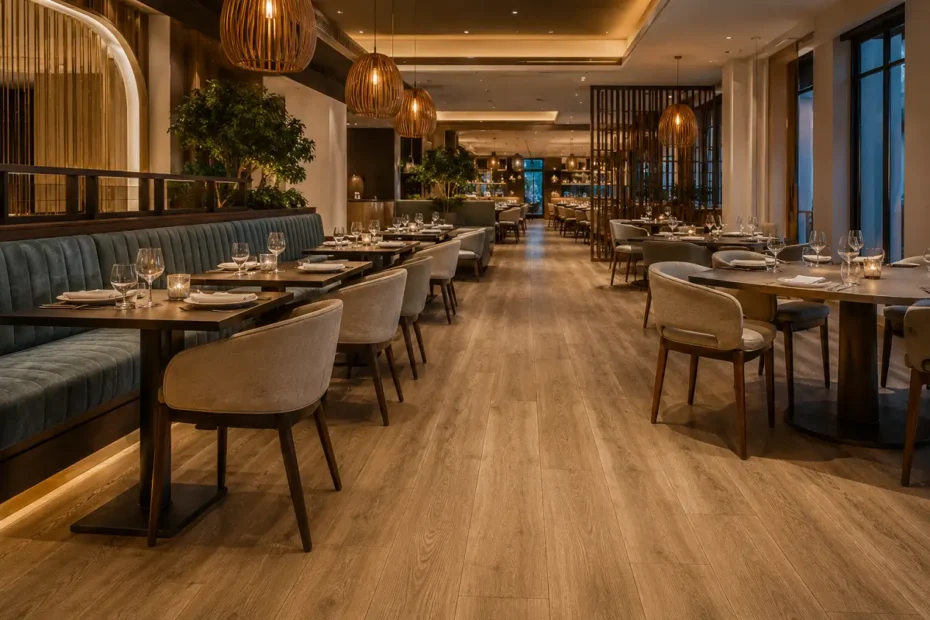
Best flooring for the dining area and café
The dining room is a durability and atmosphere problem, not a safety one. The floor takes chair-drag, heels, dropped cutlery and spills all day, and it sets the look and the noise level of the room.
LVT for the dining floor. LVT flooring is the usual lead for front of house: hard-wearing under chairs and heels, waterproof, quick to wipe clean, and available in realistic wood and stone looks that suit a café or restaurant. A contract-grade wear layer is what keeps it sharp under commercial footfall.
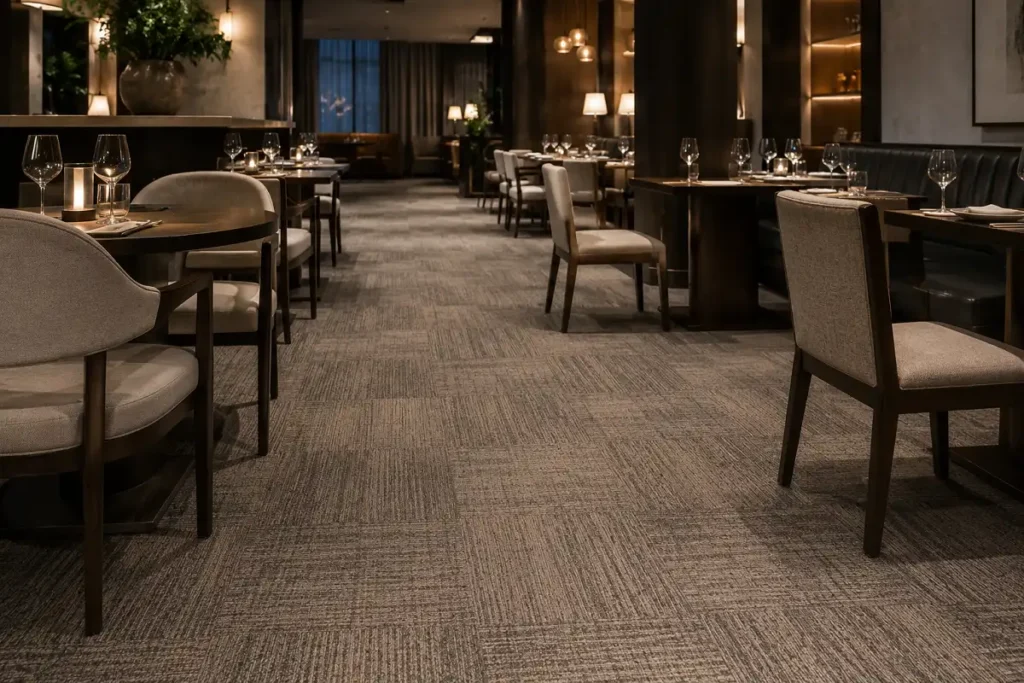
Carpet tiles for acoustics and warmth. Restaurants are loud, and soft flooring is one of the few things that genuinely quietens a room. Carpet tiles earn their place in fine-dining rooms, hotel F&B areas and quieter zones, both for warmth and for sound. They are modular, so a stained tile is swapped, not the whole floor. Many venues run LVT across the main floor and carpet tiles in the zones that need calm.
Commercial kitchen flooring: the safety-critical zone
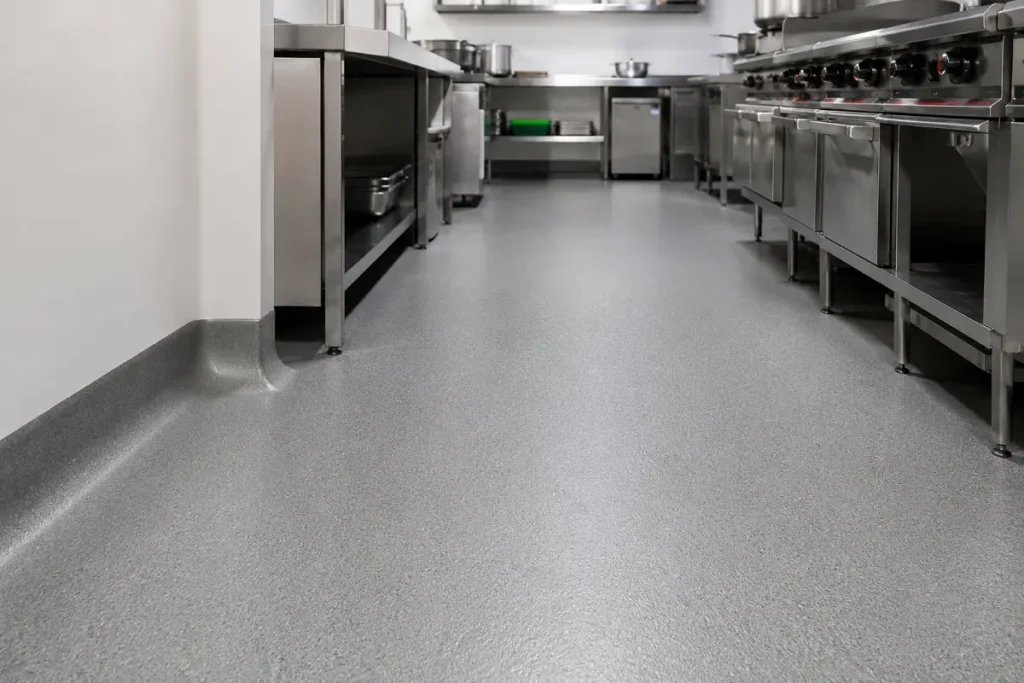
This is the zone where the floor is a safety and food-code matter, not a finish choice, and it is worth being blunt about it. A food-prep kitchen floor is wet and greasy, so it needs a properly slip-rated safety floor: R11 as a minimum for cooking and wet areas, and R12 for fryer, dishwash and high-grease zones, under the DIN 51130 and EN 13845 standards.
That rating is achieved by safety vinyl with aggregate running through the full thickness (aluminium-oxide or carborundum grit, so the grip lasts as the floor wears) or by a resin system with a broadcast aggregate. Generic LVT or smooth vinyl is not a commercial-kitchen floor, however waterproof it is.
For the kitchen, PVC and safety sheet vinyl is the primary choice: heat-welded into a continuous surface and coved up the wall for hygiene. For heavy-duty kitchens, breweries and washdown areas, a resin floor with anti-slip aggregate handles the thermal shock and traffic. Both are coved; neither relies on grout.
Best flooring for bars, serveries and high-spill zones
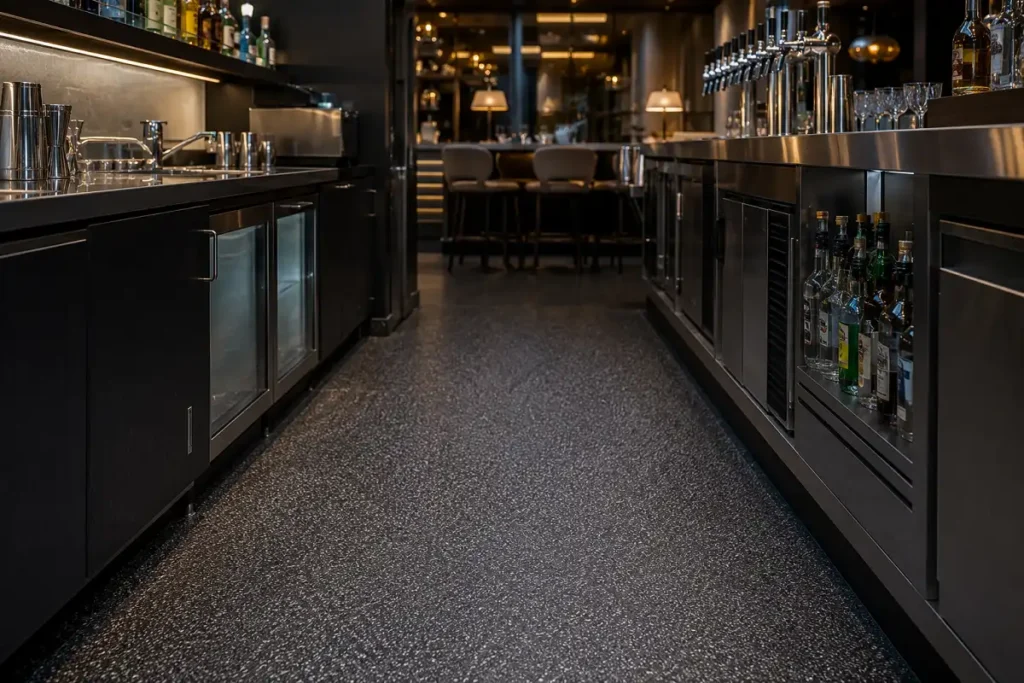
A bar floor is wet for most of service: dropped ice, spilled drinks, washdown behind the counter. The risk is the same as the kitchen in miniature, slip against constant spills, so the back-of-bar zone wants a slip-rated finish, not just a smart-looking one.
A resin floor with anti-slip aggregate suits the working side of the bar and high-spill serveries, coved where it meets the wall. On the customer side, slip-rated LVT flooring keeps the look while standing up to footfall. Match the slip rating to how wet the zone actually gets, rather than running one finish across both.
Best flooring for entrances and circulation areas
The entrance is where grit and tracked-in water do the most damage and create the highest slip risk, and the first three metres take the worst of it. Sand walked in off a Dubai street is abrasive, and wet shoes on a smooth floor are a hazard right at the door.
The fix is two-part: barrier or entrance matting to catch grit and moisture before it spreads, then a durable, easy-clean floor behind it, LVT flooring or safety sheet where the area stays wet. Treating the entrance as its own zone protects the dining floor beyond it and keeps the threshold safe.
Best flooring for outdoor terraces and shisha areas in UAE heat
Outdoor hospitality has its own brief: full UAE sun, occasional rain, and feet that are often bare or in sandals. WPC decking is the practical terrace and shisha-area floor. It is waterproof and UV-stabilised, grooved for grip and drainage, splinter-free, and lasts around 25 years in UAE conditions, far longer than natural hardwood.
The honest caveat: composite still warms in direct sun, and darker boards warm most. For an unshaded terrace, specify capped or co-extruded boards in lighter tones, with proper expansion gaps for the heat. Porcelain pavers are the hard-surface alternative here, though Urban does not supply or fit them.
Slip resistance and food safety on a commercial kitchen floor
Slip resistance in a commercial kitchen is measured, rated and, in practice, a legal expectation, so it is worth understanding the numbers rather than trusting a vague “anti-slip” claim. Under DIN 51130, floors are rated by ramp test: R10 suits dry-ish prep areas, R11 is the minimum for cooking and wet zones, R12 covers fryer, dishwash and high-grease areas, and R13 is for extreme fat-processing.
A wet-area pendulum test value (PTV) of 36 or above is the safety benchmark, and good safety vinyls reach 40 to 55+. In Dubai, following the Dubai Building Code on safe flooring is a duty of care for the venue operator, and the UAE relies on DIN, ISO and EN standards, so these ratings are the right reference.
The construction detail that matters: choose safety vinyl with the aggregate running through the full thickness, so the rating lasts the life of the floor. A merely textured vinyl loses its grip as the surface wears smooth.
Hygiene and coved skirting on a commercial kitchen floor
Hygiene in a food-prep zone is a flooring decision as much as a cleaning one, and it comes down to two things: a continuous impervious surface, and how the floor meets the wall. The standard for a commercial kitchen is a floor with heat-welded joints and coved skirting, where the floor curves up the wall in a 50 to 75mm radius instead of meeting it at a 90-degree junction.
That right-angle junction is where grease and food debris collect and resist cleaning; a coved, impervious floor-to-wall finish has nowhere for bacteria to hide and wipes down in one pass. This is what HACCP and Dubai Municipality hygiene expectations are driving at, and it is why safety sheet and resin lead in the kitchen. Tiles lose here: grout lines harbour dirt and bacteria and need constant sealing.
Downtime: fitting a hospitality floor without closing for a week
In hospitality, downtime is money, so fit-out speed is a real decision factor, and it is one where honesty matters more than a sales promise. The practical position: safety vinyl and fast-cure polyaspartic resin can often be fitted overnight or over a single closed day, and the work can be phased zone by zone or floor by floor so the venue keeps trading.
Standard epoxy, though, needs 24 to 72 hours to cure, so the kitchen specifically usually needs a planned closed window. There is no genuine zero-closure option for a resin kitchen floor, and anyone promising one is overselling. The right approach is to phase the job around your quietest periods and accept a short, planned closure for the back of house.
Hospitality flooring costs in the UAE
Hospitality flooring cost depends on the zone and the specification. Indicatively, supplied and fitted: dining LVT runs about AED 45 to 350/sqm (about AED 4.2 to 32.5/sqft), carpet tiles about AED 35 to 130/sqm (about AED 3.3 to 12.1/sqft).
Commercial-kitchen safety sheet runs about AED 80 to 180/sqm (about AED 7.4 to 16.7/sqft), resin about AED 50 to 250/sqm (about AED 4.6 to 23.2/sqft), and WPC decking about AED 120 to 400+/sqm (about AED 11.1 to 37.2+/sqft). All figures exclude 5% VAT and depend on zone, spec and site. For the full breakdown across every floor type, see our flooring cost guide.
Which floor is best for your type of venue?
The right specification follows the venue type and its mix of zones. A fine-dining room, a fast-casual counter, a hotel production kitchen and a bar all weight looks, acoustics, hygiene and slip rating differently, and most venues end up with two or three floors. Match the specification to the venue:
- Fine dining: LVT or timber-look across the room, carpet tiles in zones for warmth and quiet, safety sheet or resin in the kitchen.
- Fast-casual café: durable LVT flooring front of house for the wipe-clean, hard-wearing finish, safety sheet behind the counter.
- Hotel F&B: LVT and carpet tiles across dining and lounges for acoustics, safety sheet or resin in the production kitchen.
- Bar or brewery: slip-rated resin on the working side, slip-rated LVT for guests.
- Cloud or production kitchen: all back of house, so safety sheet vinyl or resin throughout, R11 to R12, coved.
- Set on a fully tiled traditional kitchen: porcelain is the honest fit and performs well, even though we fit safety vinyl and resin rather than tiles.
For a general waterproof-vinyl overview across formats, our vinyl flooring hub covers the range.
Restaurant and hospitality flooring: frequently asked questions
What slip rating does a commercial kitchen floor need in the UAE?
A commercial kitchen needs a properly slip-rated safety floor, R11 as a minimum for wet and greasy cooking areas, and R12 for fryer, dishwash and high-grease zones, under the DIN 51130 standard. Safety vinyl with embedded aggregate or a resin floor with broadcast grit achieves this. The Dubai Building Code treats safe flooring as a legal duty of care.
What is the best flooring for a restaurant dining area?
LVT is the usual best choice for a dining floor: it is hard-wearing under chairs, heels and trolleys, waterproof, easy to clean and available in realistic wood and stone looks. Where noise is a problem, carpet tiles in zones or soft finishes cut sound noticeably. Many restaurants combine LVT across the floor with carpet tiles in quieter or fine-dining areas.
What is the most hygienic flooring for a commercial kitchen?
A continuous safety vinyl or resin floor with heat-welded joints and coved skirting, where the floor curves up the wall, so there is no 90-degree junction to trap grease and bacteria. This impervious floor-to-wall finish supports HACCP and Dubai Municipality hygiene expectations and cleans easily. Tiles are less hygienic here because grout lines harbour dirt and need constant sealing.
Can restaurant flooring be installed overnight to avoid closing?
Often partly, yes. Safety vinyl and fast-cure polyaspartic resin can be fitted overnight or over a closed day, and work can be phased zone by zone so the venue keeps trading. Standard epoxy needs 24 to 72 hours to cure, though, so the kitchen specifically usually needs a planned closed window. There is no genuine zero-closure option for a resin kitchen floor.
How do you reduce noise in a restaurant with flooring?
Soft flooring absorbs sound. Carpet absorbs far more airborne noise than hard floor coverings, so carpet tiles in dining or zoning areas noticeably lower the din. If you want a hard floor, acoustic-backed LVT cuts impact noise far more than bare vinyl or tile. Mixing zones gives the best balance of looks and quiet.
Is vinyl or tile better for a restaurant kitchen?
Both are used, but safety vinyl usually suits a kitchen better. Heat-welded safety vinyl with coving gives a continuous, hygienic, slip-rated floor with no grout lines to harbour grease, and it is quicker to fit. Porcelain tile is hard-wearing and traditional but its grout is a hygiene and slip weak point. We fit safety vinyl and resin, not tiles.
What is the best flooring for an outdoor restaurant terrace in the UAE?
WPC decking is the practical terrace floor: waterproof, UV-stabilised, grooved for grip and drainage, splinter-free, and around 25 years of life in UAE conditions, far longer than natural hardwood. It warms in full sun like every outdoor surface, and darker composite warms most, so choose capped, lighter-toned boards for unshaded terraces and shisha areas.
How much does restaurant flooring cost in Dubai?
Indicatively, supplied and fitted: dining LVT runs about AED 45 to 350/sqm (4.2 to 32.5/sqft), carpet tiles AED 35 to 130/sqm (3.3 to 12.1/sqft), commercial kitchen safety sheet about AED 80 to 180/sqm (7.4 to 16.7/sqft), resin AED 50 to 250/sqm (4.6 to 23.2/sqft), and WPC decking AED 120 to 400+/sqm (11.1 to 37.2+/sqft). Prices exclude VAT and depend on zone and spec.
The bottom line: the best hospitality flooring by zone
The best hospitality floor is never one floor; it is the right floor in each zone. LVT and carpet tiles handle the dining room, for durability, looks and quiet. The commercial kitchen needs a genuine slip-rated safety floor, R11 to R12 safety sheet or resin, heat-welded and coved for hygiene, not ordinary vinyl, because it is a safety and food-code matter.
Bars want slip resistance against spills, entrances want matting plus a durable floor, and terraces want WPC decking for the UAE sun. Plan downtime around a phased fit-out and accept a short closed window for the kitchen.
Tiles still suit a buyer set on a traditional fully tiled kitchen, and we will say so even though we fit vinyl and resin. Map your venue zone by zone, and a free site survey will confirm the right specification for each.
Fit out your venue with a free site visit
Planning or refitting a restaurant, café, bar or hotel in Dubai or across the UAE? Message us on WhatsApp and a specialist will survey your venue zone by zone, dining, kitchen, bar, entrance and terrace, and recommend the right slip-rated, hygienic and hard-wearing floor for each, with a phased plan to keep you trading.
- WhatsApp us: +971 56 689 9831
- Call: +971 56 689 9831
- Request a free site visit and quote across Dubai and Abu Dhabi.
We have supplied and fitted commercial flooring across the UAE since 2013, with more than 10,000 projects completed by our in-house team.

Junaid Rana is a content strategist with over 10 years of experience in the interior and fit-out industry, writing on flooring, finishes and fit-out across UAE homes and commercial spaces. His guides are reviewed for accuracy by Urban Flooring’s in-house experts.