
Reviewed for accuracy by Muhammad Gulbadin, founder and operations manager at Urban Flooring, 15+ years in UAE flooring.
The best retail floor is not one floor, it is the right floor per zone. Commercial-grade LVT handles the brand-look sales floor, VCT or sealed concrete suits high-traffic aisles and back-of-house, carpet tiles bring comfort to fitting rooms and consult areas, and epoxy suits showrooms. Match the material to the zone and the footfall, and specify commercial wear ratings, not domestic.
What a retail or showroom floor has to handle
A shop floor works harder than almost any floor in a home, and it has to do several jobs at once. Footfall, trolleys, brand image and safety all land on the same surface, and they do not all want the same material. Before choosing anything, it helps to see the full demand list:
- Heavy, continuous footfall, often from open to close, seven days a week.
- Trolleys, heels and dragged stock, all of which grind at a floor differently.
- Brand image and first impression, since the floor is part of how the store looks and feels.
- Zoning, because the shopfront, the aisles, the fitting rooms and the stockroom each ask for something different.
- Slip safety, especially at entrances where wet weather is tracked in, which is a duty of care to customers.
- Cleaning and minimal closure, because a shut shop loses money.
No single material is best at all of these, which is why the honest starting point is not “which floor” but “which floor where”.
Best retail flooring at a glance
The table maps the realistic materials to retail zones, with indicative supply-and-fit costs. Porcelain tile appears as honest comparison context, the default hard retail surface, but Urban fits vinyl, carpet tiles and resin, not tile, so those figures are indicative market rates, not our quotes.
| Feature | Commercial LVT | VCT / sealed floor | Carpet tiles | Epoxy / resin | Porcelain tile (context, not sold) |
|---|---|---|---|---|---|
| Best retail zone | Sales floor, shopfront, feature | High-traffic aisles, stockroom | Fitting rooms, consult, comfort | Showroom, auto, warehouse-retail | Wet entrance, luxury hard look |
| Footfall durability | High (commercial class 33/34) | Very high (tough, hard) | Medium-high (modular swap) | Very high (continuous poured) | Highest (hardest) |
| Brand-look design freedom | Highest (wood / stone / custom) | Low (utilitarian) | Good (colour / zoning) | Good (colour / aggregate) | High (premium hard look) |
| Comfort / acoustics | Warm, quiet | Hard, noisy | Best: warm and quiet | Hard, noisy | Hard, cold, noisy |
| Slip (finish-dependent) | Good if textured (R10-R11) | Needs finish / coating | Good (textile grip) | Good if anti-slip aggregate | Good only if textured; glazed slippery |
| Fit-out downtime | Low (modular, phased / after-hours) | Low-medium | Lowest (lift and swap) | Higher (cure time) | High (bedding + grout + cure) |
| Repair a damaged area | Swap a plank / tile | Patchable | Swap a tile | Patch / recoat | Cut out and re-grout |
| Maintenance | Mop / easy | Strip and reseal periodically | Vacuum / spot-clean | Mop / easy | Mop; grout needs sealing |
| Cost (supply and fit) | AED 45-350/sqm (4.2-32.5/sqft) | AED 45-140/sqm (4.2-13.0/sqft) | AED 35-130/sqm (3.3-12.1/sqft) | AED 50-250/sqm (4.6-23.2/sqft) | Indicative market rate, not our quote |
| Best for | Brand-led front-of-house | Budget high-traffic / behind scenes | Quiet comfort zones | Showrooms, hard-use retail | Luxury / wet hard-surface stores |
Why you should zone a retail floor, not lay one material throughout
This is the single most useful decision in a shop fit-out, and the one most people get wrong: a store is not one space, so it should not be one floor. Walk a shop from the door inward and the demands change at every step. The shopfront and feature displays are about brand image and a hard-wearing first impression, which is LVT territory.
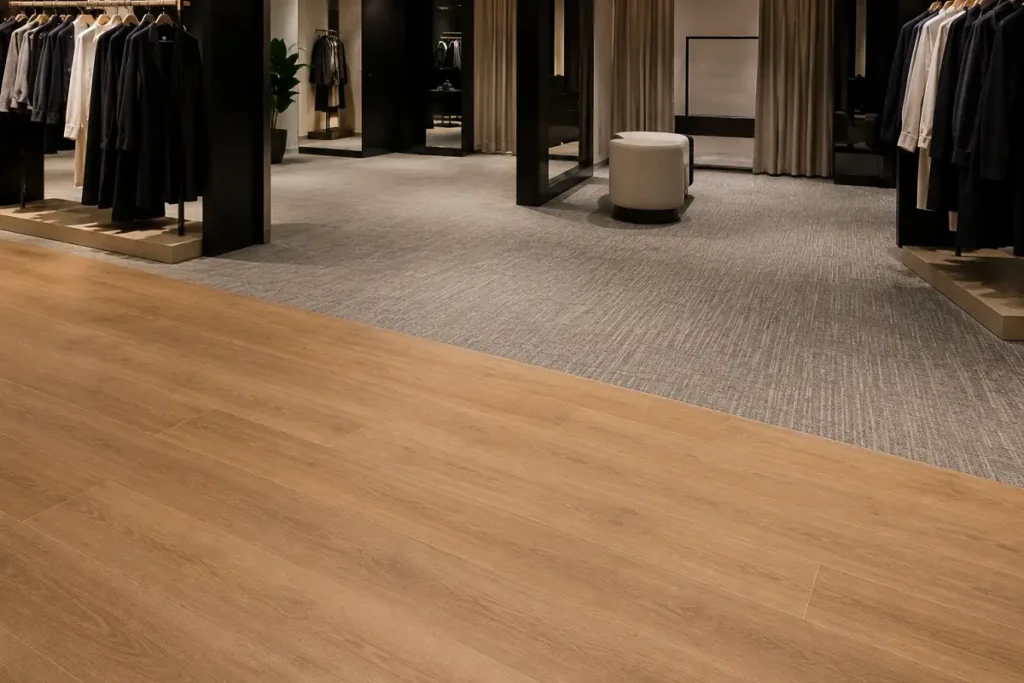
The main aisles and checkout take the heaviest footfall, so they want a high wear-rated surface. Fitting rooms and consult areas are where a customer slows down, stands barefoot or sits, so they want quiet and warmth, which is carpet-tile territory.
The stockroom just needs to be cheap and tough, which is VCT or a sealed concrete or epoxy floor. Matching the material, and its wear class, to the actual traffic in each zone is standard commercial fit-out practice. Flooring the whole store in one material is the lazy answer, and usually either overspends on the back rooms or underspecs the busy ones. Zone it.
The best flooring materials for each retail zone
Here is the material that suits each zone, and why. Four materials cover almost every retail space between them, and the difference is which one you put where rather than which one is best overall. Zone by zone:
Commercial LVT for the sales floor and shopfront
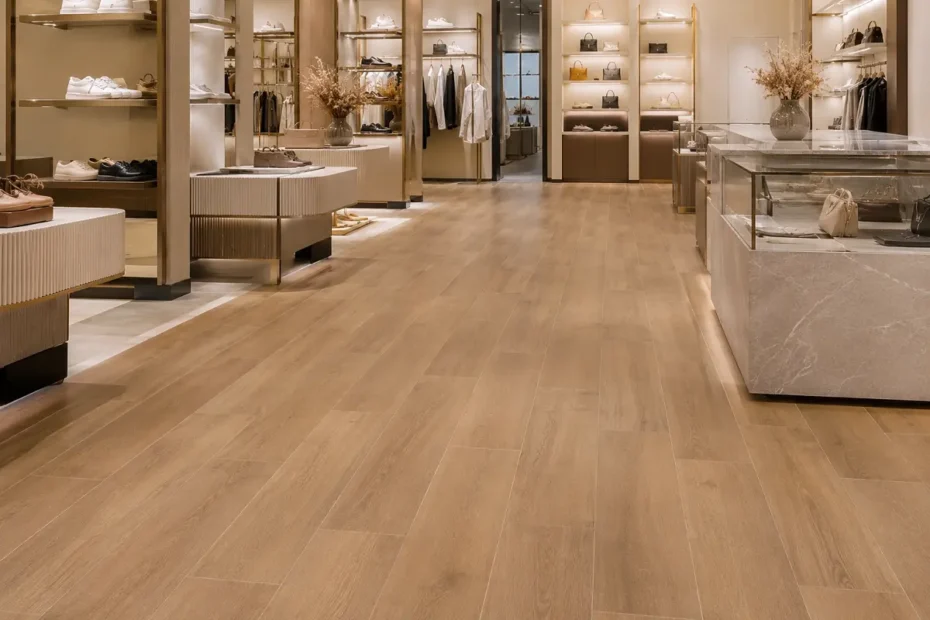
LVT flooring is the retail front-of-house workhorse. It carries realistic wood and stone looks for brand image, with design freedom in plank and tile format (you can even run the plank direction to lead customer flow), and it is warm and quiet underfoot. The non-negotiable for a shop is the spec: a commercial wear layer of at least 0.55mm and a class 33 to 34 rating, glue-down for the traffic. A single damaged plank lifts and swaps without redoing the floor. For the brand-led sales floor and shopfront, this is the lead.
VCT and sealed floors for high-traffic aisles and back-of-house
VCT flooring is the budget high-traffic and back-of-house classic, the supermarket and stockroom floor. It is extremely tough, cheap to cover large areas, and individual tiles can be replaced, though it needs periodic stripping and resealing to stay looking sharp. For aisles, checkouts and the stockroom, where durability and cost matter more than a premium look, VCT or a sealed concrete floor earns its place.

Carpet tiles for fitting rooms, consult and comfort zones
Carpet tiles bring warmth, quiet and a comfortable barefoot feel to the zones that need it: fitting rooms, consult desks and seating areas. Because they are modular, a stained or worn tile lifts straight out and swaps without touching the rest of the floor, which is exactly what a high-use fitting room needs. They also soften the acoustics in those slower, more personal corners of a store.
Epoxy and resin for showrooms and hard-use retail
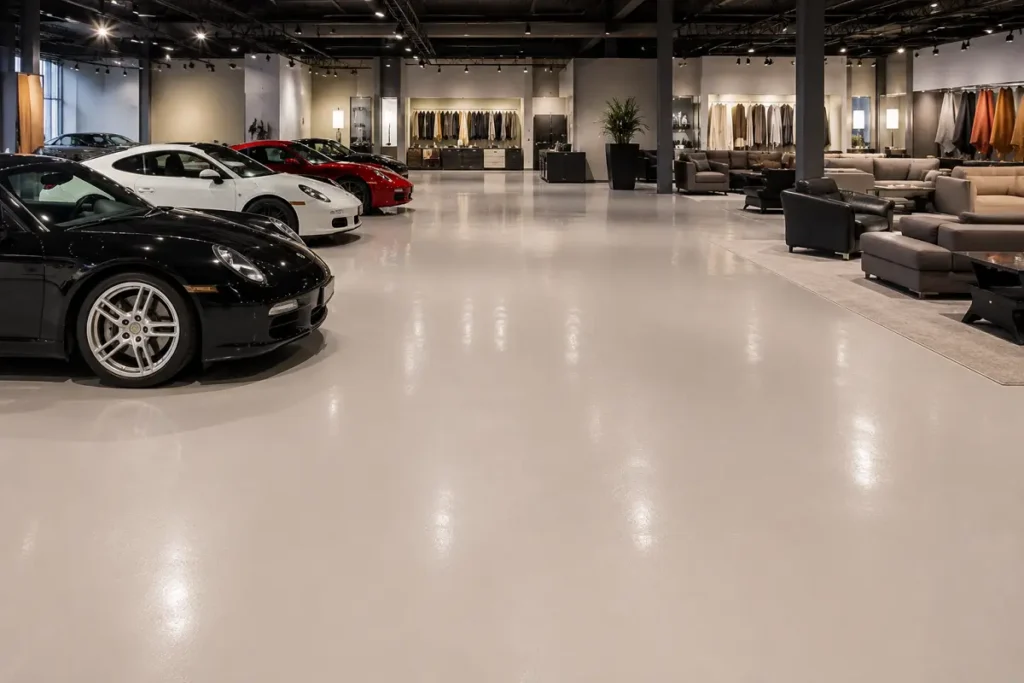
For a showroom, an epoxy or resin floor gives a durable, continuous poured surface that handles rolling loads and heavy display stock, ideal for car, furniture and warehouse-style retail. It takes colour and aggregate for a clean, large-format look, and it copes with the point loads that would mark a softer floor. The one honest catch is the cure window, a poured floor needs a planned closed period, so it is specified where the load and the look justify it.
Footfall and durability: the wear ratings retail flooring needs
This is where a retail floor is won or lost, and it is worth being specific rather than trusting the word “commercial” on a label. Floors are graded under EN ISO 10874 (and the older EN 685): the first digit is the environment (2 domestic, 3 commercial, 4 industrial) and the second is the intensity (up to 4, very heavy).
For retail, class 33 (heavy commercial, the department-store and corridor class) is the minimum, and class 34 (very heavy, for shopping centres, airports and the busiest stores) is the safer pick for high-traffic floors. For LVT specifically, specify a wear layer of at least 0.55mm, which is about 22 mil, the clear protective top layer that is the strongest predictor of how long the floor lasts. Commercial LVT also commonly carries a Bfl-s1 reaction-to-fire rating under EN 13501-1.
The honest warning: domestic-grade flooring, with a thin 6 to 12 mil wear layer and a class 2x rating, is a false economy in a shop. It looks fine on day one and wears through fast under retail footfall. Specify glue-down for trolley and rolling-load areas, and you can use click systems for fast refurbishment in occupied space, just not under continuous rolling loads.
Brand image: what the shop floor says to a customer walking in
The floor is one of the first things a customer feels, even if they never look down, so it is part of the brand, not just the building. A floor sets the tone of a store and can guide how people move through it.
This is where LVT’s design freedom pays off: wood, stone and custom looks let the floor match the brand, and running the plank direction along a path can subtly lead customers toward feature displays or the till.
A hard porcelain look reads premium and cool; a warm wood-look LVT reads inviting and considered. The point is to choose the front-of-house floor deliberately for the impression you want, rather than defaulting to whatever is cheapest, because in retail the floor is doing quiet brand work all day.
Slip safety and customer duty of care on a shop floor
A shop owes its customers a safe floor, and slip safety is a specification decision, not something to assume a material delivers by default. Standard commercial LVT sits around R9 to R10 on the DIN 51130 scale, which is fine for a dry sales floor.
The risk zone is the entrance, where wet weather gets tracked in, and any area that gets damp. There, specify a dedicated safety vinyl rated R11 to R12 with a defined slip value, and add barrier matting at the door to catch water before it spreads.
Treating the entrance as its own safety zone protects both customers and the owner’s duty of care. The deeper slip-rating principle, the same one that governs commercial kitchens, is covered in our restaurant and hospitality flooring guide.
Fitting out a shop floor with minimal downtime
A working shop loses money every hour it is shut, so how a floor is fitted matters as much as what it is. Modular floors are the retail advantage here. LVT planks and carpet tiles can be fitted in phases or after hours, so the store keeps trading, and a single damaged tile can be swapped out later without redoing the floor.
Click systems speed up work in occupied space, while glue-down is used where traffic and rolling loads demand it. The honest limit is poured floors: epoxy needs a cure window, so a showroom resin floor usually needs a planned closed period. There is no genuine zero-closure option for a poured floor, but for most of a store, a phased modular fit-out keeps the doors open. This is the same phased, after-hours logic that suits an office fit-out.
How much does retail flooring cost in the UAE?
Retail flooring cost depends on the material and the zone. Indicatively, supplied and fitted: commercial LVT runs about AED 45 to 350/sqm (about AED 4.2 to 32.5/sqft), VCT about AED 45 to 140/sqm (about AED 4.2 to 13.0/sqft), carpet tiles about AED 35 to 130/sqm (about AED 3.3 to 12.1/sqft), and epoxy about AED 50 to 250/sqm (about AED 4.6 to 23.2/sqft).
The honest takeaway: a phased, zoned spec usually costs less than re-flooring the whole store in one premium material, because you put the money where the footfall is. All figures exclude 5% VAT and depend on zone, spec and site. For the full breakdown across every floor type, see our flooring cost guide.
Which floor for your type of shop or showroom?
The right specification follows the kind of retail space and its zones. A boutique, a supermarket, a car showroom and a salon put very different demands on a floor, and most of them need more than one material. Match the specification to the space:
- Boutique or fashion store: commercial LVT flooring across the sales floor, with carpet tiles in the fitting rooms.
- Supermarket or convenience store: VCT or sealed floors for the aisles and stockroom, where toughness and cost lead.
- Car or furniture showroom: epoxy or resin for rolling loads and a large-format look, or large-format LVT for a warmer, branded finish.
- Electronics or phone shop: commercial LVT for the brand look and easy modular repair.
- Salon or clinic-retail: safety vinyl in wet and treatment zones; the same slip discipline as a hospitality venue.
For the office side of a mixed commercial space, our office flooring guide covers that decision.
Retail and showroom flooring: frequently asked questions
What is the best flooring for a retail shop in the UAE?
There is no single best floor, the right answer is to zone the store. Use commercial-grade LVT on the brand-look sales floor, VCT or sealed concrete for high-traffic aisles and the stockroom, carpet tiles in fitting rooms and comfort zones, and epoxy in showrooms. The key is matching the material and its wear rating to each zone’s footfall, and specifying commercial grade, not domestic.
What wear rating does retail flooring need?
Retail needs commercial-grade flooring, EN ISO 10874 class 33 (heavy commercial, the department-store class) as a minimum, and class 34 (very heavy) for the busiest stores and shopping centres. For LVT, specify a wear layer of at least 0.55mm. Domestic-grade flooring with a thin 6 to 12 mil wear layer is a false economy, it wears through fast under shop footfall.
Is LVT or VCT better for a shop floor?
They suit different zones. Commercial LVT leads on the brand-look sales floor: wood and stone visuals, warm and quiet underfoot, modular to repair. VCT is the budget high-traffic and back-of-house workhorse, extremely tough and cheap, with individual tiles replaceable, though it needs periodic stripping and resealing. Many stores use LVT front-of-house and VCT in the stockroom.
What flooring is best for a showroom?
For a large, hard-use showroom, an epoxy or resin floor gives a durable, continuous poured surface that handles rolling loads and heavy display stock, ideal for car, furniture and warehouse-style retail. For a warmer, more branded showroom look, large-format commercial LVT in a wood or stone finish works well. The choice depends on the load and the brand feel you want.
Can you fit a shop floor without closing the store?
Largely, yes. Modular LVT and carpet tiles can be fitted in phases or after hours, so the store keeps trading, and a single damaged tile swaps out later without re-doing the floor. Click systems speed up occupied-space work, while glue-down is used where traffic and trolleys demand it. Epoxy needs a cure window, so showroom resin floors usually need a planned closed period.
What floor is best for a fitting room?
Carpet tiles. They give warmth, quiet and a comfortable barefoot feel that suits trying on clothes, and because they are modular, a stained or worn tile lifts out and swaps without replacing the whole floor. They also add acoustic comfort to consult and seating areas. Pair them with LVT on the main sales floor for a practical, zoned fit-out.
Is tile or vinyl better for a retail floor?
Both have a place. Porcelain tile is the hardest surface and suits wet entrances and luxury hard-look stores, but it is cold, noisy, slower to fit and harder to repair. Commercial LVT is warmer, quieter, faster to install and modular to repair, with wood and stone looks for brand image. We fit vinyl and resin, not tile, so we would steer you to the practical LVT or epoxy balance.
How much does retail flooring cost in Dubai?
Indicatively, supplied and fitted: commercial LVT runs about AED 45 to 350/sqm (4.2 to 32.5/sqft), VCT AED 45 to 140/sqm (4.2 to 13.0/sqft), carpet tiles AED 35 to 130/sqm (3.3 to 12.1/sqft), and epoxy AED 50 to 250/sqm (4.6 to 23.2/sqft). A phased, zoned spec usually costs less than re-flooring the whole store in one premium material. Prices exclude VAT.
The bottom line: building a retail floor that works zone by zone
The best retail floor is never one floor, it is the right floor in each zone. Commercial-grade LVT carries the brand-look sales floor and shopfront, VCT or sealed concrete handles the high-traffic aisles and the stockroom, carpet tiles give fitting rooms and consult areas their warmth and quiet, and epoxy suits a hard-use showroom.
Whatever the zone, specify commercial wear ratings, class 33 or 34 and a 0.55mm-plus LVT wear layer, because domestic grade is a false economy in a shop. Plan the fit-out around your footfall and your trading hours, using modular floors to stay open where you can.
Tiles still suit a buyer set on a hard, luxury or wet-entrance look, and we will say so even though we fit vinyl and resin. Map your store zone by zone, and a free site survey will confirm the right floor and grade for each.
Fit out your shop floor with a free site visit
Planning or refitting a shop, store or showroom in Dubai or across the UAE? Message us on WhatsApp and a specialist will survey your space zone by zone, sales floor, aisles, fitting rooms, stockroom and showroom, and recommend the right commercial-grade floor for each, with a phased plan to keep you trading.
- WhatsApp us: +971 56 689 9831
- Call: +971 56 689 9831
- Request a free site visit and quote across Dubai and Abu Dhabi.
We have supplied and fitted commercial flooring across the UAE since 2013, with more than 10,000 projects completed by our in-house team.

Junaid Rana is a content strategist with over 10 years of experience in the interior and fit-out industry, writing on flooring, finishes and fit-out across UAE homes and commercial spaces. His guides are reviewed for accuracy by Urban Flooring’s in-house experts.