
Reviewed for accuracy by Muhammad Gulbadin, founder and operations manager at Urban Flooring, 15+ years in UAE flooring.
For most Dubai offices the default is carpet tiles: hard-wearing, sound-absorbing, replaceable one tile at a time, and easy to lift over raised access floors. Use commercial LVT for reception and premium zones, VCT or epoxy for budget and industrial areas, and broadloom where a continuous executive look matters. The right office floor is chosen zone by zone, not one material throughout.
This guide maps the real options for office flooring across flooring in Dubai and the wider UAE, zone by zone, with the acoustics, raised-access-floor and downtime detail that most office content skips. It is an honest spec guide, not a carpet sales page.
How to choose office flooring: what actually matters
Five things decide an office floor specification, and most office content only covers the first one. Traffic, acoustics, repairability, downtime and cable access each pull the choice in a different direction, and an office that gets any of them wrong pays for it later. In order:
- Traffic zoning. Reception, corridors and lift lobbies take the heaviest wear, so they need the toughest spec, while quiet back-of-house areas can use cheaper materials.
- Acoustics. Open-plan noise is the top workplace complaint, and soft floors absorb it where hard floors reflect it.
- Maintenance and replaceability. Can you repair one damaged area without redoing the whole floor? This decides the floor’s real lifetime cost.
- Downtime. Can it be fitted out of hours so the business keeps trading during the work?
- Cable management. Does the floor sit over a raised access floor that must stay openable for power and data?
The main office flooring options compared
Five materials cover almost every office. The table compares them, and each links to its full page. Read the acoustics and durability columns first, because those are the two that decide most office specifications in practice.
| Option | Best office use | Acoustics | Durability and traffic | Indicative cost (supply and fit) |
|---|---|---|---|---|
| Carpet tiles | open-plan, circulation, most zones (the default) | best, absorbs noise | high; 24oz+ loop pile for heavy traffic; replace per tile | AED 35 to 130/sqm (about AED 3.3 to 12.1/sqft) |
| Office carpet (broadloom) | executive suites, boardrooms, premium continuous look | best, soft continuous surface | high but not tile-replaceable; whole-area repair | AED 30 to 450/sqm (about AED 2.8 to 41.8/sqft) |
| LVT flooring | reception, client-facing, meeting rooms, wet/pantry | moderate; better with acoustic backing | very high; commercial wear layer 0.5mm (20 mil)+ | AED 45 to 350/sqm (about AED 4.2 to 32.5/sqft) |
| VCT flooring | budget back-of-house, corridors, utility | low; hard and reflective | high traffic, but needs strip-and-wax upkeep | AED 45 to 140/sqm (about AED 4.2 to 13.0/sqft) |
| Epoxy flooring | warehouse, industrial, plant, parking within a facility | low | extreme; vehicles and heavy loads | AED 50 to 250/sqm (about AED 4.6 to 23.2/sqft) |
Bands are indicative, supplied and fitted, before VAT, June 2026. Premium wool-blend carpet tiles can reach around AED 200/sqm (about AED 18.6/sqft), but that is a luxury finish, not typical office spec. For the full range across every floor type, see our flooring cost guide.
Best office flooring by zone
An office is not one space, so it should not be one floor. Reception, open-plan, meeting rooms, back-of-house and any industrial zone each ask for something different, and the budget goes furthest when it follows the traffic. Here is the honest routing, zone by zone.
Reception and high-traffic areas
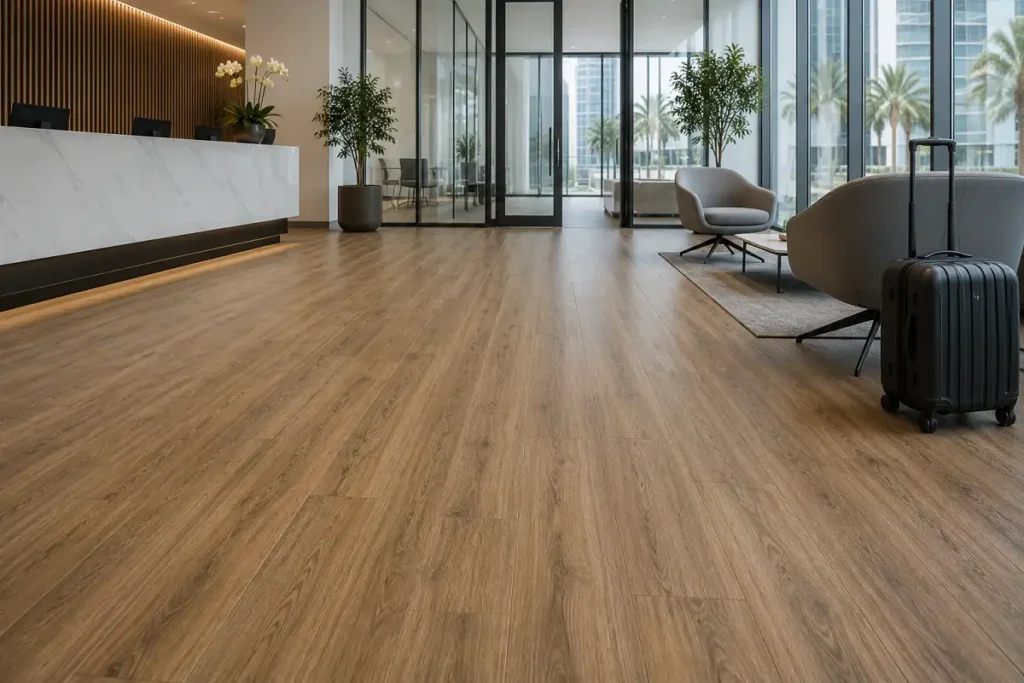
Reception, corridors and lift lobbies take the most wear in any office, so they need the toughest specification. Heavy-duty carpet tiles in a 24oz or higher loop pile hide footprints and resist crushing, and they can be swapped individually as they wear. For a premium hard-floor reception, commercial LVT with a 0.5mm (20 mil) or thicker wear layer copes with wheeled luggage, rain-tracking and constant footfall while keeping a high-end look. Avoid cut-pile carpet and thin domestic vinyl here, as both show wear quickly.
On our own office jobs, three areas show wear first: reception, the main corridors and walkways, and the floor around desks where chair castors run. We spec the toughest tile for those zones and lighter grades elsewhere, which keeps the budget where it earns its place.
Open-plan workspace
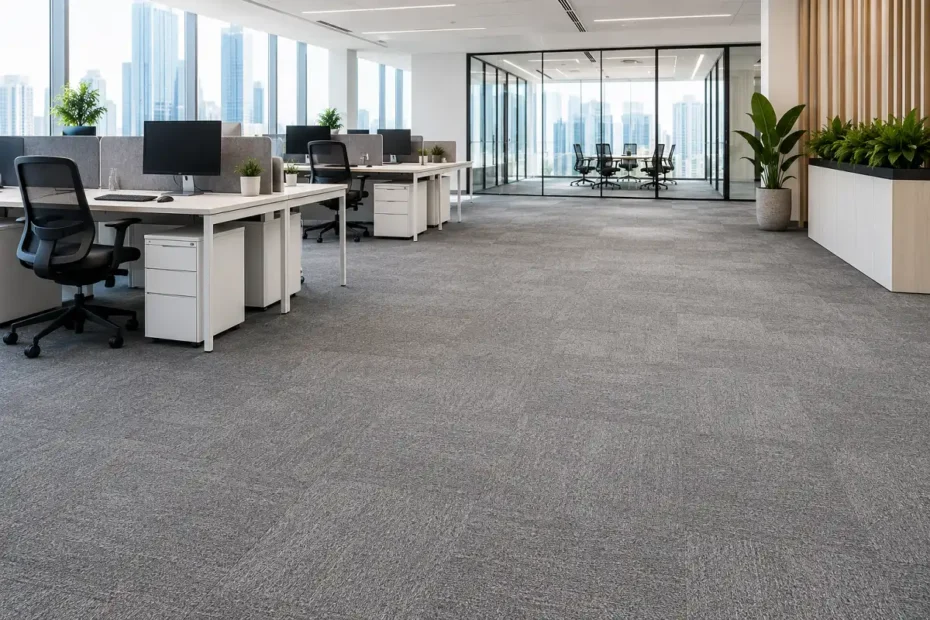
Open-plan is the zone where sound matters most, and carpet tiles are the answer. They absorb noise rather than reflect it, lay neatly over raised access floors, and let you replace a stained or worn tile without touching the rest of the floor. Specify a commercial 24oz or higher loop pile for durability across the floorplate. This is the single most important zone to get right for acoustics.
Meeting rooms and boardrooms
Meeting rooms and boardrooms call for quiet and a high-end finish. Broadloom carpet or premium carpet tiles give the warmth and sound control these rooms need, with broadloom offering a continuous, jointless look for executive spaces. Where the brief is hard-floor and design-led, commercial LVT works, ideally acoustic-backed so the room does not echo.
Back-of-house and pantry
Back-of-house areas, utility rooms and service corridors do not need a premium finish, so budget materials make sense. VCT flooring is hard-wearing and cheap to buy, though it needs a regular strip-and-wax cycle that adds to its lifetime cost. LVT is a lower-maintenance alternative and the better choice for any pantry or wet zone, as it is water-resistant and wipeable.
Warehouse and industrial zones
Any warehouse, plant room, parking deck or industrial zone within a facility needs epoxy flooring. The resin surface is jointless, easy to clean and resistant to vehicles and heavy loads, which carpet and vinyl cannot handle. An in-office gym or wellness room is another specialist case, better suited to rubber flooring for impact absorption and noise.
How to make an office quieter: flooring and acoustics
Open-plan noise is the most common workplace complaint, and flooring is one of the few fixes that works at the source. Soft floors absorb sound; hard floors reflect it. Carpet is the strongest acoustic floor. It also cuts floor-impact noise at source, which a hard floor does only with an acoustic backing.
The figure to ask a supplier for is the Noise Reduction Coefficient (NRC), scored from 0 (reflective) to 1 (absorptive). Target NRC 0.4 or higher for a noticeably quieter open-plan office; commercial carpet typically sits between 0.25 and 0.50 depending on pile and backing.
If a zone needs a hard floor but must stay quiet, specify acoustic-backed commercial LVT. Tested impact-sound reduction reaches around 16 dB with an acoustic backing, against roughly 1 to 6 dB for a bare hard floor, and a 10 dB difference is about halving perceived loudness. For most offices the practical answer is to zone it: carpet tiles across open-plan and meeting areas, acoustic-backed LVT where a hard floor is wanted.
Carpet tiles vs broadloom for offices
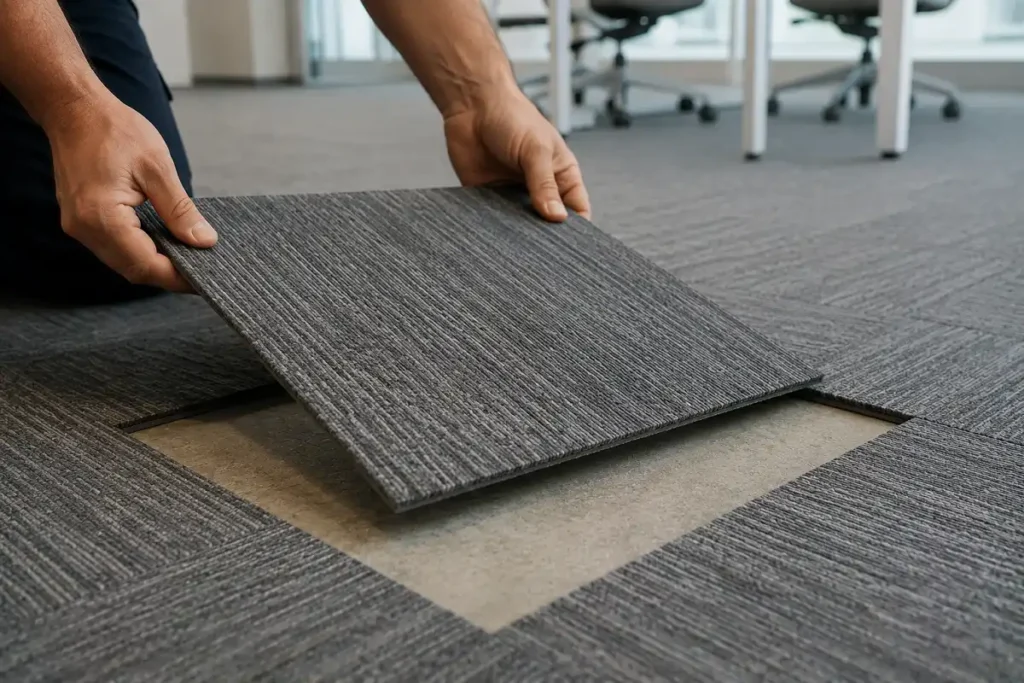
Both are commercial carpet, and the choice comes down to repair and look. Carpet tiles win for most offices on replaceability and flexibility. You can lift and swap a single 50x50cm tile after a spill or localised wear, rotate tiles to even out traffic, and replace only the worn tiles rather than redoing a whole floor. They also sit over raised access floors, lifting cleanly for cabling.
Broadloom, or office carpet, wins on a continuous, pattern-matched finish with no visible tile joints, which is why it is favoured for executive suites and boardrooms. The trade-off is repair: a damaged area means a larger, more disruptive job, and broadloom cannot practically sit over an access floor.
The honest split is carpet tiles across the floorplate, broadloom where a high-end, jointless look justifies the trade-off.
On our jobs, the reasons clients value most are practical: a damaged tile is swapped one at a time rather than relaying the whole floor, and tiles go down faster. When a client is replacing an existing floor, the first thing they ask is how long the work will take, and tiles usually win on that alone.
Which office flooring is easiest to maintain and repair?
Repair cost is what separates a cheap floor from a cheap-to-own floor. Carpet tiles and LVT are spot-repairable, you swap a tile or cut in a plank, while broadloom needs whole-area attention and VCT carries an ongoing strip-and-wax cost that makes its lifetime cost higher than its low purchase price suggests.
For most offices that means carpet tiles or LVT keep the long-run bill down, even where another material is cheaper to buy.
Can an office floor be fitted without disrupting business?
Usually yes. Office flooring in the UAE is commonly fitted after hours, overnight or across a weekend, so the business keeps running. Modular carpet tiles laid with a light tackifier can be walked on immediately, while glue-down vinyl and broadloom need setting or curing time. A phased fit-out, floor by floor or zone by zone, keeps a working office trading throughout.
From our own office work, how we schedule depends on the office. For operational offices, around 70 to 80% of clients want the work done in non-working hours and days; those who allow daytime work prefer it done one zone at a time. For a new office that is not yet operational, the client’s only real concern is hitting the deadline. We plan the timing around which of these you are.
Best office flooring over a raised access floor
Offices with under-floor power and data need a modular floor covering so the access panels stay usable. Carpet tiles are the natural fit, laid loose or with a non-permanent tackifier so a tile lifts to reach the panel below; anti-static or ESD carpet tiles suit server and data rooms.
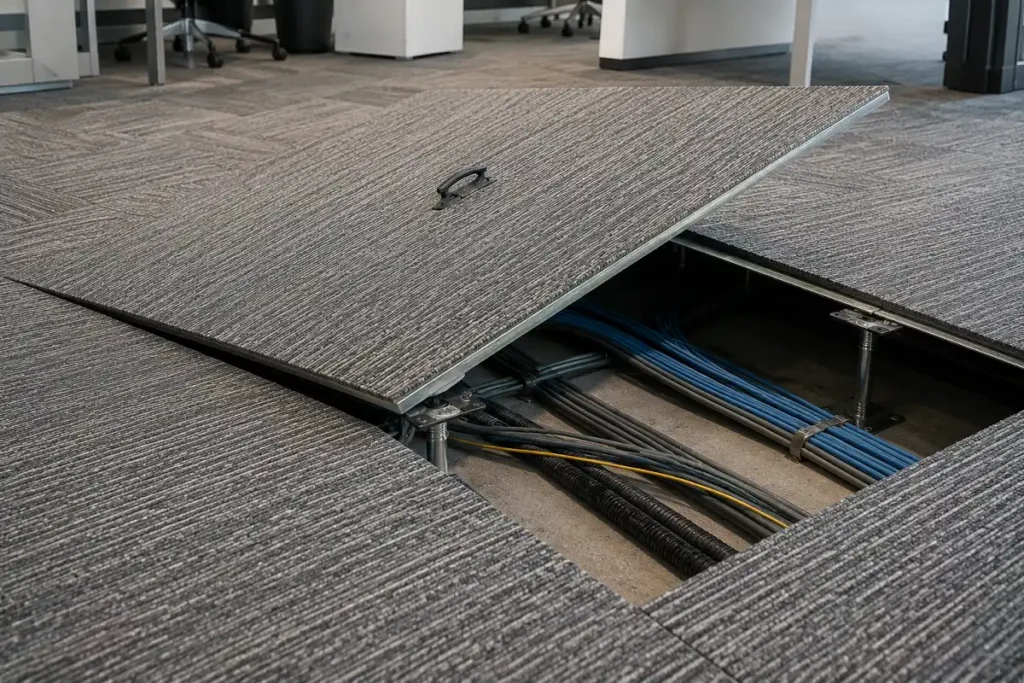
Commercial LVT works if it is at least 5mm thick, to avoid telegraphing the panel grid, and tackifier-laid rather than permanently glued. Avoid anything fixed, glued broadloom, glue-down VCT, epoxy or terrazzo, because it locks the panels down and defeats the purpose of an access floor.
How much does office flooring cost in the UAE?
Office flooring in the UAE runs from around AED 30/sqm (about AED 2.8/sqft) for budget broadloom or VCT, with commercial carpet tiles the typical workhorse at roughly AED 50 to 130/sqm (about AED 4.6 to 12.1/sqft). Reception-grade commercial LVT starts at about AED 80/sqm (about AED 7.4/sqft) and rises with the wear layer and finish, while epoxy for industrial zones runs AED 50 to 250/sqm (about AED 4.6 to 23.2/sqft).
All figures are indicative, supplied and fitted, before 5% VAT, and depend on grade, area and site. An accurate figure comes from a free site survey. For the full breakdown by material, see our flooring cost guide.
Office flooring: frequently asked questions
Are carpet tiles or broadloom better for an office?
For most offices, carpet tiles. You can lift and replace a single 50x50cm tile after a spill or wear, rotate tiles to even out traffic, and they sit neatly over raised access floors. Broadloom suits executive suites and boardrooms where a continuous, premium look matters, but a damaged area means a bigger repair. Tiles for the floorplate, broadloom for statement rooms.
What is the best flooring for a high-traffic office reception?
A reception needs the toughest spec. Heavy-duty carpet tiles in a 24oz or higher loop pile hide footprints and resist crushing, while commercial LVT with a thick wear layer handles wheeled luggage, rain-tracking and constant footfall with a premium hard-floor look. Both clean easily. Avoid cut-pile carpet and thin domestic vinyl in this zone, as they wear visibly fast.
What is the quietest flooring for an open-plan office?
Carpet is the quietest. Carpet absorbs far more airborne noise than hard floor coverings, and it cuts floor-impact noise too. For a noticeably quieter open-plan office, target a carpet with a Noise Reduction Coefficient of 0.4 or higher. Hard floors reflect sound unless paired with acoustic-backed LVT.
Which office flooring is easiest to maintain and replace?
Carpet tiles and LVT. Both let you spot-repair a damaged area instead of redoing the whole floor: tiles lift out individually, LVT planks can be cut in. VCT is durable but needs regular stripping and waxing, so its upkeep cost is higher. Broadloom carpet cleans well, but a worn or stained patch means a larger, more disruptive repair.
Is LVT or carpet better for offices?
It depends on the zone. Carpet, tiles or broadloom, is quieter and warmer, so it suits open-plan and meeting rooms. LVT is harder-wearing, water-resistant and wipeable, so it suits reception, pantries and client-facing areas, and looks premium. Many Dubai offices use both: carpet tiles across the workspace, LVT in reception and wet zones. Acoustic-backed LVT narrows the noise gap.
Can office flooring be installed without closing the office?
Usually yes. Office flooring in the UAE is commonly fitted after hours, overnight or over a weekend so business is not disrupted, and the work can be phased zone by zone or floor by floor. Modular carpet tiles laid with a light tackifier can be walked on immediately, while glue-down vinyl and broadloom need some setting time. We plan timing around your operating hours.
What flooring works over a raised access floor?
Only modular coverings keep the access panels usable. Carpet tiles are the standard choice, laid loose or with a non-permanent tackifier so a tile lifts to reach the cabling below. LVT works if it is at least 5mm thick and tackifier-laid, not permanently glued. Avoid glued broadloom, glue-down VCT, epoxy or terrazzo over access floors, as they lock the panels down.
How much does office flooring cost per square metre in Dubai?
Indicatively, supplied and fitted: budget VCT and broadloom from around AED 30/sqm (about AED 2.8/sqft), commercial carpet tiles roughly AED 50 to 130/sqm (about AED 4.6 to 12.1/sqft), reception-grade LVT from about AED 80/sqm upward, and epoxy for industrial zones AED 50 to 250/sqm (about AED 4.6 to 23.2/sqft). Prices exclude 5% VAT and depend on grade, area and site. See our cost guide for the full range.
The bottom line: the best office flooring
There is no single best office floor, only the right floor for each zone. Carpet tiles are the workhorse for open-plan and most of the floorplate: quiet, replaceable and access-floor friendly. Use commercial LVT for reception and client-facing zones, broadloom for executive rooms that need a continuous finish, VCT for budget back-of-house, and epoxy for any industrial area.
Get the acoustics, the access-floor compatibility and the fit-out timing right, and the floor supports the workplace instead of fighting it. A free site survey is the fastest way to map your zones and spec each one correctly.
Get a free office flooring survey
Fitting out or refurbishing an office in Dubai or across the UAE? Message us on WhatsApp and we will map your floor zone by zone, recommend the right material for each, and plan the work around your operating hours, including after-hours and phased fit-outs.
- WhatsApp us +971 56 689 9831
- Call: +971 56 689 9831
- Request a free site survey and quote across Dubai and Abu Dhabi.
We have supplied and fitted commercial floors across the UAE since 2013, with more than 10,000 projects completed by our in-house team.

Junaid Rana is a content strategist with over 10 years of experience in the interior and fit-out industry, writing on flooring, finishes and fit-out across UAE homes and commercial spaces. His guides are reviewed for accuracy by Urban Flooring’s in-house experts.