
Reviewed for accuracy by Muhammad Gulbadin, founder and operations manager at Urban Flooring, 15+ years in UAE flooring.
Both SPC and WPC are rigid, 100% waterproof click vinyls; the difference is the core. SPC has a dense stone core, so it is harder, more dent-resistant, more heat-stable and cheaper. WPC has a foamed wood-plastic core, so it is warmer, softer and quieter underfoot, but dearer. Choose SPC for high-traffic and sunny rooms, WPC for comfort in bedrooms and living areas.
What is the difference between SPC and WPC flooring?
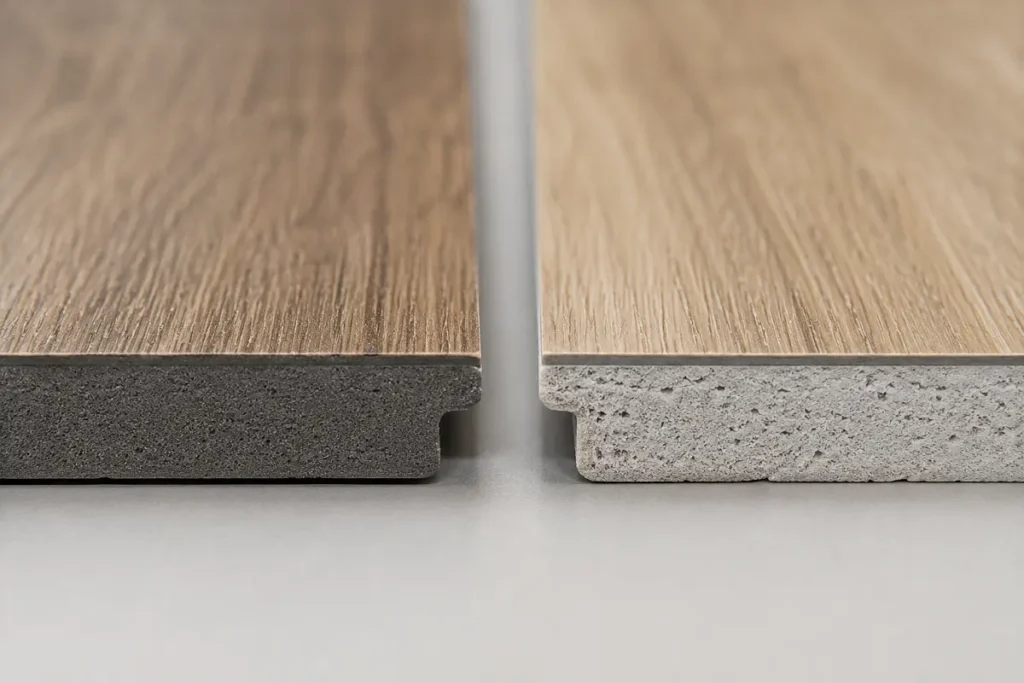
SPC stands for Stone Plastic Composite. Its core is a dense blend of limestone powder and PVC, pressed into a solid, rigid board, close to a thin tile in hardness. WPC stands for Wood Plastic Composite. Its core is a foamed mix of wood flour and plastic, which makes it thicker, lighter and softer.
So the simplest way to hold the difference in your head: WPC is a foam core, SPC is a solid core. Both are rigid click planks, both are fully waterproof, and from that one solid-versus-foam distinction every other difference flows.
SPC vs WPC at a glance: the full comparison table
The table sets the two side by side across core, feel, durability, heat stability, thickness, subfloor needs, cost and lifespan. Read it as a map of trade-offs rather than a scoreboard: the two are identical on waterproofing and on scratch resistance, and separate mainly on hardness, comfort and price. Both are indoor rigid vinyls; no figure here refers to outdoor decking.
| Feature | SPC (Stone Plastic Composite) | WPC (Wood Plastic Composite, indoor) |
|---|---|---|
| Core | Dense limestone / stone-composite (solid) | Foamed wood-plastic composite |
| Waterproof | 100% | 100% |
| Feel underfoot | Firmer, cooler | Warmer, softer, more cushioned |
| Acoustics | Good; firmer sound | Quieter, better sound absorption |
| Dent resistance | Higher (dense core) | Lower (softer foamed core) |
| Scratch resistance | Same at equal wear-layer thickness | Same at equal wear-layer thickness |
| Heat / direct-sun stability | More dimensionally stable | Moves a little more in intense sun |
| Profile thickness | Thinner, easier retrofit under doors | Thicker |
| Subfloor forgiveness | Needs flatter subfloor | More forgiving of minor flaws |
| Lay over existing tile | Yes (thinner, easier) | Yes (check height / threshold) |
| Best for | High-traffic, heavy furniture, sunny rooms, budget | Bedrooms, living rooms, comfort and quiet |
| Cost (supply and fit) | AED 35-150/sqm (3.3-13.9/sqft) | AED 90-200/sqm (8.4-18.6/sqft) |
| Lifespan | 15-25 years | 15-20 years |
What SPC flooring is, and where it wins
SPC flooring is the rigid vinyl with a dense stone-composite core, and that density is its whole advantage. It is harder and more dent-resistant under heavy furniture and point loads, more dimensionally stable when temperatures swing, and thin in profile, so it fits under doors and existing skirting with less fuss. It is also the cheaper of the two.
That combination makes SPC the high-traffic workhorse: kitchens, hallways, living areas, sun-flooded rooms and tighter budgets. For how SPC compares with the other popular vinyl, our SPC vs LVT comparison covers that decision in full.
What WPC flooring is, and where it wins
WPC flooring is the indoor rigid vinyl with a foamed wood-plastic core, and that foam is its whole appeal. It is warmer underfoot, softer and more cushioned to stand and walk on, and quieter, absorbing more sound than a solid core. Its thicker, more forgiving build also copes a little better with minor subfloor imperfections.
Where comfort and quiet matter most, bedrooms, living rooms and upper-floor spaces, WPC is the honest pick. To be clear, this is the indoor floor product; it is not the outdoor composite decking that shares the WPC initials.
Is SPC or WPC warmer, softer and quieter underfoot?
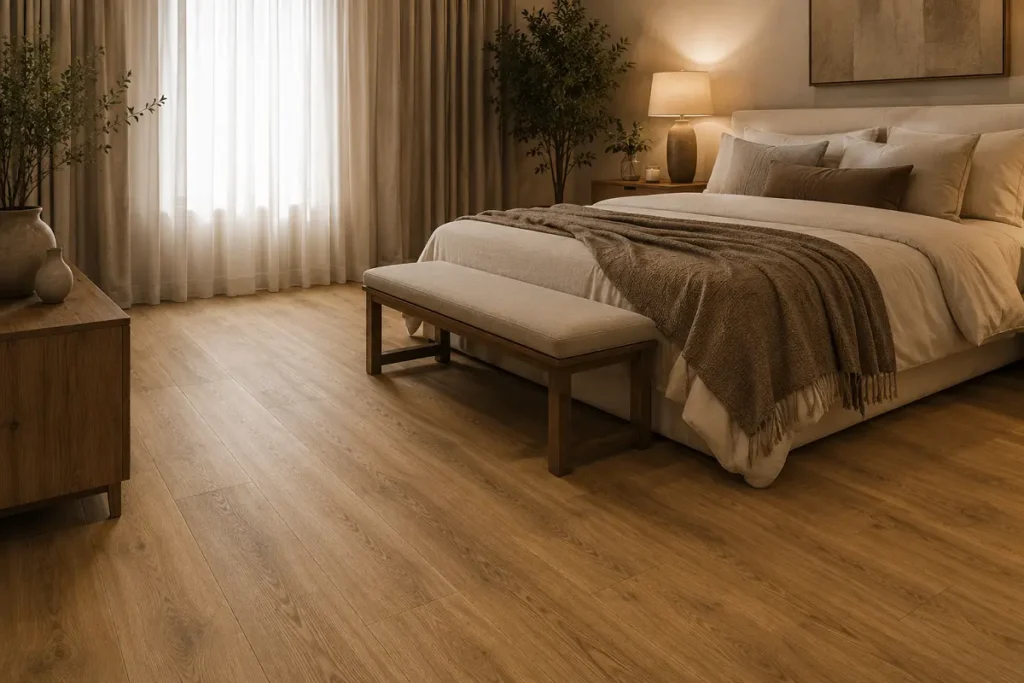
WPC, on all three counts, and it is not close. Its foamed core has more give, so it feels warmer underfoot, cushions each step, and absorbs more sound rather than transmitting it. SPC’s solid stone core feels firmer and cooler and carries a little more sound.
If you are choosing for a bedroom, a living room or any room where barefoot comfort and a quiet step matter, WPC is the more comfortable surface. A good attached underlayment narrows the gap on either product, but the foam core gives WPC the natural edge here.
Is SPC or WPC more dent-resistant and hard-wearing?
SPC, clearly, on dents and heavy use. Its dense stone core resists denting from heavy furniture legs, hard casters and stiletto heels far better than WPC’s softer foamed core, which can take a permanent dent under a concentrated point load like a heavy dining-table leg or a hard office-chair caster. Furniture pads and caster cups help on WPC.
One honest correction to a common myth, though: scratch resistance is identical on the two at the same wear-layer thickness, because scratches happen on the wear layer, which is the same material on both. The dent difference is real; a scratch advantage is not.
Which copes better with UAE heat and direct sunlight, SPC or WPC?
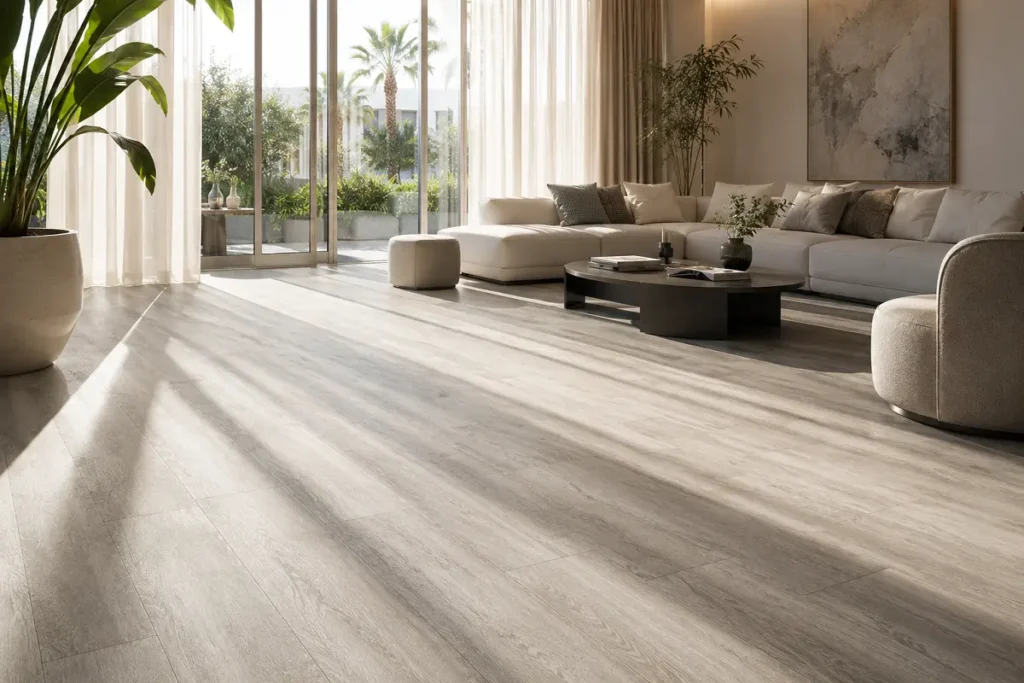
SPC, generally, and in the UAE this matters. Its denser core is more dimensionally stable under the big temperature swings you get behind floor-to-ceiling glass and in sun-flooded rooms, so it expands and contracts less than WPC’s foamed core. For a room that bakes in direct sun all afternoon, SPC is the safer choice.
The honest boundary on this: it is a real edge, not a disqualifier for WPC. Quality WPC laid indoors with proper acclimatisation and correct expansion gaps performs well in normal rooms. It is specifically the intensely sun-flooded room, the glass-walled majlis or the west-facing lounge, where SPC’s stability pulls ahead.
Is SPC or WPC more affordable in the UAE?
SPC is the more affordable of the two. Supplied and fitted, SPC runs about AED 35 to 150/sqm (about AED 3.3 to 13.9/sqft), while indoor WPC runs about AED 90 to 200/sqm (about AED 8.4 to 18.6/sqft). WPC costs more because its foamed core and greater thickness add the comfort and warmth.
If budget is the priority and you do not need the extra cushioning, SPC gives strong waterproof performance for less. All figures exclude 5% VAT and depend on grade and site. For the full breakdown across every floor type, see our flooring cost guide.
Can you lay SPC or WPC over your existing tiles?
Both can, as long as the tile is sound, level and clean. They float over it on a click system with no glue, and wide grout lines are filled first so they do not telegraph through.
The practical difference is profile: SPC’s thinner build is the easier retrofit, clearing doors and existing skirting with less adjustment, while thicker WPC may need a door trimmed or a threshold reset. Neither goes over carpet, and both want a flat subfloor, SPC will telegraph an uneven base a little more, WPC is slightly more forgiving. A site visit confirms the tile is a suitable base and checks the height against your doors and fittings.
Should you choose SPC or WPC for your room?
The honest resolution is to match the core to the room rather than pick one floor for the whole property. SPC goes where hardness, heat stability and budget lead. WPC goes where comfort and quiet lead. Many UAE homes end up using both, and that is the right answer rather than a compromise.
- High-traffic areas, heavy furniture, very sunny rooms, tight budget: SPC flooring, for hardness, heat stability and value.
- Bedrooms, living rooms, anywhere comfort and quiet lead: WPC flooring, for the warm, soft, quiet foamed core.
- A whole home: plenty of projects run SPC in the kitchen, hallway and sun-flooded rooms, and WPC in the bedrooms, getting the best of both.
Both sit in the wider vinyl flooring family, and if you are also weighing vinyl against laminate, our vinyl vs laminate guide covers that choice.
SPC vs WPC flooring: frequently asked questions
What is the main difference between SPC and WPC flooring?
The core. SPC has a dense stone-plastic composite core (limestone plus PVC), which makes it hard, dent-resistant and heat-stable. WPC has a foamed wood-plastic composite core, which makes it warmer, softer and quieter underfoot. Both are 100% waterproof rigid click vinyls, so everything else, feel, dent resistance, heat stability and price, follows from solid core versus foam core.
Is SPC or WPC better for a bedroom?
WPC, usually. Its foamed core is warmer, softer and quieter underfoot, which suits a bedroom where comfort and a cushioned, low-noise step matter more than heavy-traffic durability. SPC works in a bedroom too and costs less, but it feels firmer and cooler. If barefoot comfort and quiet are the priority, WPC is the honest pick.
Is SPC or WPC more durable?
SPC, on dents and heavy use. Its dense stone core resists denting from heavy furniture legs, hard casters and heels far better than WPC’s softer foamed core, which can dent under point loads. Scratch resistance is the same on both at an equal wear-layer thickness. For high-traffic rooms and heavy furniture, SPC is the tougher choice; WPC is durable enough for quieter rooms.
Are both SPC and WPC fully waterproof?
Yes, both are 100% waterproof. Neither core swells, warps or degrades from water, so both suit kitchens, bathrooms and wet-prone areas. The choice between them is not about water at all, it is about feel, dent resistance, heat stability and cost. Pick SPC for hardness and value, WPC for comfort and quiet. Neither replaces proper wet-room waterproofing underneath.
Which is better for UAE heat and sunny rooms?
SPC, generally. Its dense stone core is more dimensionally stable under the big temperature swings you get behind floor-to-ceiling glass and in sun-flooded rooms, so it expands and contracts less than WPC’s foamed core. Quality WPC laid indoors with proper acclimatisation and expansion gaps is fine, but for a room that bakes in direct sun, SPC is the safer choice.
Is SPC cheaper than WPC?
Yes. Supplied and fitted, SPC runs about AED 35 to 150/sqm (3.3 to 13.9/sqft), while WPC indoor runs about AED 90 to 200/sqm (8.4 to 18.6/sqft). WPC costs more because its foamed core and greater thickness add comfort and warmth. If budget is the priority and you do not need the extra cushioning, SPC gives strong performance for less.
Can you install SPC or WPC over existing tiles?
Both can, if the tile is sound, level and clean. They float over it with a click system, no glue. SPC’s thinner profile is the easier retrofit, it clears doors and existing skirting with less fuss, while thicker WPC may need door or threshold adjustment. Wide grout lines are filled first so they do not telegraph. A site visit confirms the tile base suits.
Is SPC or WPC quieter to walk on?
WPC. Its less dense, foamed core absorbs more sound and gives a softer, quieter step, while SPC’s solid stone core feels firmer and can transmit a little more sound. For upper-floor rooms, bedrooms or anywhere underfoot quiet matters, WPC is the more comfortable, quieter surface. A good attached underlayment narrows the gap on either product.
The bottom line: choosing between SPC and WPC
SPC and WPC give you the same thing where it counts most in the UAE: a rigid, 100% waterproof floor that will not swell or warp. The choice is not about water, it is about the core. SPC’s dense stone core makes it harder, more dent-resistant, steadier in direct sun and cheaper, so it leads in high-traffic rooms, under heavy furniture, in sun-flooded spaces and on a budget.
WPC’s foamed core makes it warmer, softer and quieter, so it leads in bedrooms, living rooms and anywhere comfort matters most. Many homes sensibly use both. Decide room by room, and a free site visit will confirm the right core and check your subfloor and door heights.
Get the right vinyl floor with a free site visit
Choosing between SPC and WPC for a home in Dubai or across the UAE? Message us on WhatsApp and a flooring specialist will recommend the right core for each room, SPC where you need hardness, heat stability and value, WPC where comfort and quiet lead, and check your subfloor, tile base and door clearances.
- WhatsApp us: +971 56 689 9831
- Call: +971 56 689 9831
- Request a free site visit and quote across Dubai and Abu Dhabi.
We have supplied and fitted waterproof vinyl floors across the UAE since 2013, with more than 10,000 projects completed by our in-house team.

Junaid Rana is a content strategist with over 10 years of experience in the interior and fit-out industry, writing on flooring, finishes and fit-out across UAE homes and commercial spaces. His guides are reviewed for accuracy by Urban Flooring’s in-house experts.