
Persian and Oriental Rugs in Dubai and the UAE
Genuine hand-knotted Persian and Oriental rugs in wool and silk, traditional patterns and custom sizes, alongside quality machine-made pieces for tighter budgets. Sourced, advised and delivered by one team since 2013.
- Established 2013
- 10,000+ Projects
- In-House Team
- Hand-Knotted & Machine-Made
- Honest Authenticity Advice
- Free Measurement
Or call +971 56 689 9831
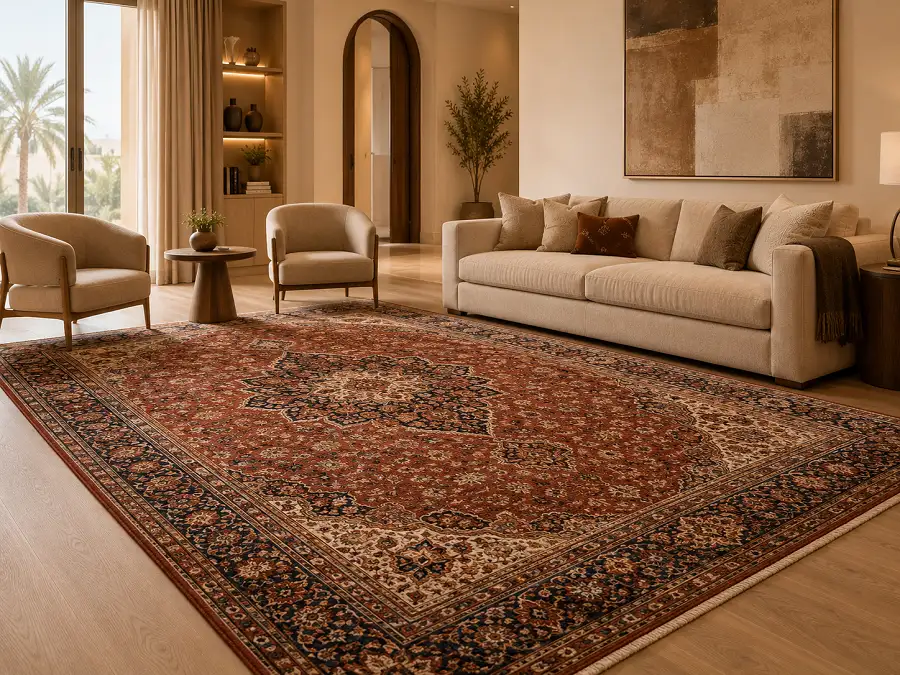
What Is a Persian Rug?
A Persian rug, also called an Iranian rug, is a hand-knotted rug woven in wool or silk on a cotton or silk foundation, defined by its knot density and traditional regional patterns. Genuine pieces are tied by hand, knot by knot. They are valued for durability and craftsmanship, and good ones last for decades. Urban Flooring supplies genuine hand-knotted and quality machine-made Persian and Oriental rugs across the UAE.
What Makes a Rug Genuinely Persian
Genuine is a manufacturing description here, not a compliment. It says the rug was tied by hand rather than woven or printed by machine, and that single fact drives the price and how long the rug lasts. Everything else, the region, the pattern, the fibre, sits on top of it. So it is the first thing to establish and the easiest thing to check.
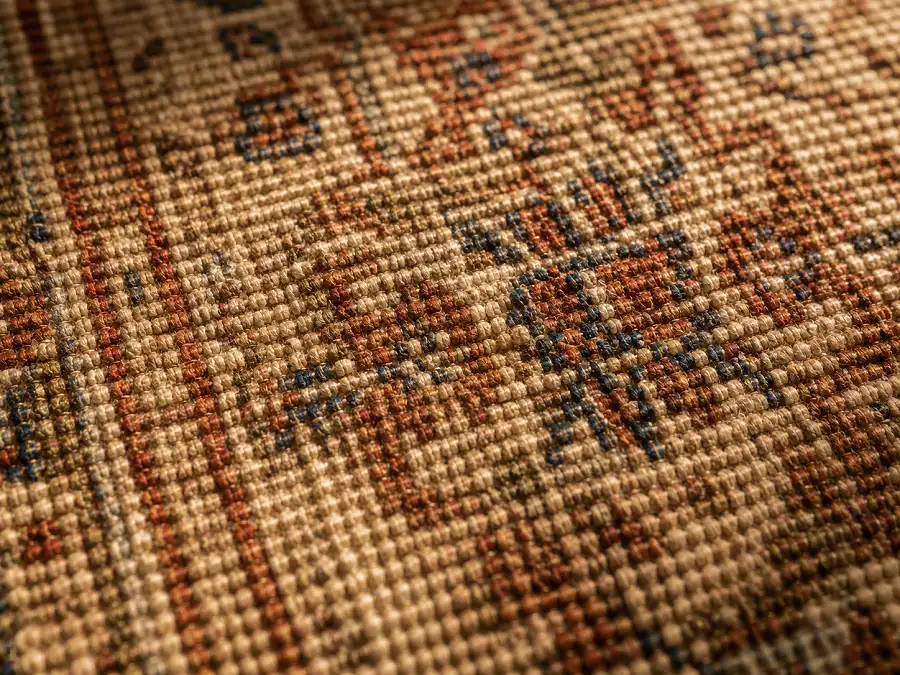
A genuine Persian rug is defined by how it is made, not just how it looks. It is hand-knotted: a weaver ties each individual knot by hand onto a foundation of cotton or silk warps, building the pattern row by row. A single rug can hold hundreds of thousands of knots and take months to complete.
That foundation and that hand-tying are what separate a real hand-knotted rug from a machine-made one printed or woven to look similar. The pile is usually wool or silk, the dyes are often natural, and traditional pieces carry patterns tied to a specific weaving region of Iran or the wider region. "Persian" refers to rugs from Iran specifically, which is why Persian rugs are also called Iranian rugs; "Oriental" is the broader term covering Iran, Turkey, the Caucasus, Central Asia and beyond.
How to Tell a Real Persian Rug from a Machine-Made One
You do not need to be an expert to spot the main differences. Turn the rug over and look at the back, that is where the truth is. On a hand-knotted rug the design reads through to the reverse and the knots sit slightly unevenly. On a machine-made one the back is a uniform mesh or glued, and the fringe is stitched on separately.
| Check | Genuine hand-knotted | Machine-made |
|---|---|---|
| The back | Pattern shows clearly on the back; individual knots visible | Uniform mesh or a glued backing; pattern faint |
| Knots | Slightly irregular, tied by hand | Perfectly uniform, machine-consistent |
| Fringe | Part of the rug, an extension of the foundation warps | Usually sewn or stitched on separately |
| Symmetry | Small natural irregularities in pattern and line | Flawlessly symmetrical and repeating |
| Knot count | Countable individual knots, varies by quality | Not hand-knotted; no true knot count |
| Lifespan | Decades, often generations | Years, not generations |
| Price | Higher, reflects the hand labour | Much lower |
None of this makes machine-made rugs bad, they are an affordable, practical way to get a Persian look, and we sell them honestly as what they are. But they are a different product from a hand-knotted piece, and we will always tell you which is which rather than blur the two.
Persian and Oriental Rug Types
Traditional rugs are often named for their weaving region or style, each with its own character. Tabriz, Kashan, Isfahan and Nain are finely woven city rugs. Qom is the finest, usually all silk, with the highest knot densities. Kilims are flatwoven with no pile. Qashqai, Heriz and Gabbeh are tribal and village pieces, bolder and more accessible.
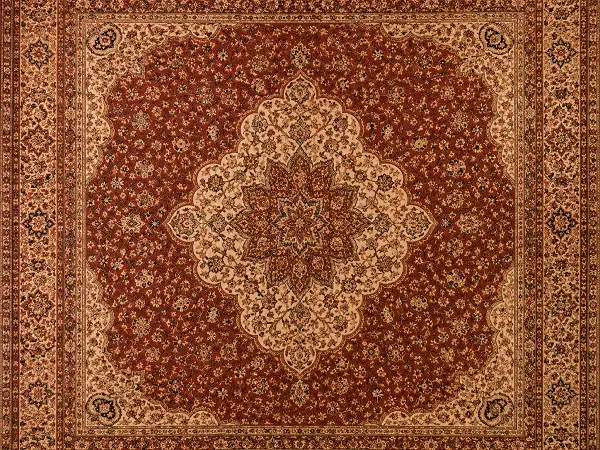
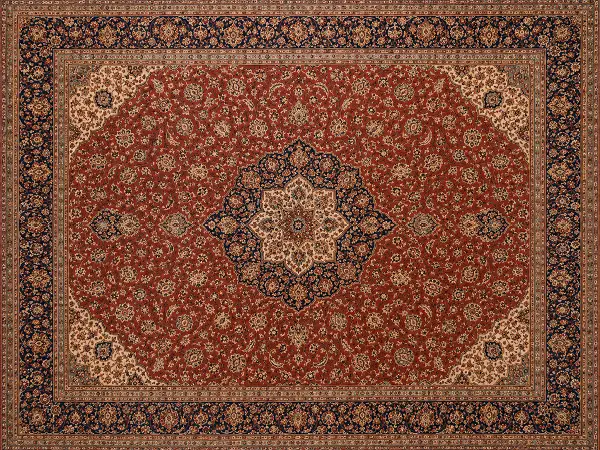
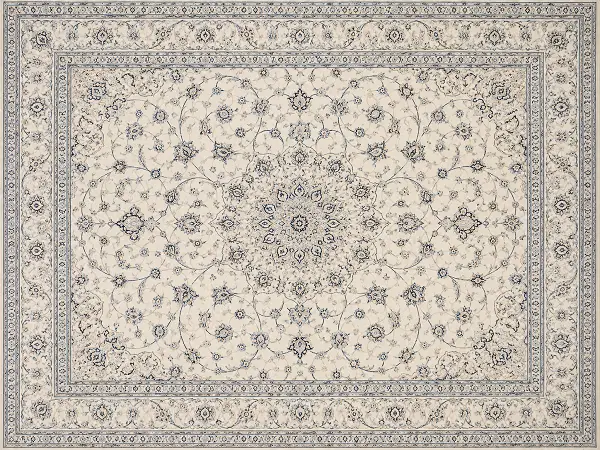
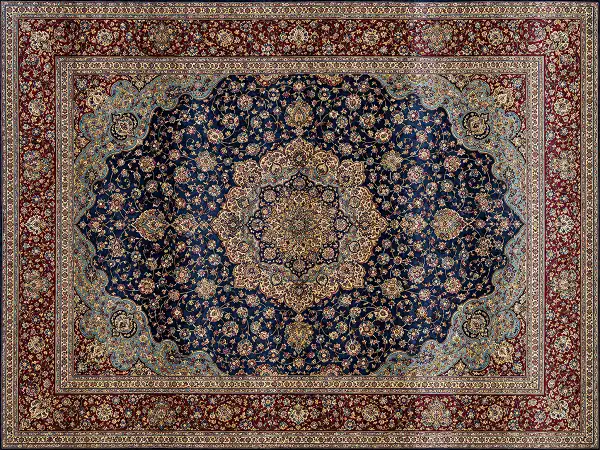
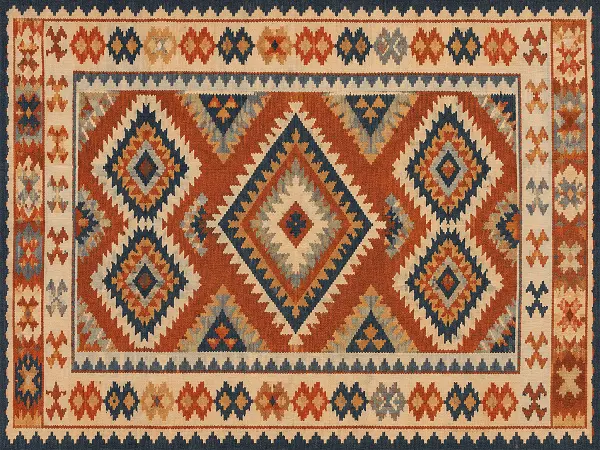
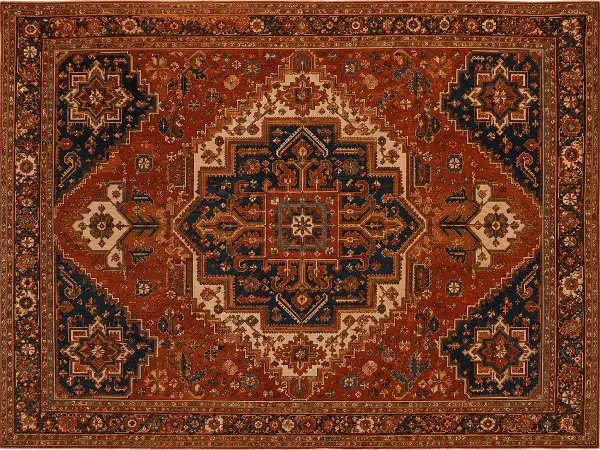
Beyond Persian, Oriental covers Turkish, Caucasian and Central Asian rugs in similar hand-knotted traditions. We help you choose the type that suits your room, budget and taste.
Wool or Silk: Which Persian Rug?
Wool or silk is really a question about the room, not the rug. Wool takes traffic, hides wear and stays comfortable underfoot, which is why it belongs on floors people actually walk on. Silk is finer and catches light, but it marks easily and suits a formal room or a wall. Blends sit between the two.
Wool
The workhorse and the right choice for most homes. It is durable, warm and soft underfoot, hides wear well, takes traffic, and suits living rooms and family spaces.
Good long-staple wool (kork or lambswool) resists wear and holds colour for decades.
Silk
About beauty, not durability. It gives a fine sheen, jewel-like colour and the highest knot detail, but it is delicate, shows footprints, and is best kept to low-traffic settings, a formal room, a wall hanging, or a piece you want to admire rather than walk on daily.
Wool-and-silk blends are a middle path, wool for wear with silk highlights for sheen.
For a floor you actually use, we usually steer clients to wool, and say so honestly rather than push the pricier silk.
Knot Count and Quality
Knot count, usually given as knots per square inch (KPSI), measures how densely the rug is tied. A higher count means finer detail, a crisper pattern and more weaving time, which is why a fine silk Qom at very high density costs far more than a wool Tabriz at a lower count.
Higher is not automatically better for every use, though. A dense, fine silk rug is a wrong fit for a busy family living room, where a hard-wearing wool at a moderate knot count will look right and last far longer. Density should serve the design and the use, not be chased as a number. We explain the knot count of any piece honestly, and match it to how the room is actually used.
Knot count deserves one caution. KPSI is a trade measure, not a certified one, and there is no third-party method behind a number on a label. The nearest published standard is ISO 1763, which sets how tufts or loops per unit length are counted in textile floor coverings, and it is written for machine-made construction rather than hand-tied knots. Treat a quoted KPSI as the seller's own count, and ask to see the back of the rug, where the knots can be counted directly.
Sizing, Placement and Custom Hand-Knotted Rugs
Traditional rugs come in recognised sizes, set out below, with larger pieces woven to order. For placement in a living room, the same principle as any area rug placement applies: size it to the seating so the front legs of the furniture sit on the rug, rather than leaving the rug floating in the middle of the floor.
| Size (cm) | Size (approx ft) | Typical use |
|---|---|---|
| 100 x 150 cm | 3'3" x 4'11" | Small accent piece, entrance or bedside |
| 200 x 300 cm | 6'7" x 9'10" | The classic living-room size |
| 300 x 400 cm | 9'10" x 13'1" | Large villa living or dining room |
Hand-knotted rugs can also be commissioned to a custom size, pattern and colourway, though genuine hand-knotting takes months, not days. We cover bespoke pieces on our custom hand-knotted commissions page.
Caring for a Persian Rug in the UAE Climate
A good hand-knotted rug rewards a little care, and the UAE climate asks for some specific habits. The three that matter most are turning it so wear and light fall evenly, keeping it away from the window that gets the afternoon sun, and leaving deep cleaning to someone who cleans rugs for a living.
Rotate the rug every few months so foot traffic and sunlight wear it evenly, direct sun through UAE windows will fade any natural-dyed rug over time, so keep fine pieces out of harsh direct light. Vacuum gently without a hard beater bar, and blot spills immediately rather than rubbing. Guard against moths and humidity, particularly for wool pieces stored or kept in less-used rooms. Deep cleaning of a hand-knotted rug should be done professionally, not with domestic carpet machines or heavy chemicals, which can damage natural fibres and dyes. Done sensibly, a quality piece stays beautiful for decades.
Why Urban Flooring for Persian and Oriental Rugs
We have supplied rugs across UAE homes since 2013, on more than 10,000 projects, and we sell both hand-knotted and machine-made pieces. The two are priced differently because they are different products, and you will always be told which one you are looking at before you decide.
Frequently Asked Questions
How can I tell if a Persian rug is genuine?
Turn it over. On a genuine hand-knotted rug the pattern shows clearly on the back and you can see individual, slightly irregular knots, and the fringe is part of the weave, not sewn on. A machine-made rug has a uniform or glued backing, perfectly even knots and a stitched-on fringe. The back tells you the truth.
What is the difference between a Persian rug and an Oriental rug?
Persian means the rug was woven in Iran specifically, so Persian rugs and Iranian rugs are the same thing. Oriental is the broader term covering hand-knotted rugs from Iran, Turkey, the Caucasus, Central Asia and beyond. All Persian rugs are Oriental, but not all Oriental rugs are Persian. Both can be genuine hand-knotted pieces; the difference is region of origin, not quality.
Are Persian rugs and Iranian rugs the same thing?
Yes. Iran was historically called Persia, so a Persian rug and an Iranian rug are the same: a hand-knotted rug woven in Iran. The trade uses both names interchangeably, with "Persian" more common in the West and "Iranian" referring to the same rugs by the country's modern name. When you buy a genuine Persian rug from us, you are buying an authentic Iranian hand-knotted rug.
Wool or silk, which Persian rug should I choose?
Wool for a floor you use: durable, warm, hides wear, ideal for living and family rooms. Silk for beauty in low-traffic settings: fine sheen and detail, but delicate and best admired rather than walked on daily. For most homes we recommend wool, and say so honestly rather than push the pricier silk.
What does knot count (KPSI) mean, and does higher mean better?
KPSI is knots per square inch, a measure of how densely the rug is tied. Higher density means finer detail and more weaving time, hence higher cost. But higher is not automatically better: a hard-wearing wool at moderate density suits a busy room far better than a delicate high-density silk. Density should serve the use.
Do Persian rugs hold their value?
A quality hand-knotted rug is durable and, unlike most decor, can retain real-world resale value over decades, depending heavily on condition and provenance. That said, rugs are not liquid assets and we do not sell them as investments. If you want an existing rug valued, we recommend an in-person assessment rather than a figure quoted blind.
How do I clean and care for a Persian rug in the UAE climate?
Rotate it every few months for even wear, keep fine pieces out of harsh direct sun to limit fading, vacuum gently without a beater bar, and blot spills immediately. Watch for moths and humidity on wool. Deep cleaning should be done professionally, not with domestic machines or heavy chemicals, which can harm natural fibres and dyes.
How much do Persian rugs cost in Dubai?
The range is wide and depends on hand-knotted versus machine-made. Machine-made Persian-style rugs start from a few hundred dirhams. Genuine hand-knotted pieces run from around AED 500 to 2,000 for small wool rugs, into the thousands for larger wool, and AED 15,000 upward for fine silk, with premium pieces higher again. We quote honestly for the actual rug.
Can you commission a custom-size hand-knotted rug, and do you deliver across Dubai and Abu Dhabi?
Yes to both. We arrange custom hand-knotted commissions to your size, pattern and colour, though genuine hand-knotting takes months to weave. We deliver and place rugs across Dubai, Abu Dhabi and the wider UAE, and advise on care on handover. Tell us what you are looking for and we will guide you.
Get Your Free Persian Rug Quote
Tell us the room, size and style you have in mind, or send a photo on WhatsApp, and we will guide you to the right piece, hand-knotted or machine-made, with an honest quote and no obligation.
Or call +971 56 689 9831
Urban Flooring Maintenance and Decor Works 7 24A Street, Al Quoz Industrial First, Al Quoz, Dubai, UAESat to Thu 9:00 AM to 7:00 PM GST · Closed Friday
+971 56 689 9831 · info@urbanfloorings.com
Get Directions