
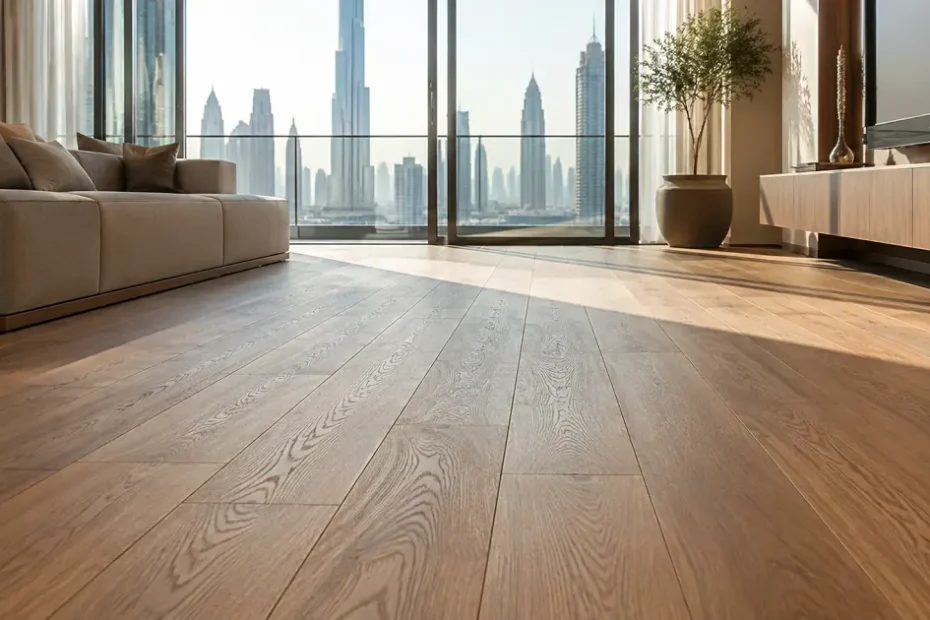
Reviewed for accuracy by Muhammad Gulbadin, founder and operations manager at Urban Flooring, 15+ years in UAE flooring.
Engineered wood has a genuine hardwood surface over a stable core. Laminate has a printed photograph of timber under a clear wear layer. Engineered wood costs roughly double and can be sanded back when it wears. Laminate cannot be refinished at all. Choose laminate for rentals, large areas and tight budgets. Choose engineered wood for a long-term home with a real timber floor.
Laminate vs engineered wood at a glance
The table below sets the two floors against each other on the twelve points that actually decide the purchase in a UAE home. Read the refinishing row and the water row first, because those two are where the difference stops being cosmetic.
| Feature | Laminate | Engineered wood |
|---|---|---|
| What the surface is | Printed decor paper under a melamine wear layer | Genuine hardwood wear layer |
| Real wood | No | Yes |
| Core | HDF or MDF | Cross-grain plywood or HDF |
| Durability spec to ask for | AC rating (EN 13329). AC3 minimum for bedrooms, AC4 for family living areas and hallways, AC5 for rentals and light commercial | Wear layer thickness in millimetres. 3mm (about 0.12 inch) minimum if you ever want to refinish |
| Can be refinished | No. Sanding reaches the print | Yes, at 3mm (about 0.12 inch) or thicker. About one refinish at 3mm, two at 4mm (about 0.16 inch), about four at 5mm (about 0.20 inch) and above |
| Behaviour in UAE humidity swings | The HDF core is stable in the 30 to 40 percent humidity of an air-conditioned interior. It is exposed when cooling is off and indoor humidity passes 70 percent, and at board edges once water reaches the core, where the swelling is permanent | A cross-grain or fibreboard core restrains the movement solid timber shows across the 30 to 40 percent against 60 to 80 percent swing. Needs acclimatising to a UAE equilibrium moisture content of 8 to 10 percent |
| Behaviour under strong direct sun | Generally holds its colour better, attributed to the aluminium oxide top coat. Still discolours under sustained intense sun | Real timber shifts colour under UV. Tropical species darken, sometimes within months. Oak and maple bleach lighter, over years |
| Water resistance | Water-resistant at best, and the core swells. Warranties time-limit standing water to 24 hours on most classes, 72 hours on the highest | Not waterproof |
| Suits wet areas | No | No |
| Typical lifespan | 10 to 15 years | 20 to 30 years |
| Cost, supply and fit | AED 45 to 160/sqm (about AED 4.2 to 14.9/sqft) | AED 100 to 300+/sqm (about AED 9.3 to 27.9+/sqft) |
| Best for | Budget, rentals, large areas, a fast refresh | Long-term homes, a real timber surface, resale |
All prices are indicative, supply and fit, before VAT.
What laminate and engineered wood actually are
The difference is simple and it is not a matter of degree. Engineered wood is real wood: a genuine hardwood surface bonded to a stable core. Laminate is a photograph of wood, printed and sealed under a clear wear layer. Everything else in this comparison follows from that one fact.
What engineered wood flooring is
An engineered board is a genuine hardwood veneer bonded to a dimensionally stable core, either cross-laminated plywood or HDF. The surface you walk on is the same timber as a solid wood floor. Only the material underneath it is different.
The stability comes from the construction, not from the timber. Cross-laminated plies run their grain in opposing directions, so each layer restrains the next and the board cannot move the way a single slab of timber does. Where the core is fibreboard instead, the random fibre orientation removes directional grain altogether, which gives minimal expansion or contraction across humidity swings.
There is a useful mechanical detail behind this. On veneer-faced construction, a thin veneer of roughly 0.5 to 0.6mm (about 0.02 inch) exerts negligible force on its substrate even when it takes up moisture, which is why the board does not warp the way a solid panel does. Flooring wear layers are thicker than joinery veneers, but the mechanism is the same one.
If you want the full range of real-timber options, our engineered wood flooring page covers the species, formats and wear layers we stock.
What laminate flooring is
A laminate board is a high-resolution printed decor paper under a clear melamine wear layer, over an HDF or MDF core. The wood you can see is an image. The hardness of the surface comes from the wear layer, which is commonly reinforced with aluminium oxide, not from any timber.
This is not a criticism of laminate. A good laminate print is convincing, the surface is genuinely hard-wearing, and the price is roughly half. But it changes what happens at the end of the floor’s life, and it changes what happens when the surface is damaged. Our laminate flooring page sets out the AC grades and formats available.
One specification worth asking for on either floor, since both use a fibreboard core with adhesives: ask whether the core is rated E1 or CARB Phase 2. That is the practical handle on emissions for a family home, and any supplier who cannot answer it is worth a second look.
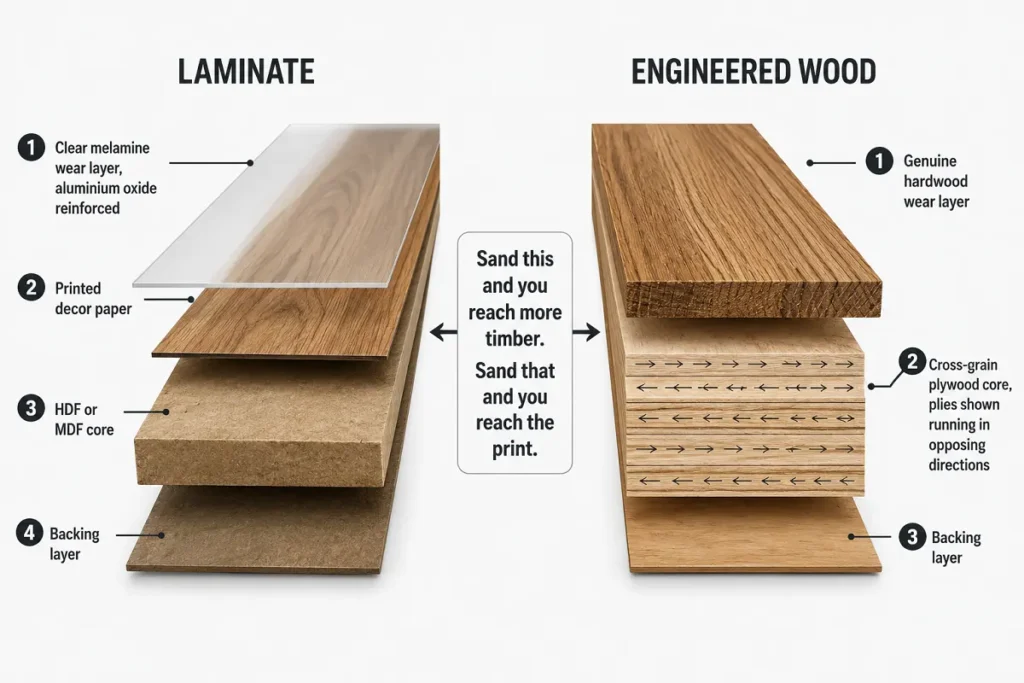
The distinction that matters. Sand an engineered board and you reach more of the same timber. Sand a laminate board and you reach the print. That single sentence is the spine of this entire comparison.
How laminate and engineered wood handle UAE heat and humidity
The intuitive answer is wrong, and it is worth correcting before anything else. An occupied, air-conditioned UAE interior runs at 30 to 40 percent relative humidity at 20 to 22°C (68 to 72°F). That is dry air. Dry air is kind to an HDF core, not hostile to it. The humidity threat in a UAE home is not the cooled, occupied state at all.
The threat is the swing, and it turns up in three specific situations: an unoccupied or unserviced property through the summer, where indoor humidity climbs past 70 percent within days once the cooling is off; a handover or fit-out period before the air conditioning is running; and any point where liquid water reaches a board edge.
Here is what the local numbers look like side by side.
| Condition | Relative humidity |
|---|---|
| UAE interior, AC running, 20 to 22°C (68 to 72°F) | 30 to 40 percent |
| UAE property, AC off, summer, within days | Above 70 percent |
| Dubai outdoor, summer, coastal | 80 to 90 percent |
| Dubai outdoor, winter | 30 to 40 percent |
| Recommended indoor range for a Dubai home | 40 to 60 percent |
The equilibrium moisture content point. Timber in a UAE interior settles at an equilibrium moisture content of roughly 8 to 10 percent. In Northern Europe it settles at 12 to 15 percent. A board manufactured and packed for a European interior therefore arrives wetter than the room it is going into, and it will give up that moisture after it is laid unless it is acclimatised first. That is a UAE-specific fact that most comparison articles do not carry, and it is why acclimatisation is not optional here.
How the two floors actually differ. Engineered wood is the more stable of the two real-timber constructions, and its cross-grain core restrains movement across the 30 to 40 percent against 60 to 80 percent cycle better than solid timber manages. Against laminate, its advantage is that its surface is timber, so it can move slightly and still be sanded back. It is not immune, and nobody should sell it that way.
Laminate’s HDF core is perfectly stable in a conditioned 30 to 40 percent interior. It is exposed in the cooling-off scenario, and it is exposed at board edges once liquid water reaches the core, where the swelling is permanent and no repair recovers it.
The case to name concretely is the villa standing empty through a UAE summer with the cooling switched off, or the property in handover before the AC is commissioned. That is where the intuitive humidity fear becomes real, and it is real for both floors.
Villa against apartment. A villa carries more external wall and roof exposure, more glazing, and a higher likelihood of standing unoccupied. An apartment in a serviced tower sits inside a more constant conditioned envelope. That is the honest basis for the difference and it does not need a figure attached to it.
Sun and fade, where laminate wins. Real timber changes colour under UV, and the direction depends on the species. Tropical species darken fast: Brazilian cherry and tigerwood react very quickly, with one documented case showing dramatic discolouration in under nine months, and walnut is very photosensitive. Domestic species such as red oak, maple and hickory bleach lighter instead, and much more slowly, typically over years. A rug lifted after six weeks can already leave a mark on prefinished red oak.
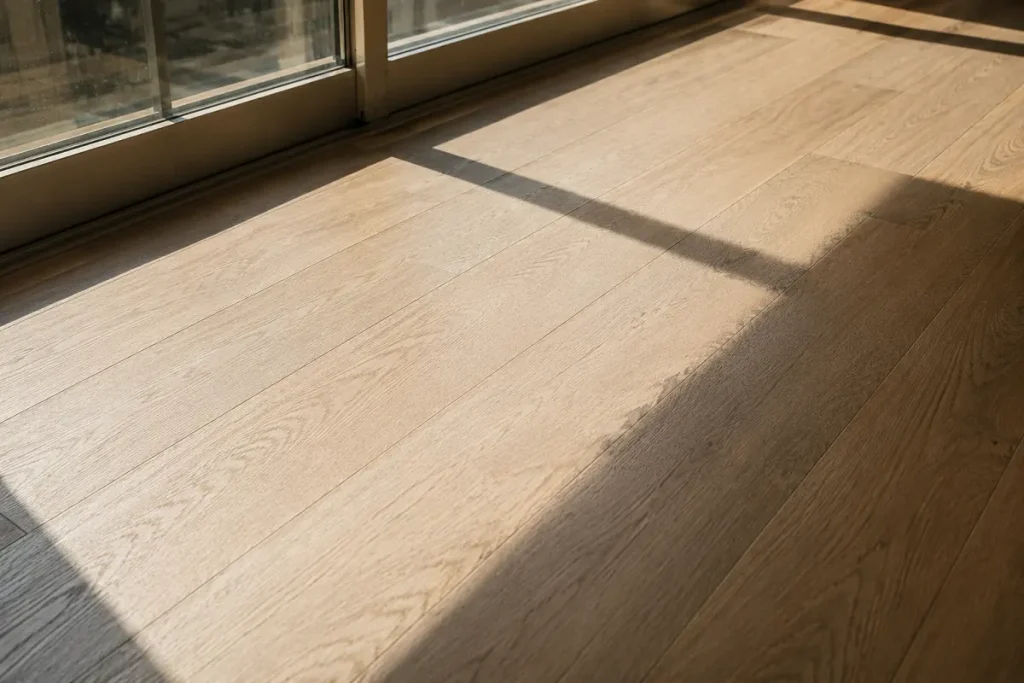
The finish shifts as well as the wood. UV, infrared and visible light together turn oil-based polyurethane finishes yellow or orange over time, independent of the timber underneath.
Laminate resists fading better as a general rule, credited to the aluminium oxide coating on its top layer, although discolouration still happens under sustained intense sun. No manufacturer publishes test data or a timeframe for this, so treat it as the general position rather than a measured claim.
The honest UAE line: in a room with a wall of glass, laminate is likely to hold its colour better, and that is a real point in laminate’s favour in a bright UAE living room. Mitigations exist for timber, including UV-filtering window film, low-emissivity glass and higher-end water-based finishes that reduce ambering, but no finish stops fading. It only slows it.
For the wider picture of how different materials cope with local conditions, our guide to flooring in the UAE climate covers heat, humidity and fade across every material we fit.
Which lasts longer, laminate or engineered wood, and can either be refinished?
Engineered wood lasts longer and it can be refinished, provided its wear layer is thick enough. Laminate cannot be refinished at any thickness, because there is no timber under the print. Typical service life is 10 to 15 years for laminate against 20 to 30 years for engineered wood.
Wear layer thickness, and what each depth actually buys
The wear layer is the only specification that decides whether an engineered floor can be renewed. Ask for it in millimetres, as a number. Marketing words such as “premium” or “heavy duty” carry no defined thickness and tell you nothing.
| Wear layer | What it supports | Note |
|---|---|---|
| 1.2 to 2mm (about 0.05 to 0.08 inch) | Not refinishable | Below the sanding threshold. A finish-life floor, not a renewable one |
| 3mm (about 0.12 inch) | About one refinish | Clears the threshold with roughly 0.5mm (about 0.02 inch) to spare |
| 4mm (about 0.16 inch) | About two refinishes, or one heavy correction | Roughly 1.5mm (about 0.06 inch) of margin |
| 5mm (about 0.20 inch) and above | About four refinishes | Roughly 2.5mm (about 0.10 inch) or more of margin. Rare in the market, so verify the actual figure |
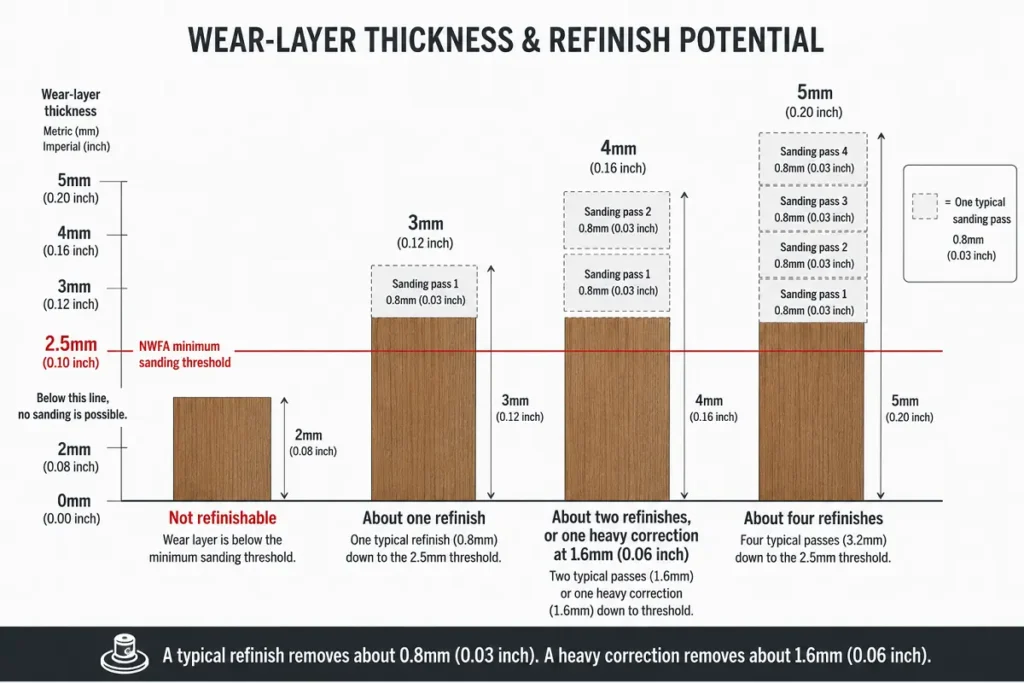
The arithmetic behind those bands is worth showing, because it is what makes the numbers checkable rather than assertable. The National Wood Flooring Association sets a minimum sanding threshold of 2.5mm (about 0.10 inch). A typical refinish removes about 0.8mm (about 0.03 inch). A heavy correction removes roughly 1.6mm (about 0.06 inch). Subtract the threshold from the wear layer, divide by what a sanding pass takes, and the bands fall out exactly where the table puts them.
AC ratings, and which one a UAE home needs
Laminate has no wear layer in the timber sense, so its durability is graded by abrasion resistance under EN 13329, expressed as an AC class.
| Class | Rated for | Practical UAE reading |
|---|---|---|
| AC1 | Very low traffic | Guest bedrooms, storage |
| AC2 | Moderate residential | Bedrooms, small studies. Not hallways, not homes with pets |
| AC3 | Heavy residential | The proper residential standard. Living rooms, hallways, active family homes |
| AC4 | Light commercial | Offices, boutiques, high-traffic households |
| AC5 | Heavy commercial | Retail, restaurants, schools, hotel lobbies |
| AC6 | Extreme | Airports, stations, public buildings |
UAE retail practice runs one notch more conservative than the global scale reads, positioning AC3 for low-traffic bedrooms, AC4 for busy family living areas with children, and AC5 for commercial spaces such as cafes and lobbies.
Our recommendation for a UAE home: AC3 as the minimum for a bedroom, AC4 for a family villa or any hallway and living area, and AC5 for a rental that turns over frequently or any light commercial use.
The comparison buyers get wrong. An AC rating and a wear layer thickness are not the same kind of measurement and they cannot be read against each other. An AC rating measures how well a surface resists abrasion. A wear layer thickness measures how much real timber is available to be sanded away and refinished. One is a resistance grade. The other is a renewable depth.
That distinction has a practical consequence. A high-AC laminate can genuinely out-resist scratching better than a thin softwood-veneer engineered board, and still be finished forever once the print layer wears through, because there is nothing underneath it but a photograph. A buyer holding an AC number against a millimetre figure is comparing two unlike things.
Water and wet areas: why neither laminate nor engineered wood is the answer
Neither floor belongs in a bathroom, and laminate is not waterproof at any price or any grade. If you want a wood look in a kitchen, a bathroom or anywhere that sees standing water, the honest answer is that neither of these is the right material.
The clearest evidence is not marketing copy, it is warranty language, because that is what a manufacturer will actually stand behind. Published laminate warranty conditions from a major European manufacturer show the following:
- Standing water tolerance is time-limited, not unlimited. Class 34 and one Class 33 product line carry a 72-hour tolerance. Other Class 33 products and Class 32 carry 24 hours.
- Standard laminate “may not be installed in damp and/or humid areas or in extremely dry areas.”
- Even water-resistant ranges exclude “very humid areas or in extremely dry areas or areas where there are extremely high temperatures (such as but not limited to saunas, pool areas and rooms with build-in drains like showers).” Rooms with built-in drains are excluded by name.
- Water damage exclusions are broad. Damage from ice machines, refrigerators, sinks, dishwashers, pipes, natural disasters, excessive moisture in concrete slabs and hydrostatic pressure is not covered, and neither is “water/humidity between the subfloor and the laminate.”
- For products that are not water-resistant, the instruction is that moisture on the floor and around skirtings and profiles “is to be removed immediately.”
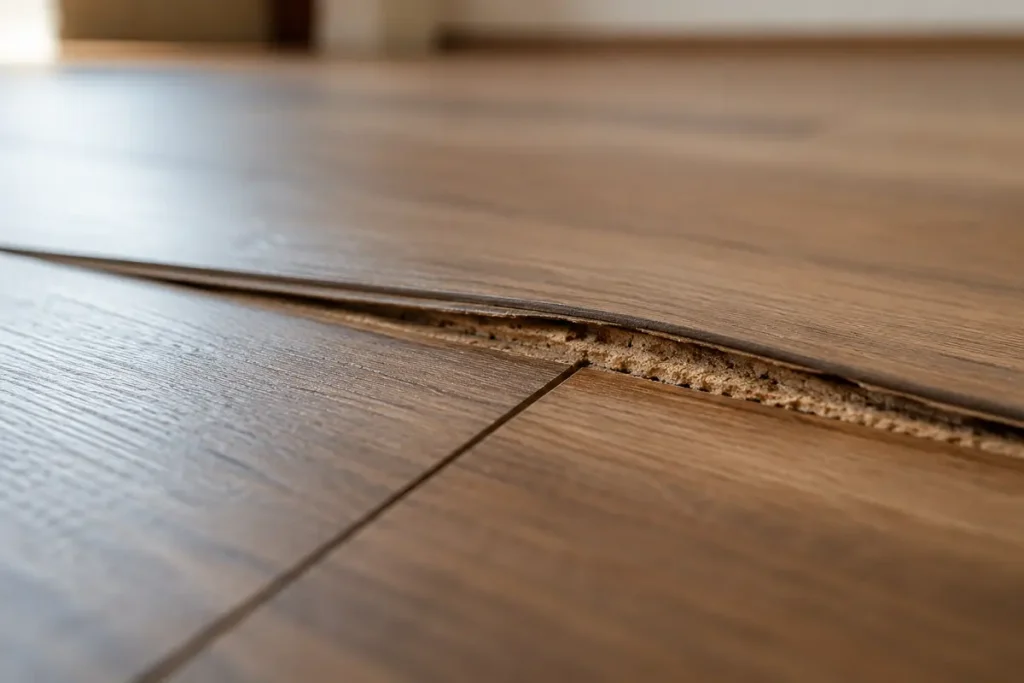
The honest formulation is this: a water-resistant laminate survives a spill you notice and mop up. Its warranty does not cover the rooms where unnoticed water is routine. Those are two different promises, and marketing tends to merge them into one.
Engineered wood deserves the same firmness, not a free pass. Engineered wood is real timber. Real timber does not belong in a bathroom. Presenting engineered wood as the wet-area upgrade over laminate is a different overclaim with exactly the same shape, and we will not make it.
Where to go instead. For a wet area that needs to look like wood, SPC flooring is the rigid-core, genuinely waterproof answer, and LVT gives the most realistic wood print available in a waterproof format. If reading this has moved you away from the wood-look question altogether, our guide to vinyl compared with laminate runs that decision properly rather than in passing.
What laminate and engineered wood cost in the UAE
Laminate costs roughly half what engineered wood costs at like-for-like specification. Laminate runs AED 45 to 160 per sqm (about AED 4.2 to 14.9 per sqft), supply and fit. Engineered wood runs AED 100 to 300+ per sqm (about AED 9.3 to 27.9+ per sqft), supply and fit. Both figures are indicative and quoted before VAT. Our flooring cost guide carries the full band for every material we fit.
On that “+” at the top of the engineered band. It is doing real work and it is not a typographical habit. UAE supply-only pricing for engineered wood already reaches AED 300 per sqm (about AED 27.9 per sqft) before any fitting labour is added. Add UAE labour and a real supply-and-fit job lands at or above the top of that band. Nobody should read AED 300 per sqm as a ceiling.
What the money actually buys on a laminate job. UAE market pricing for laminate supply and fit sits around AED 45 to 120 per sqm (about AED 4.2 to 11.1 per sqft), breaking down as boards at AED 25 to 90 per sqm (about AED 2.3 to 8.4 per sqft), labour at AED 20 to 40 per sqm (about AED 1.9 to 3.7 per sqft) and underlay at AED 5 to 15 per sqm (about AED 0.5 to 1.4 per sqft), for a typical total of AED 50 to 145 per sqm (about AED 4.6 to 13.5 per sqft). Roughly a third of a laminate job is labour and underlay rather than board, which is why the cheapest quoted board rate rarely produces the cheapest finished floor.
Frame the gap as a decision, not an upsell. On a large villa area, the difference between the two floors is roughly the cost of a second room’s flooring. That is a real trade-off with two defensible answers, and it depends on how long you intend to keep the floor rather than on which material is better.
Costs that do not appear in a headline rate, and which change a quote materially: subfloor preparation and levelling, acclimatisation time, removal and disposal of the existing floor, underlay upgrades, and a waste allowance of 5 to 15 percent. At least one UAE source puts labour at 40 to 60 percent of total flooring cost. Treat that as one supplier’s figure rather than a market rule, but it points the right way, which is that fitting is a large share of what you pay.
A free measurement is the only way to get an exact number for your space, because area, subfloor condition and threshold detailing all move the total.
Looks, feel and resale value: how each floor reads to a buyer
A real timber surface is the one a buyer and a valuer read as a wood floor, and that perception is the honest basis for the resale argument. There is no measured UAE uplift figure for either material, and anyone quoting you one is guessing.
The best available international evidence comes from the NAR and NARI Remodeling Impact Report (2022), which puts new wood flooring at 118 percent of cost recovered and refinishing existing hardwood at 147 percent of cost recovered, both carrying a Joy Score of 10, the top of the scale.
Three cautions apply to that figure and all three matter. It is a United States dataset, not a UAE one. It measures wood flooring generally, not engineered wood against laminate specifically. And cost recovered is not the same thing as value added. It is the strongest data available on the question, which is not the same as being data about Dubai.
UAE evidence is weaker and should be treated as market opinion. One Dubai renovation source claims a 5 to 10 percent increase in price per square foot after full villa flooring replacement in premium materials, and separately names cheap laminate as a material to avoid on humidity grounds while recommending engineered wood for bedrooms and living areas. No transactions, study or valuation data sit behind those claims. We will not repeat the percentage as though it were established.
So the honest claim is about perception, and perception is what moves a viewing. A real wood surface reads as a real wood floor to a buyer walking through, and to an agent describing the property. A convincing laminate reads as a well-presented floor. Those are different things and they show up at different points in a sale.
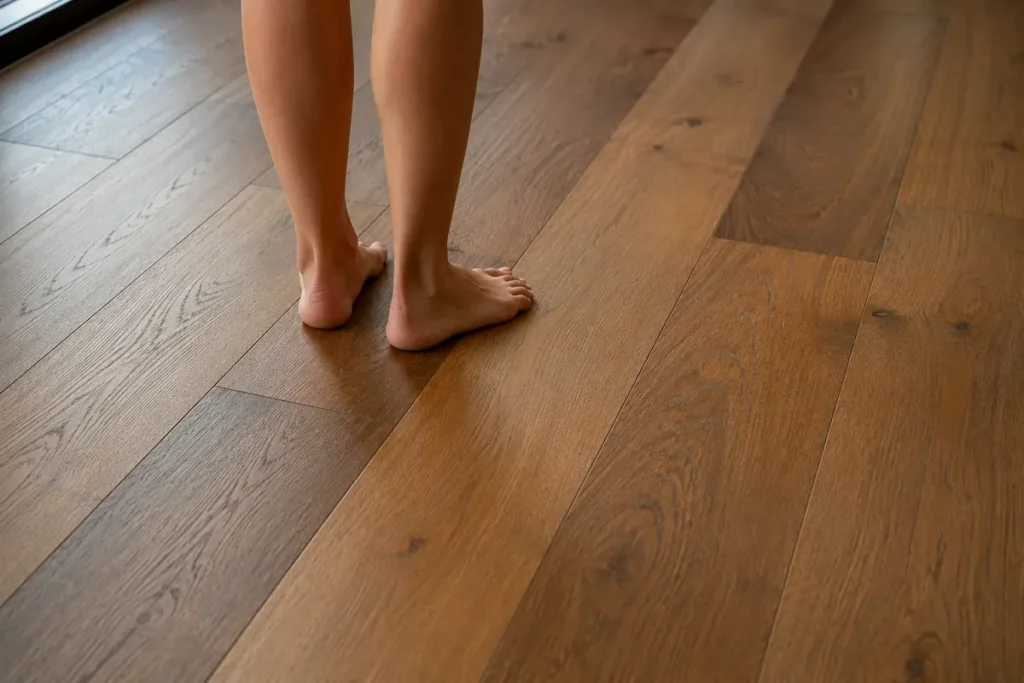
Underfoot and to the ear, the difference is easy to feel and hard to photograph. Real timber over plywood reads warmer and duller underfoot. Laminate over HDF reads harder and sounds more hollow, which a good underlay improves but does not remove. Walk on both before you decide, because this is the part of the comparison that no specification sheet captures.
Fitting laminate and engineered wood over a UAE concrete subfloor
On a UAE concrete slab, the slab has to be tested and dry before either floor goes down. Skipping that step is the single most common cause of wood floor failure in this market, and it is the one part of the job where cutting a corner is guaranteed to show up later.
The moisture test, with the numbers that make it a real specification. ASTM F2170 uses in-situ relative humidity probes, and the slab must test at or below 75 percent RH before any wood flooring system is installed. The detail that catches people out is that any single location above the limit fails the whole test, regardless of what the other readings say.
- Probe depth is 40 percent of slab thickness. On a 100mm (4 inch) slab that is 40mm (1.6 inch).
- A minimum of 72 hours of equilibration is needed after the sleeve goes in before a reading is taken.
- The slab must be conditioned for at least 48 hours at occupancy temperature and humidity before testing starts. In a UAE context that matters more than it sounds, because testing a slab in an uncooled building does not give you a usable number.
- Minimum three tests for the first 1,000 sq ft (about 93 sqm), plus one more per additional 1,000 sq ft, prioritising areas near external walls and low points.
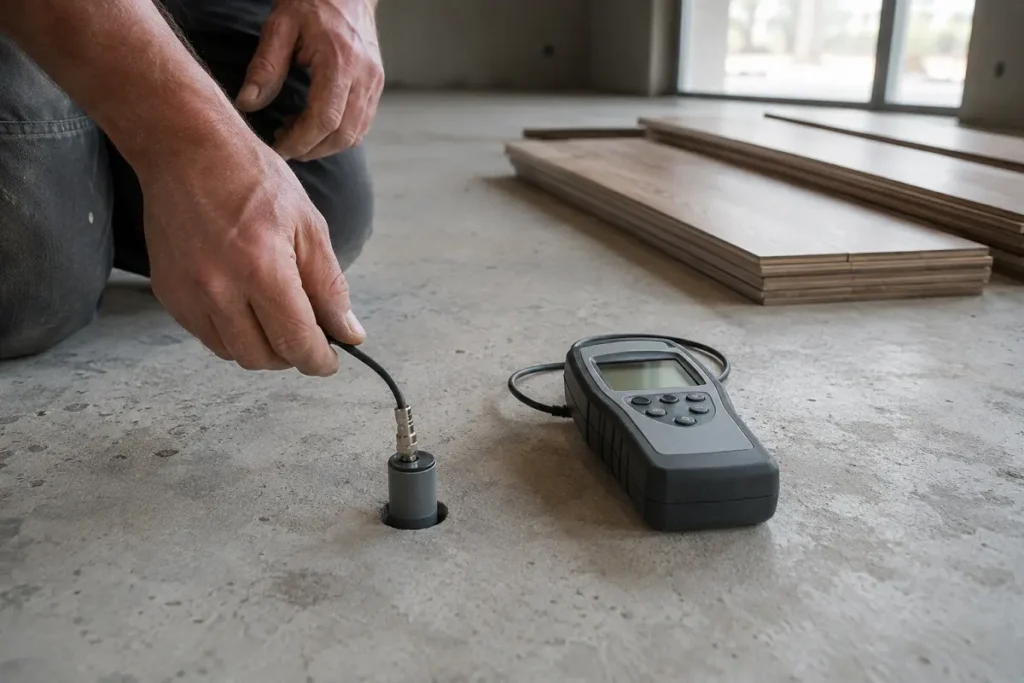
ASTM F1869, the calcium chloride method, is the alternative, and it caps moisture vapour emission at 3 lb per 1,000 sq ft per 24 hours (about 1.4 kg per 93 sqm per 24 hours). It measures surface release rather than the internal condition of the slab, which is why the RH probe method is the stronger test of the two
Acclimatisation, with the disagreement stated rather than averaged. UAE guidance for timber going into a cooled interior runs to a minimum of two weeks, because of the equilibrium moisture content gap described earlier: material arriving at 12 to 15 percent moisture content is going into a room that will pull it down to 8 to 10 percent. Other UAE flooring sources cite 24 to 72 hours. Those figures disagree, and averaging them would produce a number nobody stands behind.
The practical position is that acclimatisation runs from a couple of days for a factory-finished floating floor up to two weeks for real timber going into a cooled interior, and the fitter sets the period against the specific material and the specific site. Ask what period your fitter is allowing and why.
What goes wrong when these steps are skipped: checking, meaning surface cracks where outer layers dry and contract faster than the core follows; cupping across wide boards from uneven moisture loss; splitting along the grain where material moves from humid storage into a cooled interior without acclimatising; and joint failure or finish adhesion breakdown after fitting. For laminate specifically, add permanent swelling of the HDF core where slab moisture reaches it.
There is a commercial dimension to this as well as a technical one. Laminate warranties explicitly exclude “excessive moisture in concrete slabs” and “water/humidity between the subfloor and the laminate”, so a skipped damp-proof membrane is an uninsured risk, not only a bad idea.
Floating against glue-down. Laminate is a floating system on underlay in almost all residential cases. Engineered wood can be floated or glued down, and glue-down is the more usual specification for a long-term villa floor on a slab. Both need the same slab moisture result before work starts.
Laying over an existing tiled floor is possible for either material, and the constraints are practical rather than exotic: the base has to be sound, flat and dry, and the finished floor height has to work at doors and thresholds. That is a measurement question your fitter answers on site.
On underfloor heating, both materials are compatible with most systems within the manufacturer’s stated temperature limits. It is worth one sentence and no more, because UAE residential building is cooling-led and underfloor heating is not a decision factor in the vast majority of homes here.
Which should you choose, laminate or engineered wood?
There is no universal winner between these two, and any guide that names one is selling something. The right answer depends on how long the floor has to last and what you want the surface to be.
Choose laminate if you are fitting a rental or an investment unit, covering a large area on a fixed budget, doing a room that will be redone within five years, or flooring a bright room with a wall of glazing where fade resistance matters more than surface authenticity. Specify AC4 for a UAE family home. Laminate is genuinely the right call in all four of those situations, and we will say so rather than talk you upwards.
Choose engineered wood if this is a long-term home, if you want a real timber surface underfoot, if you want a floor that is still serviceable in twenty years, or if you value the option to sand back rather than replace. Specify a wear layer of 3mm (about 0.12 inch) as a minimum, and 4mm (about 0.16 inch) if the ability to refinish twice matters to you.
Choose neither if the room is a bathroom, a wet room or anywhere with standing water. Go to SPC or LVT for that, as set out above.
If you have read this far and what you actually want is solid timber, that is a different comparison and it deserves a proper answer rather than a footnote here. Our guide to engineered wood compared with solid timber runs that decision on stability, cost and refinishing.
If you are still weighing the wood look against everything else, our full wood flooring range shows what is available across both materials, and the step-by-step method for how to choose a floor works through traffic, moisture, budget and upkeep in order.
Frequently asked questions about laminate and engineered wood
Can you tell the difference between laminate and engineered wood by looking at it?
Close up, yes. At a glance, often not. Engineered wood shows real timber at the board edge, and its surface texture registers with the grain because the grain is physically there. Laminate’s decor is printed, so the pattern repeats across a run of boards and the embossing may not line up with it. Engineered wood also varies board to board.
Which is better for UAE heat and humidity, laminate or engineered wood?
Engineered wood handles the swing better, though the risk sits in a narrower window than most buyers expect. Air-conditioned interiors run at 30 to 40 percent relative humidity, which is dry and benign for both floors. Dubai outdoor summer humidity reaches 80 to 90 percent, and an unserviced property with the cooling off passes 70 percent indoors within days. That is where laminate’s HDF core is exposed.
Can engineered wood be sanded and refinished, and how many times?
Yes, if the wear layer is 3mm (about 0.12 inch) or thicker. The National Wood Flooring Association sets 2.5mm (about 0.10 inch) as the minimum sandable depth, and a typical refinish removes about 0.8mm (about 0.03 inch). So 3mm supports about one refinish, 4mm about two, and 5mm and above about four. Below 2mm, a board is not refinishable. Ask for the millimetre figure.
Is laminate flooring waterproof?
No. Water-resistant is not waterproof, and the warranty language proves it. Standing water tolerance is time-limited, at 24 hours on most classes and 72 hours on the highest. Manufacturers exclude damp and humid areas outright, exclude rooms with built-in drains by name, and exclude water damage from dishwashers, sinks, pipes and slab moisture. For a genuinely waterproof wood look, choose SPC or LVT.
Which is cheaper to fit in Dubai, laminate or engineered wood?
Laminate, by roughly half. Laminate runs AED 45 to 160 per sqm (about AED 4.2 to 14.9 per sqft) supply and fit. Engineered wood runs AED 100 to 300+ per sqm (about AED 9.3 to 27.9+ per sqft). Both are indicative and before VAT. On a laminate job, labour and underlay account for roughly a third of the rate.
Does laminate or engineered wood add more value to a property?
Engineered wood, on perception rather than on any measurable UAE uplift. The NAR and NARI Remodeling Impact Report puts new wood flooring at 118 percent of cost recovered and hardwood refinishing at 147 percent, with top Joy Scores, but that is United States data covering wood flooring generally. No UAE study exists. A real timber surface reads as a real wood floor.
Can laminate or engineered wood be laid over an existing tile or concrete floor?
Yes, over a sound, flat and dry base, and the slab test comes first. In-situ relative humidity probes must read 75 percent or below under ASTM F2170 before either floor is fitted, with probes set at 40 percent of slab depth, 72 hours to equilibrate, and the building conditioned for 48 hours beforehand. Over tile, flatness and finished floor height decide it.
Which is better for a bedroom or a living room, laminate or engineered wood?
Both work in both, and budget, sunlight and intended lifespan decide it. AC3 is the residential minimum and AC4 suits busy UAE family living areas. A bright, heavily glazed room favours laminate on fade resistance. A long-term room favours engineered wood. Our guides to bedroom flooring and living room and majlis flooring go room by room.
The bottom line: a real timber surface or a printed one
This decision comes down to one question, and it is not a question about quality. Engineered wood gives you a genuine hardwood surface that can be sanded back and renewed, at roughly double the price and with a service life of 20 to 30 years.
Laminate gives you a convincing printed wood look with a hard, fade-resistant surface, at roughly half the price and with a service life of 10 to 15 years, and it cannot be renewed at any point.
Both are honest choices in the right room. Laminate is the right answer for a rental, a large area on a fixed budget, a room facing a wall of glass, or a floor that will be replaced in five years anyway. Engineered wood is the right answer for a home you intend to keep, where the surface underfoot should be real timber and where the option to refinish is worth paying for.
The one place neither belongs is a wet area, and that limit holds regardless of what a board is graded or what a range is called. In a bathroom or any room with standing water, the right material is SPC or LVT, and no laminate warranty in the market says otherwise.
In a UAE home, the practical order is this: decide how long the floor has to last, check whether the room takes direct sun through glazing, confirm the slab is dry before anything is laid, and then pick the material. Get those four right and either floor performs.
Get the right wood floor with a free site visit
Deciding between laminate and engineered wood for a home in Dubai or across the UAE? Message us on WhatsApp and a flooring specialist will walk your space with you, check the subfloor, look at the glazing and the traffic, and recommend the right material and specification for each room, honestly, including when the cheaper option is the right one.
- WhatsApp us: +971 56 689 9831
- Call: +971 56 689 9831
- Request a free site visit and quote across Dubai and Abu Dhabi.
We have supplied and fitted wood and wood-look floors across the UAE since 2013, with more than 10,000 projects completed by our in-house team.

Junaid Rana is a content strategist with over 10 years of experience in the interior and fit-out industry, writing on flooring, finishes and fit-out across UAE homes and commercial spaces. His guides are reviewed for accuracy by Urban Flooring’s in-house experts.