
Glue-Down LVT Herringbone in a Dubai Apartment
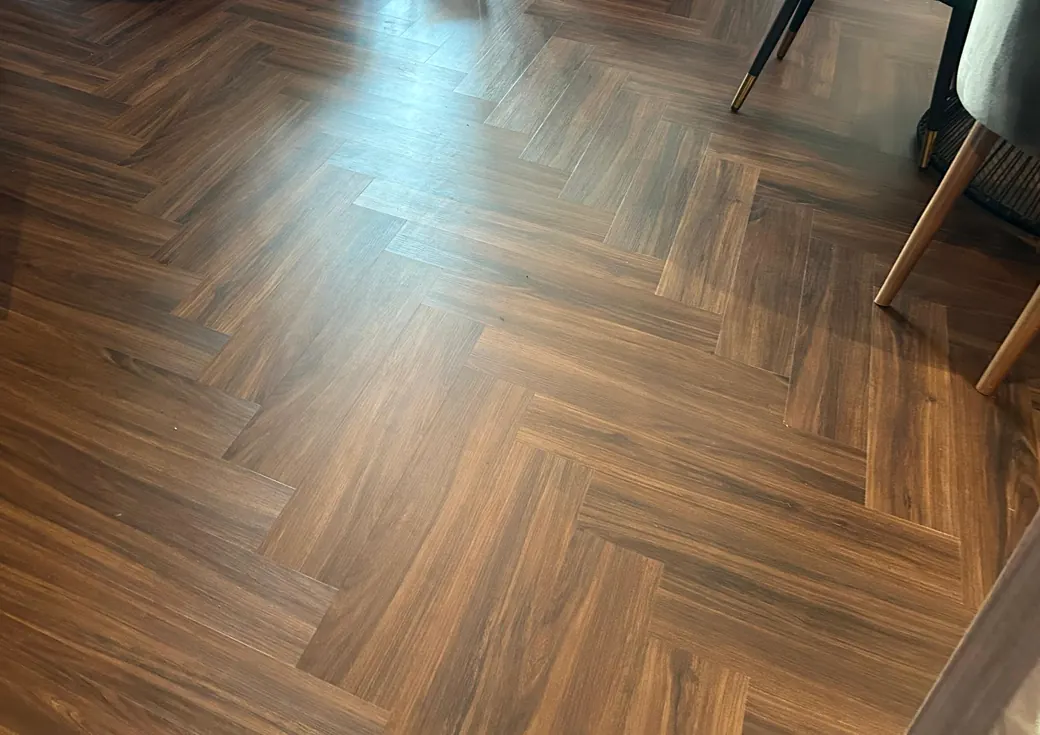
Urban Flooring supplied and fitted a glue-down LVT herringbone floor through an apartment at Land Residence Complex in Dubai, running one continuous pattern across the living and dining areas, the entrance hall, the corridor and the bedrooms. Every tile is bonded to the subfloor rather than clicked to its neighbour.
Or call +971 56 689 9831
Project at a Glance
- Location
- Land Residence Complex, Dubai
- Property
- Apartment
- Product
- Glue-down LVT, dark walnut tone
- Lay pattern
- Herringbone, single continuous direction throughout
- Areas
- Living area, dining area, entrance hall, corridor and bedrooms
- Fixing
- Bonded to the subfloor, not click-jointed
- Detail
- Pattern carried through door openings without threshold strips
- Media
- 7 project photos
- Scope
- Supply and installation, Urban Flooring in-house team
- Area served
- Dubai, Abu Dhabi and all seven emirates
What Glue-Down Changes
A herringbone in glue-down LVT is a different job from a herringbone in a click floor, and the difference is not the pattern. It is what holds the pattern together. Click planks lock into their neighbours. Bonded tiles do not. Each one is fixed to the subfloor on its own.
That changes how the floor is set out. On a click floor each row helps hold the next one true, because the joint mechanism carries the line whether the fitter is watching it or not. On a bonded floor there is no mechanism. A centre line is struck across the room first, and every tile is worked back to that line rather than to the tile beside it.
It also changes what a mistake costs. A click plank laid slightly out can be lifted and re-engaged. A bonded tile is in the adhesive, and once it has grabbed it stays where it was put. A tile set a degree off does not get pulled straight by the next one. It pushes the error further along the room, and by the far wall that error is measured in whole tiles.
This is why glue-down herringbone is priced on the setting-out rather than the square metres, and why a site visit gives a far more useful figure than a floor plan does.
The Subfloor Does More Work
Bonded flooring follows the surface underneath it. That is the trade for having no joint mechanism: nothing bridges, so nothing hides.
A rigid click plank spans a shallow dip because the plank itself is stiff and locked to its neighbours on both sides. A bonded tile has no such help. It sits down into the dip and the finished floor carries it as a soft spot you can feel through your foot before you can see it. On a herringbone the same dip also breaks the light along the pattern, because the tiles either side of it are no longer sitting in the same plane.
So the preparation is the long part. Levelling, filling and cleaning the subfloor takes more of the programme than laying does on a job like this, and none of it is visible when the floor is finished. It is the part of the work a client never sees and the part that decides whether the floor is still flat in five years.
The perimeter is the second place the subfloor shows. A herringbone meets every wall at an angle, so the edge of the floor is a continuous run of cut tiles rather than a straight row of full ones. Each of those cuts has to sit flat and tight against the wall, and a subfloor that falls away near the skirting makes every one of them sit slightly proud. On a straight-plank floor the same fall would be hidden under the skirting line. On a herringbone it shows as a ragged edge of light down the length of the room.
One Floor, Room to Room
The same pattern runs through every space in the apartment in one direction, which sounds simpler than it is.
Carrying a herringbone from a wide living area into a narrow corridor is where setting-out is tested. An open room is forgiving, because the eye has nothing close by to measure the pattern against. A corridor gives it two parallel walls a metre or so apart, so a pattern running even slightly out of square reads immediately as a drift along the skirting.
Door openings are the other test. The floor carries straight through them with no threshold strip, which means the pattern has to arrive at the opening in the right place, not merely in the right direction. That is decided at the centre line, at the start, long before anyone reaches the door.
The entrance hall makes the same point in reverse. It is the first floor anyone sees on the way in, it is narrow, and it is where a set-out error would have accumulated the furthest from the centre line.
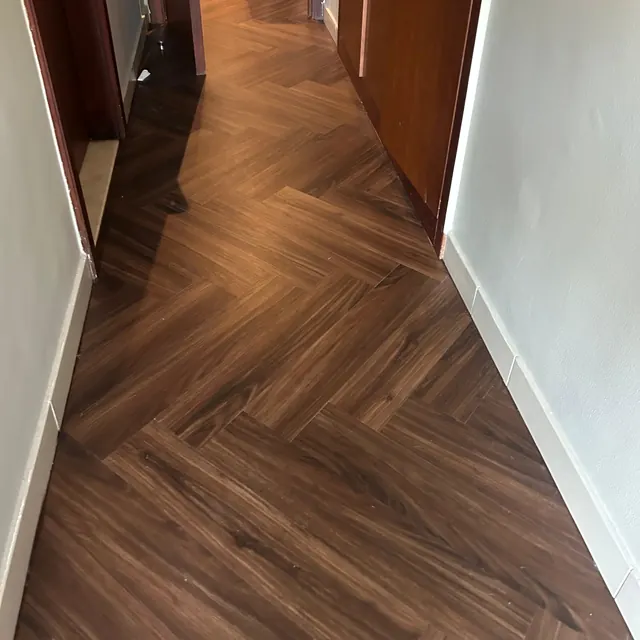
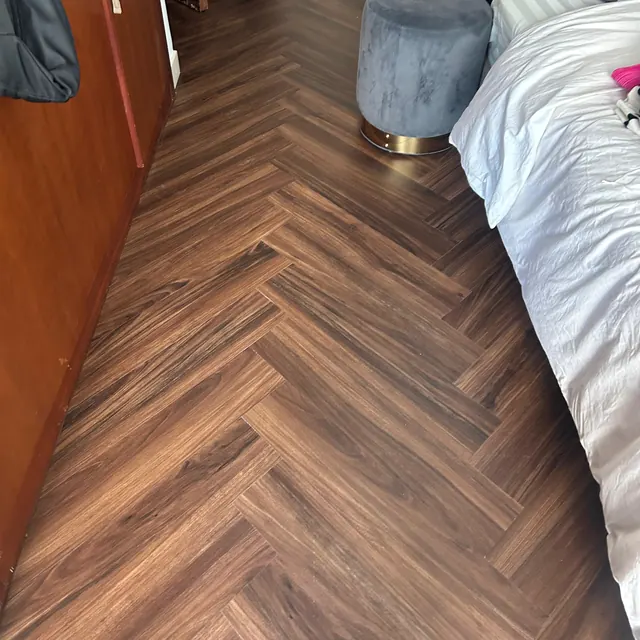
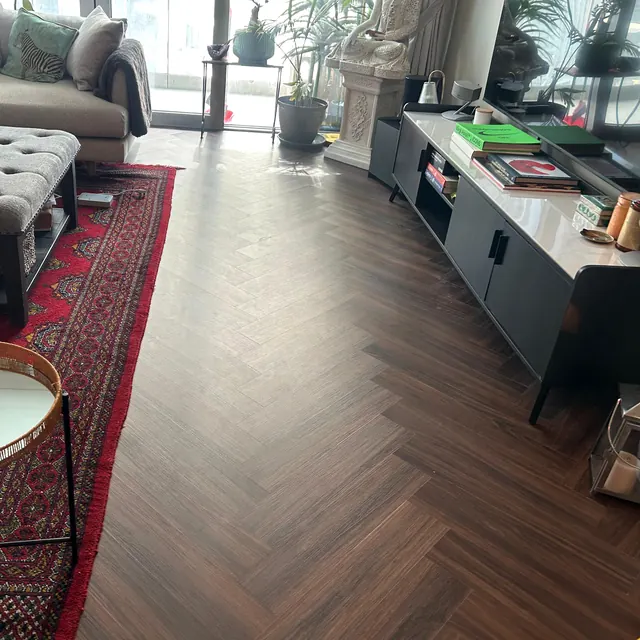
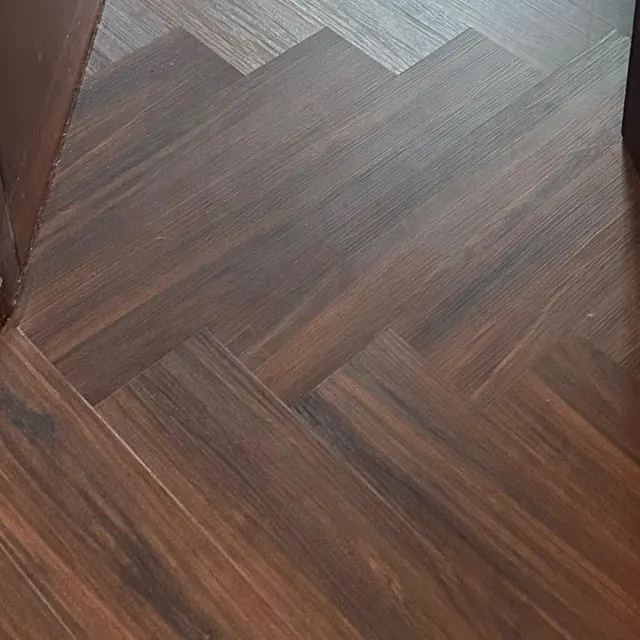
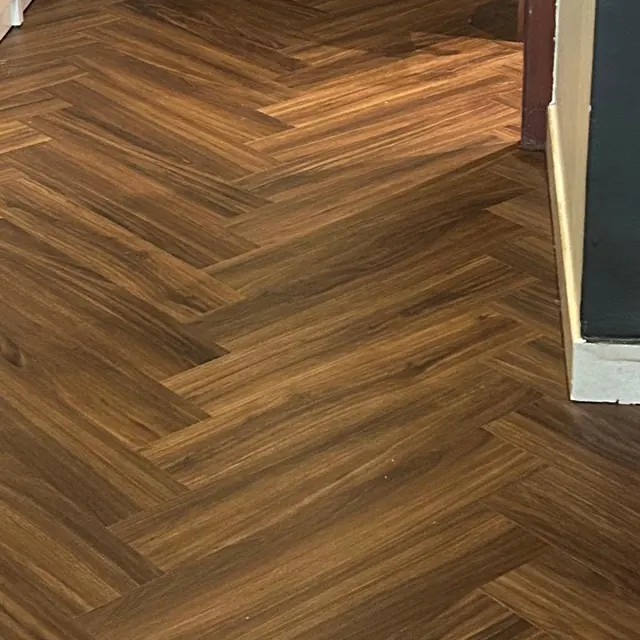
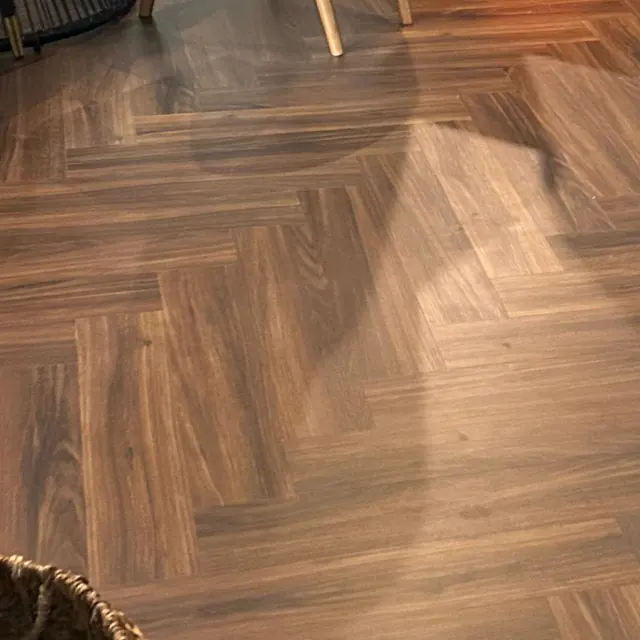
Urban Flooring supplied and fitted the LVT flooring. Joinery, doors, decoration and furniture shown were already in place or fitted by others.
Where Glue-Down LVT Suits a UAE Home
- Apartments where a pattern has to run continuously through several rooms and a corridor
- Rooms where a very low build-up matters, because a bonded tile adds almost nothing over the subfloor
- Spaces with heavy furniture or rolling loads, where a floating floor can shift over time
- Any layout with several door openings that should read as one floor rather than several
Glue-down is not automatically the right answer. A floating click floor is faster to fit, needs less preparation underneath it, and can be lifted and relaid if a tenancy changes. Bonded LVT earns its place where the pattern has to hold across a whole apartment, where the build-up has to stay low, or where the floor has to carry weight without shifting. On a straightforward single-room plank floor, the extra preparation buys very little.
Specification, tile formats and indicative prices are on our LVT flooring page, and the wider family is covered on vinyl flooring. For the same pattern in a rigid click product, see our Valia Tower herringbone SPC project.
Glue-Down LVT FAQs
What does glue-down mean in LVT flooring?
The tiles are bonded to the subfloor with adhesive rather than clicked to each other. There is no locking joint and no underlay, so the floor sits directly on the prepared surface. It is the standard method for LVT in patterns, and it gives a very low finished build-up.
Why does a bonded herringbone need a flatter subfloor?
Because nothing bridges. A rigid click plank spans a shallow dip using its own stiffness and its joints. A bonded tile has neither, so it settles into the dip and the finished floor carries it as a soft spot underfoot and a break in the light across the pattern.
How is a herringbone floor set out on site?
A centre line is struck across the room first and the pattern is built outward from it in both directions. Every tile is referenced back to that line rather than to the tile beside it, because on a bonded floor there is no joint mechanism holding the line for you.
Can a single glue-down tile be replaced if it is damaged?
Yes, and more easily than a plank in the middle of a click floor. The damaged tile is lifted, the adhesive residue cleaned back, and a new tile bonded into the gap. A floating floor usually has to be unclipped back from the nearest wall to reach the same point.
How soon can you walk on a newly bonded LVT floor?
It depends entirely on the adhesive, and the product data sheet governs it rather than a rule of thumb. Foot traffic is usually allowed well before furniture, and rolling loads later again. We set the programme around the adhesive the specification calls for.
Does a glue-down floor need an expansion gap at the walls?
Bonded floors do not move as a sheet the way a floating floor does, so they do not need the same perimeter gap. The detail at the wall is different rather than absent, and it is set out at the start alongside the skirting and any thresholds.
Does a bonded floor move or creak underfoot?
A correctly bonded floor has nowhere to move to, which is one of its advantages over a floating floor in a room with heavy furniture. Movement or a hollow sound almost always means a bonding failure under that area rather than a fault with the tile itself.
Why does herringbone take longer to fit than straight planks?
Because almost every tile is a decision rather than a repetition. The pattern runs at an angle to the room, so the perimeter is a continuous run of angled cuts, and the setting-out has to be held true across every room the pattern passes through.
Planning a Herringbone Floor in an Apartment?
Send us the room sizes and a photograph of the space and we will come back with a measured quote. Pattern work is priced on the setting-out and the cutting rather than the square metres alone, so a site visit gives you a far more accurate figure. Site visits and measurements are free anywhere in the UAE.
Or call +971 56 689 9831 · See more projects
Urban Flooring Maintenance and Decor Works 7 24A Street, Al Quoz Industrial First, Al Quoz, Dubai, UAEHours: Saturday to Thursday, 9:00 AM to 7:00 PM GST, Friday closed
Phone: +971 56 689 9831 · Email: info@urbanfloorings.com
Get directions