
SPC Herringbone Flooring in Dubai and Abu Dhabi
Specification and installation guidance on this page is overseen by Muhammad Gulbadin, our founder and operations manager, with 15+ years of hands-on flooring experience.
SPC herringbone flooring is rigid stone-composite vinyl plank supplied in mirror-image A and B planks that click together into the classic herringbone V. It gives the parquet look with a fully waterproof, dent-resistant core, so it suits rooms where real wood should not go. Urban Flooring supplies and fits SPC herringbone across Dubai, Abu Dhabi and the UAE, laid by our own in-house team.
- Established 2013
- 10,000+ Projects
- Fully Waterproof Core
- In-House Fitting Team
- Free Measurement
Or call +971 56 689 9831
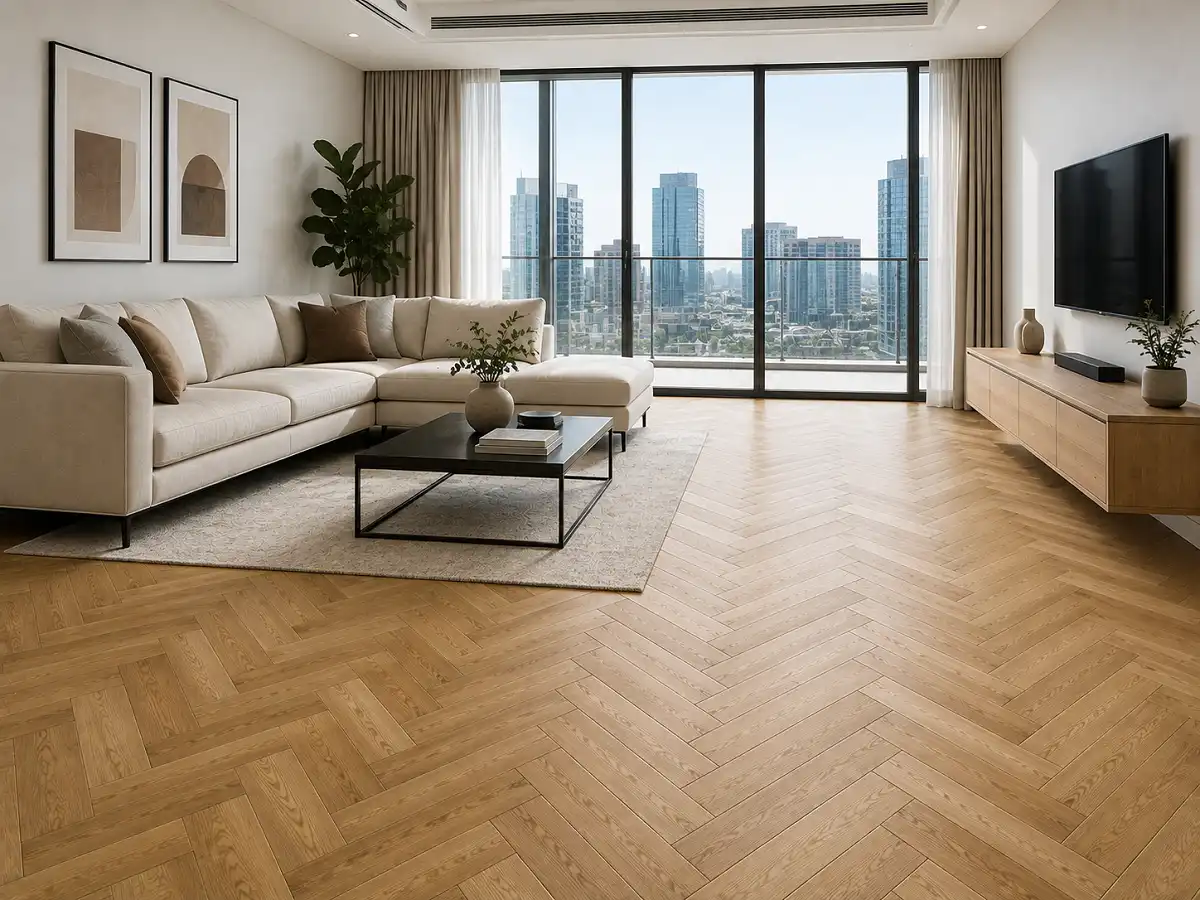
SPC Herringbone or Wood Parquet: Which Should You Choose?
Choose SPC herringbone if you want the herringbone look with a waterproof, low-maintenance floor at a lower cost; choose real wood parquet if you want genuine timber warmth underfoot and the option to refinish it over decades. Both are good floors; they suit different priorities and different rooms.
| SPC Herringbone | Wood Parquet | |
|---|---|---|
| Look and feel | Realistic wood look; firmer, cooler underfoot | Genuine timber; warmer, softer underfoot |
| Water resistance | Fully waterproof core | Not waterproof; damaged by standing water |
| Dent resistance | High, rigid stone-composite core | Softer; can dent and scratch |
| Refinishing | Cannot be sanded or refinished | Can be sanded and refinished repeatedly |
| Lifespan | Long, with a hard-wearing surface | Very long if maintained and refinished |
| Underfloor heating | Compatible with most systems | Compatible, with care on movement |
| UAE stability | Dimensionally stable in heat and humidity | Can move with humidity and AC cycling |
| Cost | Lower to buy and fit | Higher to buy and fit |
| Best rooms | Kitchens, bathrooms, whole home, wet areas | Dry living and bedroom areas |
To be fair to real wood: parquet is warmer underfoot, can be sanded back and refinished many times, and carries a resale appeal that a vinyl product does not. What SPC herringbone gives in return is a fully waterproof floor that stays dimensionally stable in UAE heat and humidity, costs less, and goes confidently into kitchens, bathrooms and laundries where a solid wood parquet floor should not. For many UAE fit-outs, that waterproofing and stability is the deciding factor.
How SPC Herringbone Is Made and Laid
SPC herringbone comes as two mirror-image planks, an A and a B, effectively a left-handed and a right-handed plank, which alternate to form the V of the pattern. Ordering and sequencing them correctly is what makes the pattern lock together and align.
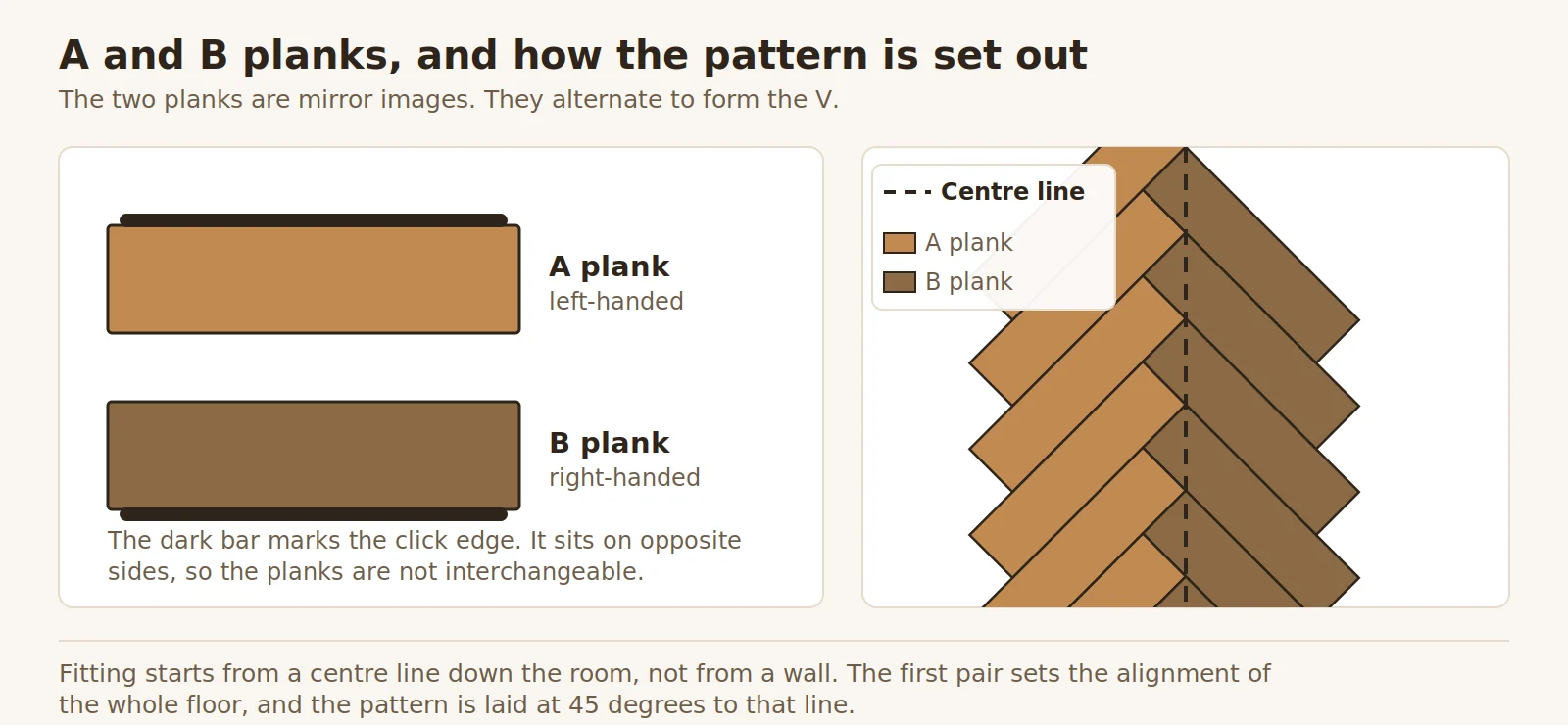
This has a practical consequence worth understanding. Because the planks are handed, you cannot cut a straight-plank SPC floor into a herringbone layout; the two plank types are manufactured for the pattern and must be ordered in matched quantities. Getting the A and B sequence wrong stops the joints engaging and throws the alignment out.
Fitting starts from a centre line down the room, not from a wall. The first pair of planks forms a V on that line and sets the alignment of the whole floor, so it is checked carefully before the rest is run out. The pattern is laid at 45 degrees to that centre line. This is precise work, which is why herringbone is a fitting-skill floor and an experienced in-house team makes a real difference to the finish.
Herringbone and Chevron: What Is the Difference?
The difference is in the cut. Herringbone planks are cut square and meet at 90 degrees in a staggered zigzag, so each plank sits against the side of the next. Chevron planks are cut at an angle at each end and meet point to point, forming a continuous V that runs in unbroken lines up the floor.
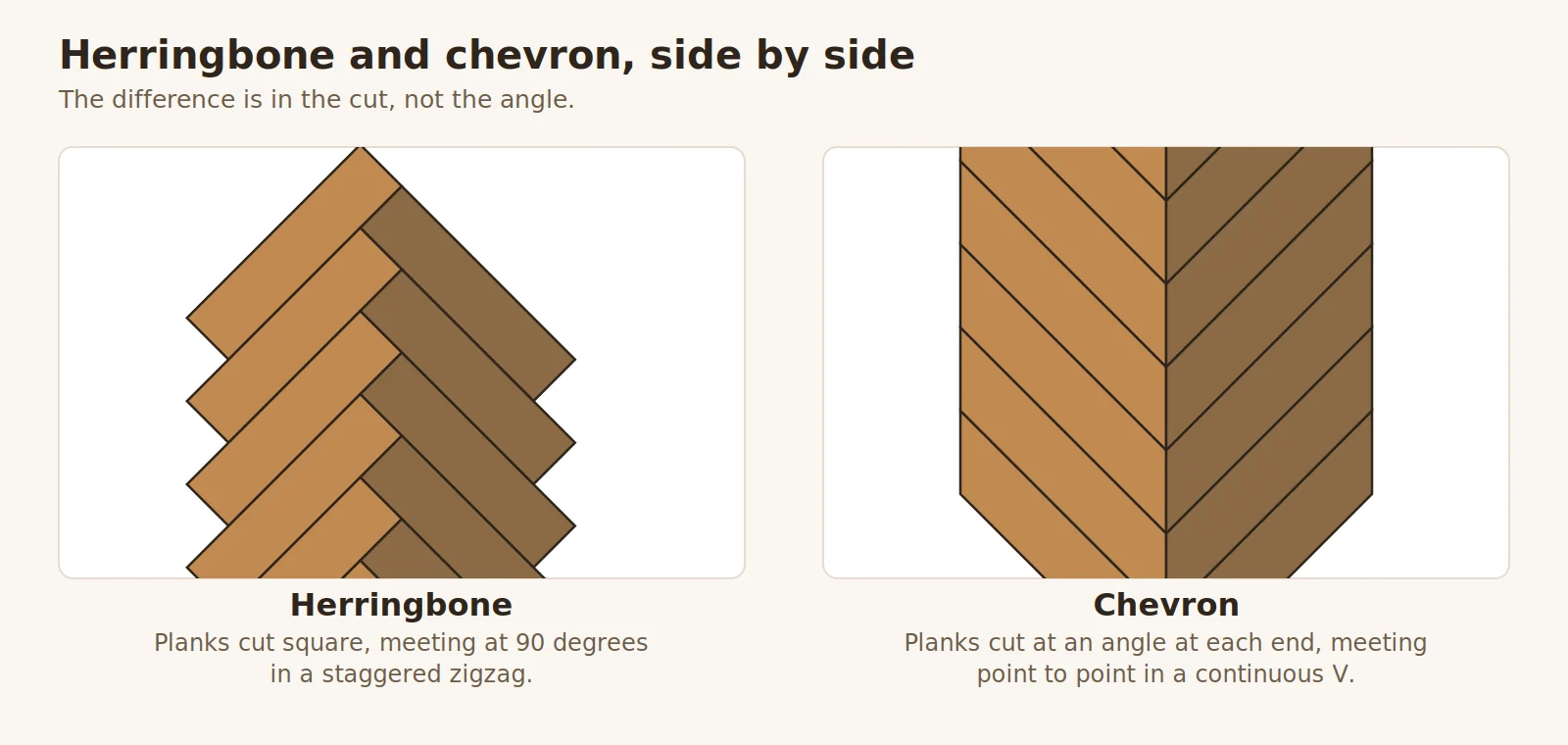
Both patterns are available in SPC. Chevron costs a little more because of the angled cutting involved, both in the plank and in the fitting. Which looks better is down to taste: herringbone reads as classic and busy, chevron as sleeker and more directional.
Sizes, Thickness and Wear Layer
SPC herringbone planks commonly run around 5.5mm to 6.5mm (about 1/4in) in total thickness, typically including an attached underlay. Herringbone planks are smaller than straight planks, because the pattern is built from many shorter pieces.
The number that actually governs durability is the wear layer, not the total thickness. At least 0.3mm (12 mil) is the widely quoted minimum for residential use, with more for commercial settings. Exact plank length and width vary by product, so rather than quote a standard that would not hold, we confirm the precise specification on the range we quote for you. It is the wear layer and the core quality, more than the dimensions, that decide how a herringbone floor lasts.
Installation, Subfloor and Waste
Herringbone asks more of the subfloor and the fitting than a straight-plank floor, and being straight about that up front is part of getting it right. The base must be flat to within 3mm over a 2m (about 6ft 7in) straight edge, the floor needs a 6mm (about 1/4in) expansion gap all round, and the pattern is set out from a centre line rather than a wall.
Subfloor flatness. The base must be clean, dry, flat and stable, level to within 3mm over a 2m (about 6ft 7in) straight edge. Flatness matters more on herringbone than on straight plank, because every plank meets three neighbours rather than two, so any dip shows.
Expansion gap. As a floating floor, it needs an expansion gap of around 6mm (about 1/4in) around the full perimeter, against every wall, fixed object and threshold.
Underlay. Click SPC usually ships with underlay already attached, and a second layer should not be added unless the specific product allows it.
Acclimatisation. The planks are left in the room to acclimatise before fitting.
Waste and labour. This is the honest one: herringbone produces more offcuts and takes longer to lay than straight plank, so there is more work in the fitting, even though our supply-and-fit pricing lands broadly in line with straight-plank SPC. We say so plainly, because a buyer who reads it here trusts the quote, while one who discovers it at quote stage feels misled.
Colours and Finishes
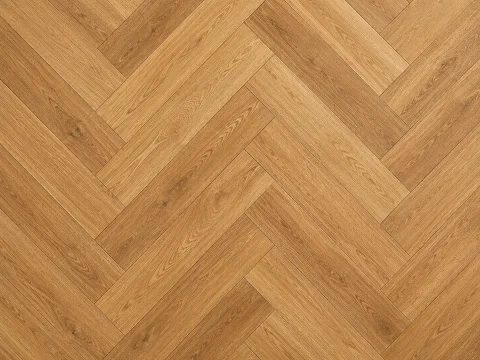
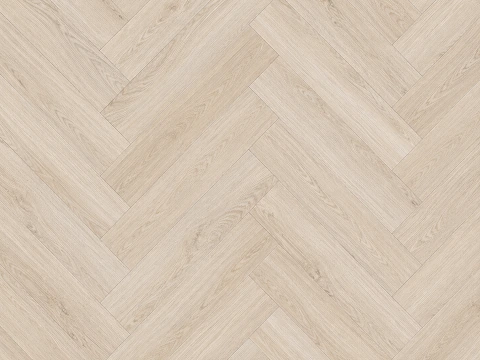
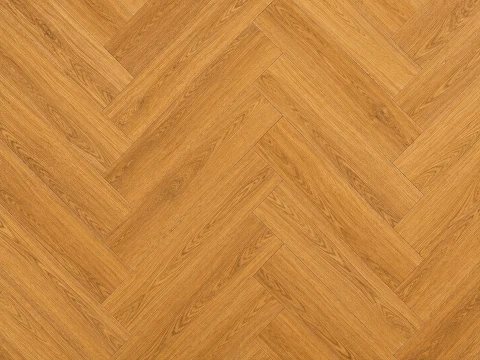
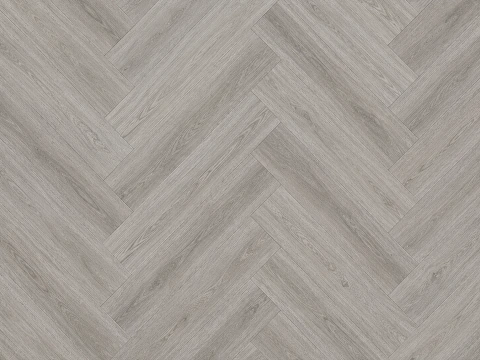
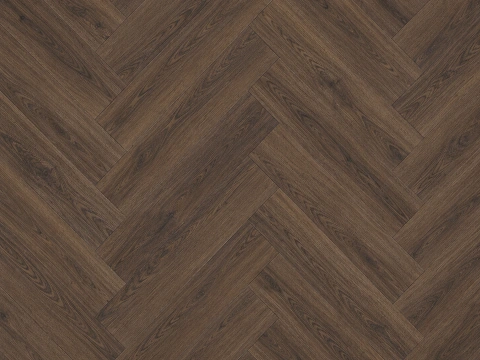
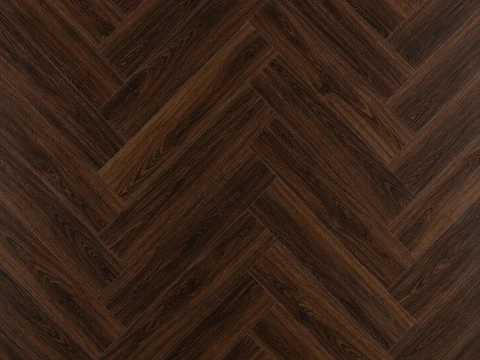
Oak tones lead the SPC herringbone range: natural, light, honey, grey, smoked and walnut. Matt and lightly textured finishes suit the pattern best, because the herringbone geometry is already doing the visual work, so a quieter finish reads as more considered than a high-gloss one. We bring samples so you can see the tone in your own light before deciding.
Where SPC Herringbone Works
SPC herringbone suits almost any room, and its waterproof core is what sets it apart from wood parquet. It works in living rooms, majlis, bedrooms and hallways for a premium designed look, and it goes confidently into kitchens, bathrooms and laundry areas where real wood should not, which is its biggest practical advantage in UAE homes.
In Dubai and Abu Dhabi fit-outs, it is in strong demand precisely because it delivers a high-end, designed floor on a fit-out budget, and because the rigid stone-composite core stays dimensionally stable through heat and air-conditioning cycling that would move a solid wood floor. It suits apartments, villas, and retail and hospitality interiors alike. For the full story on the SPC core and its waterproofing, see our SPC flooring page.
SPC Herringbone Flooring FAQs
What is SPC herringbone flooring?
SPC herringbone flooring is rigid stone-composite vinyl plank made in mirror-image A and B planks that click together into the classic herringbone V pattern. It gives a realistic parquet look with a fully waterproof, dent-resistant core, so it suits rooms where real wood cannot go. It is a floating click floor, fitted over a flat, prepared subfloor.
Is SPC herringbone flooring waterproof?
Yes. The stone-polymer composite core is fully waterproof, which is one of the main reasons buyers choose SPC herringbone over wood parquet. It can be fitted in kitchens, bathrooms, laundries and other wet areas where a solid wood floor would swell or be damaged. The waterproofing comes from the SPC core itself, not a surface coating.
What is the difference between herringbone and chevron?
Herringbone planks are cut square and meet at 90 degrees in a staggered zigzag, with each plank against the side of the next. Chevron planks are cut at an angle at each end and meet point to point in a continuous V. Both come in SPC; chevron costs a little more because of the angled cutting. The choice is down to taste.
What are A and B planks?
A and B planks are the two mirror-image plank types SPC herringbone is made from, a left-handed and a right-handed plank. They alternate to form the V of the pattern and are designed to lock together in sequence. Because they are handed, they must be ordered in matched quantities, and a straight-plank floor cannot be cut into herringbone.
Does herringbone flooring cost more to install than straight planks?
Not by much in practice. Herringbone takes longer to lay and produces more offcuts than straight plank, so there is more work in the fitting. Our supply-and-fit pricing for SPC herringbone still lands broadly in line with straight-plank SPC of the same thickness. It is precise, skilled work, set out from a centre line and laid at 45 degrees, and we show the pattern in the quote openly.
Is SPC herringbone better than wood parquet?
Neither is simply better; they suit different needs. SPC herringbone is waterproof, dimensionally stable in UAE heat, dent-resistant and cheaper, and it goes in wet areas. Real wood parquet is warmer underfoot, can be refinished repeatedly, and holds resale appeal. For a waterproof, low-maintenance floor on a fit-out budget, SPC wins; for genuine timber, parquet does.
Can SPC herringbone be used in a kitchen or bathroom?
Yes, and this is one of its main advantages. Because the SPC core is fully waterproof, herringbone SPC can be fitted in kitchens, bathrooms, laundries and other wet areas where real wood parquet should not go. It gives the premium herringbone look throughout the home, including the rooms where a solid wood floor would be at risk from water.
How much does SPC herringbone flooring cost in Dubai?
As an indicative guide, supply and fit for SPC herringbone runs from around AED 55/sqm to AED 150/sqm (about AED 5.1 to 14.0/sqft), broadly in line with straight-plank SPC in the same thickness, since herringbone is made in the 5.5mm to 6.5mm range rather than budget grades. Exact cost depends on the range, the area and the subfloor. Request a free measurement for a precise quote.
Get Your SPC Herringbone Quote
For the herringbone look in a waterproof floor that suits every room, including the kitchen and bathroom, we supply and fit SPC herringbone with our own in-house team, with a free measurement and a clear written quote before any work starts.
Or call +971 56 689 9831
Urban Flooring Maintenance and Decor Works 7 24A Street, Al Quoz Industrial First, Al Quoz, Dubai, UAESat to Thu 9:00 AM to 7:00 PM GST · Closed Friday
+971 56 689 9831 · info@urbanfloorings.com
Get Directions