
Stone Carpet Flooring in Dubai
Resin bound stone carpet flooring, laid textured and permeable over concrete or a prepared base, for courtyards, paths, terraces and decks across Dubai and Abu Dhabi.
- Textured, permeable finish
- Laid continuously, no joint lines
- Aggregate samples brought to site
- Free site visit
Or call +971 56 689 9831
What Stone Carpet Flooring Is
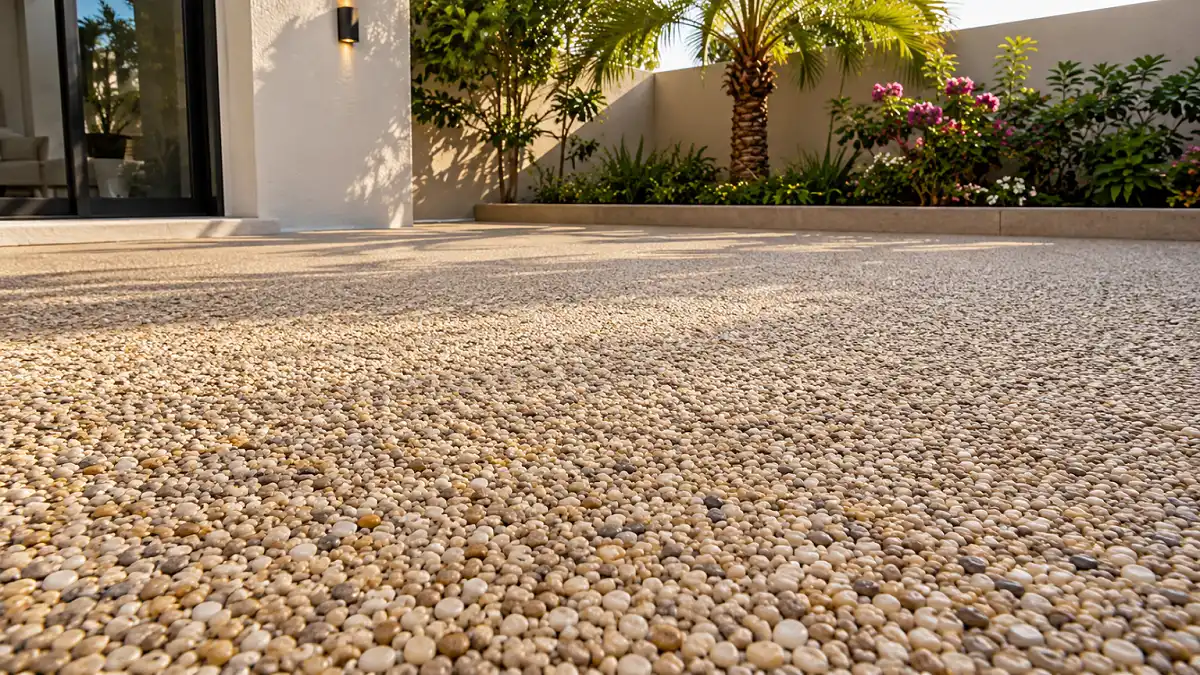
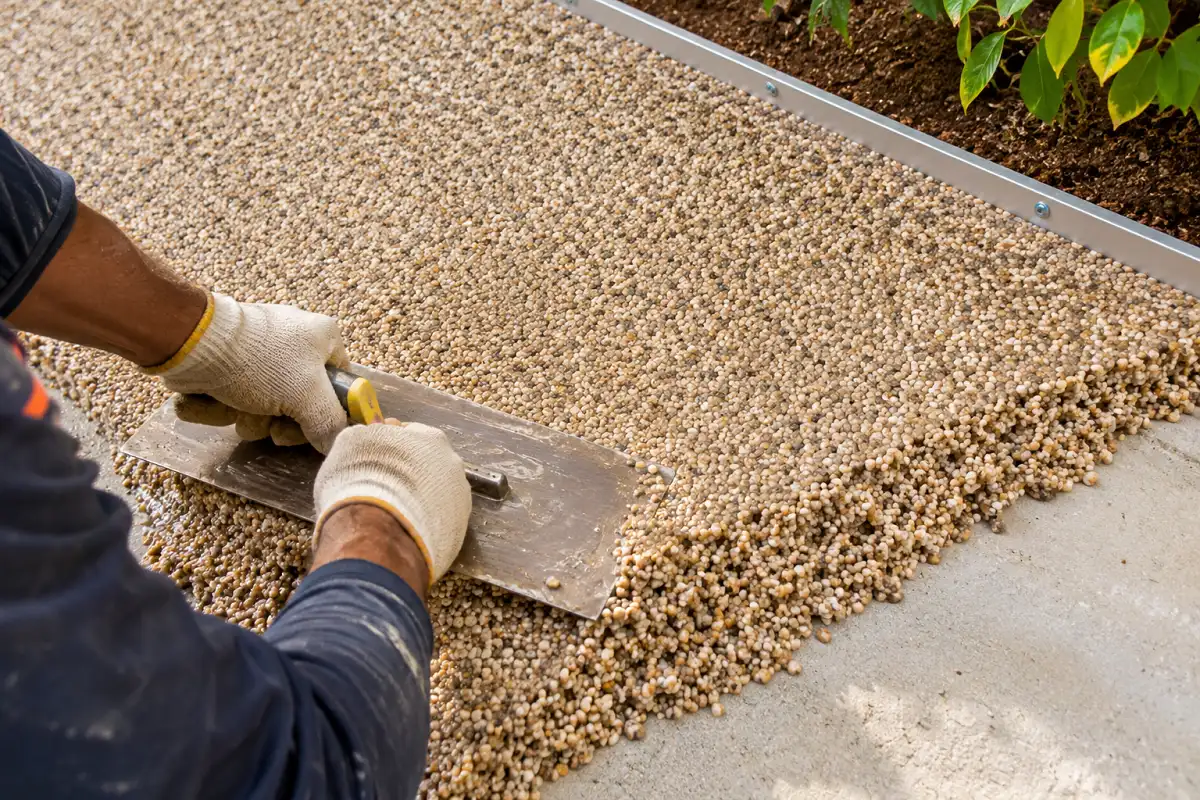
Stone carpet flooring is natural or engineered aggregate bound in clear resin and trowelled in place as a continuous surface. The stone is the wearing surface. The resin holds the stones to each other and to the base, leaving voids between them, so the finished floor is textured and water passes through it.
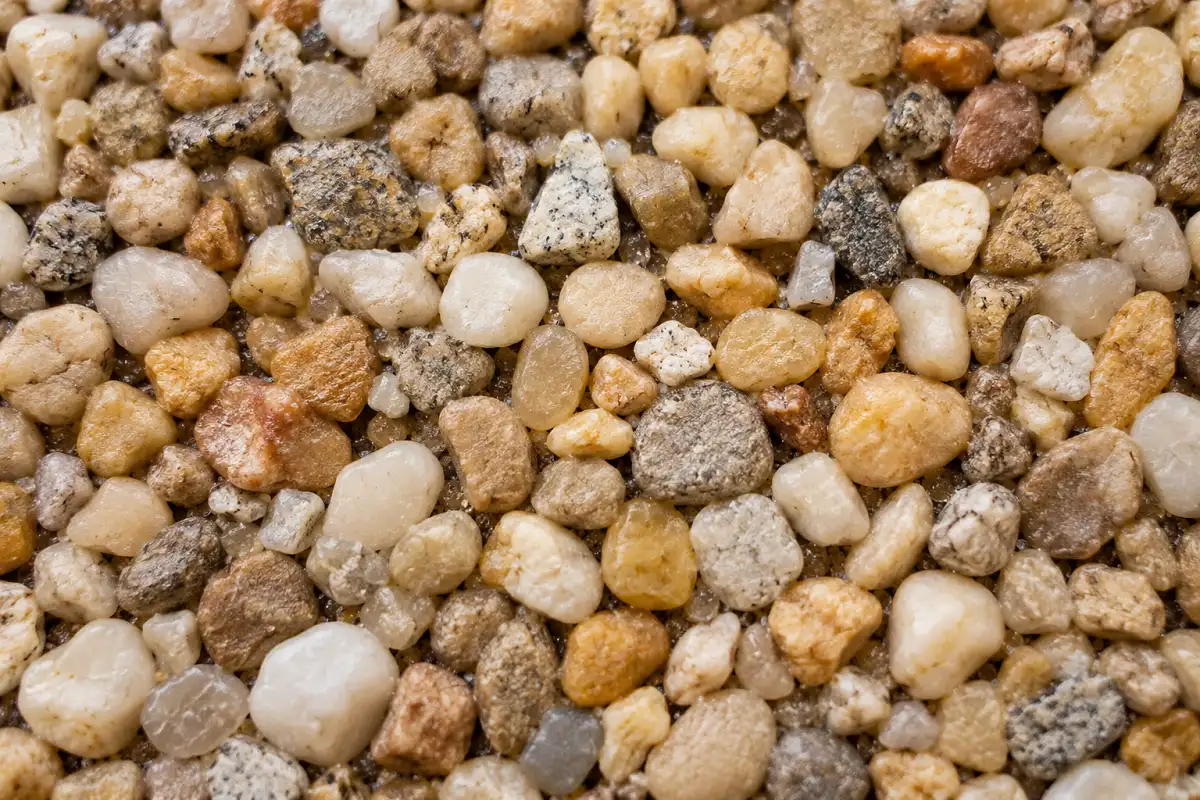
It is also called resin bound stone, and both names describe the same build-up. A dried aggregate of a chosen size and colour is mixed with a clear two-part resin in a forced-action mixer, then spread and trowelled to an even depth over a prepared base. The mix cures to a solid layer in which every stone is coated and locked, rather than loose underfoot.
The word carpet describes the laying method and not the material. There is no textile in it. The surface reads as stone because it is stone, with the resin visible only as the film holding the aggregate together.
Stone Carpet, Terrazzo and Epoxy Compared
All three put stone or resin on a floor, and they differ in which one ends up as the surface you walk on. That single distinction decides the finish, the drainage and the repair method.
| Stone carpet | Terrazzo | Epoxy and resin coatings | |
|---|---|---|---|
| What you walk on | The stone itself | Stone and binder, ground flat together | The resin |
| Finish | Left textured, stones proud | Ground and polished smooth | Smooth film, matt to gloss |
| Water | Drains through the surface | Sealed, non-permeable | Sealed, non-permeable |
| Typical use | Courtyards, paths, terraces, decks, lobbies | Interior floors and stairs | Workshops, garages, plant rooms |
| Repair | Cut out and re-lay the patch | Grind and re-polish | Re-coat the area |
Against poured and polished terrazzo, the ingredients overlap and the finishes are opposites. Terrazzo is poured, then ground and polished flat, and sealed. Stone carpet is laid and left as it falls, textured and open.
Against epoxy and resin coatings, the difference is which material is on top. In a coating the resin is the surface and any aggregate is held beneath it. In stone carpet the stone is the surface and the resin is only the binder.
Where Stone Carpet Works
Stone carpet suits outdoor and transitional areas where water has to leave the surface and a continuous finish is wanted. Courtyards, garden paths, terraces, rooftop and podium decks, building entrances and covered balconies are the usual places, and interior lobbies where the look is wanted indoors.
Two properties drive those uses. The surface drains, so standing water does not collect on it in the way it does on a sealed floor. And it is laid continuously, so it follows a curve, a step or an irregular edge without cutting and without joint lines across the area.
On a rooftop or podium deck it works where the existing waterproofing and drainage are sound and the deck can take the added build-up, which is a structural and waterproofing question answered before anything is specified. Other options for the same locations are set out in our guide to outdoor flooring.
Where It Falls Short
Stone carpet is the wrong choice in three places, and the reason is the same in each: the open texture that makes it drain also makes it hold what lands on it.
Bathrooms and wet rooms
A bathroom floor needs to be cleaned to a hygienic standard and dried quickly, and an open-textured surface holds soap residue and body oils in the voids between stones. It is also laid against a waterproofing layer that has to be continuous, which is harder to achieve around a floor that drains by design.
Kitchens and food areas
Grease is the problem. Oils work into the voids, cannot be mopped out of them, and build up over time. A smooth sealed floor is the right specification wherever food is prepared, commercially or at home.
Walls and vertical surfaces
The material is trowelled flat and relies on gravity while it cures. It is a floor finish and it is not laid vertically.
Stairs are a case-by-case decision rather than a yes or a no. A trowelled aggregate surface has no natural edge at a step, so each nosing has to be formed with its own detail or profile rather than laid up to the edge and left. Where that detail can be designed and fixed properly a flight is workable, and where it cannot, the floor is better stopped at the top or the bottom of it.
Two further limits are worth stating. The surface gets hot in direct summer sun, as any dark dense material does, so shade or a lighter aggregate matters where people walk barefoot. And the voids that pass water also admit fine sand, so in a dusty location it needs washing rather than only sweeping.
Thickness, Aggregate and Build-Up
Laid depth is set by the system manufacturer, against the traffic the floor will take and the size of the aggregate in the mix. It is not a single number that applies to every job, and it is specified per project rather than chosen from a catalogue.
Resin system manufacturers publish minimum laid depths for their own systems. Those minimums sit at around 15 mm where the floor takes foot traffic only, and around 18 mm where vehicles run over it. A manufacturer's stated minimum is a minimum rather than a target, and it cannot be averaged across an area, so a floor laid thin in places does not meet it even if the total volume is right.
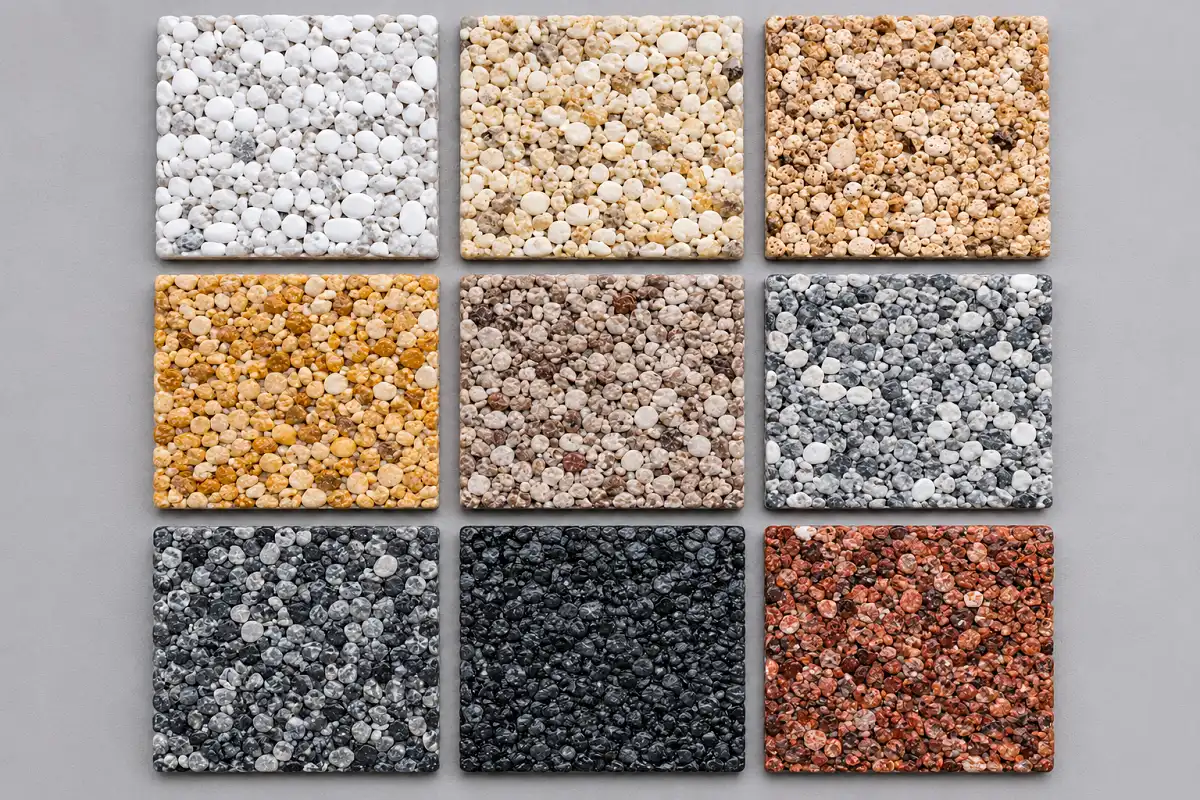
Aggregate size drives the rest. A larger stone needs a deeper layer to lock properly, so depth and aggregate are chosen together. The aggregate also sets the colour and texture of the finished floor, since the stone is what shows.
Beneath it, the base does the structural work. A sound concrete slab or a prepared permeable base carries the load, and the stone carpet layer sits on top as a wearing surface rather than a structural one.
The aggregate and colour range for this product is being confirmed. Send us the area and the look you want and we will bring samples to site.
Drainage and Why the Base Matters
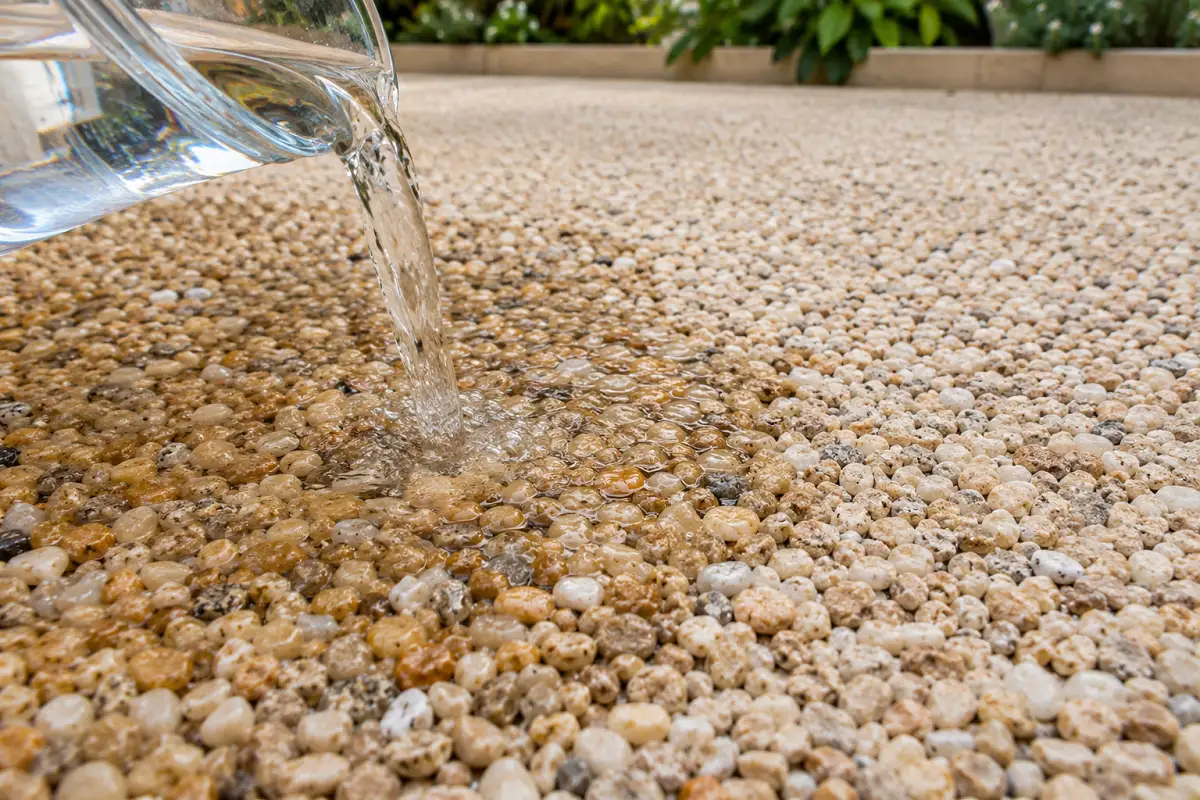
A permeable surface is only useful over a base that takes the water away. Stone carpet passes water through the voids between the stones, and that water then has to go somewhere. Over a base that does not drain, it sits between the two layers instead, and the surface stops behaving as a draining floor.
Two build-ups follow from that. Where the base is a permeable construction, water passes through the stone carpet, through the base and away into the ground or a drainage layer, which is the arrangement the product is designed around. Where the base is an existing sealed slab, the water passes through the surface and then has to be taken to a drain by falls built into the slab beneath.
Either works. What does not work is laying a draining surface over a flat sealed slab with nowhere for the water to go, which is the most common way this product is specified badly. The substrate, the falls and the existing drainage are checked at the site visit before we quote.
Cracking is a base problem rather than a surface one. A resin bound layer is rigid and bonded to what it sits on, so it moves with the base rather than independently of it, which means a crack in the floor started in the slab underneath. Where the slab has movement joints, those joints are carried up through the surface rather than bridged, because a joint that is covered over reappears as a crack along the same line.
Colour, Sun and Yellowing
Resin chemistry decides whether a clear binder holds its colour outdoors, and there are two families. Aliphatic resins are formulated for ultraviolet exposure and hold colour far better. Aromatic resins are strong but amber under sunlight, and a system manufacturer's own installer guidance records that darkening can begin within weeks of exposure.
The stone does not change. What changes is the film holding it, and as that film ambers it shifts the apparent colour of the whole floor, most visibly on pale aggregates where there is nothing to hide it.
That makes the resin specification the question rather than the aggregate choice. It is also not something a buyer can see in a sample, since a fresh sample of either resin family looks clear.
What to ask any supplier, including us. Ask which resin family the system uses, aliphatic or aromatic. Ask for the system manufacturer's own data on ultraviolet performance rather than a verbal assurance. Ask what the installer has seen on a floor of theirs that has been down through a few Gulf summers. A supplier who answers those three plainly is giving you something you can check.
What Stone Carpet Costs in Dubai
Stone carpet is quoted per square metre, supplied and installed, and the rate moves with the aggregate chosen, the laid depth the traffic requires and the condition of the base underneath. Preparing or forming a base, where one is needed, is quoted separately from the surface itself. We give the rate for your job after a site visit rather than publishing a band that would not survive contact with the base condition.
Two things move a quotation more than the aggregate does. A base that needs forming or repairing is a separate item of work and can exceed the surface cost on a difficult site. And a small area carries a higher rate per square metre than a large one, because mixing and setting up are much the same either way. How flooring is priced across materials is set out in our flooring cost guide.
Installation and What Happens On Site
Installation runs in four stages: assess the base, prepare it, lay the mix, then leave it to cure undisturbed. Stone carpet is mixed on site in batches and trowelled by hand, so the working area and the weather on the day both shape the programme.
The base is assessed first, for soundness, for falls and for drainage. Where it is an existing slab it is cleaned and primed and any repair is done before the surface goes down. Edges are the next decision: a trowelled surface needs something to stop against, so an edge restraint, a channel or a profile is set out before laying begins rather than after.
Laying is continuous within a bay. A batch is mixed, spread and trowelled, and the next joins it wet so there is no visible joint, which is why an area is set out and finished in one pass.
Then it cures. The floor is kept off and kept dry through the cure window, and the system manufacturer sets how long that is for the resin in use and the temperature on site. In Gulf summer conditions the mix handles differently from the same product in a temperate climate, which is a reason to lay in the cooler part of the day.
Cleaning and Upkeep
Stone carpet is swept and washed, and the point of washing it is to keep the voids open. Dust and fine sand settle into the gaps between the stones, and once those gaps are full the surface stops draining and starts holding water on top instead.
A brush and a hose does most of it, and in a dusty location the washing is the part that cannot be skipped.
Stone carpet is not sealed the way polished stone is, because the resin binding the aggregate is already the protective element rather than a film applied over the top of it. Where a particular system calls for a sealer or a refresher coat, that comes from the manufacturer's data sheet for that resin, so ask for the sheet rather than assuming it either way.
What ends the life of this floor is the binder rather than the stone. Aggregate does not wear out, so the working life is governed by how the resin holds up to ultraviolet exposure and traffic, which is why the choice between aliphatic and aromatic resin matters more than the choice of stone. Any expected life quoted for a system is the manufacturer's figure for that resin and should be read as theirs rather than as ours.
Where a section is damaged, it is cut out and re-laid rather than patched over, and a repair blends best when material from the original batch has been kept. Ask for the aggregate reference and keep a bag of the mix after installation.
Stone Carpet Flooring FAQs
Can stone carpet be laid over my existing concrete or tiles?
Over sound concrete, yes, once it has been cleaned, primed and repaired where needed. Over tiles it depends on whether the tiles are firmly bonded and whether the added height works at thresholds and doors. Either way the base has to deal with the water that passes through the surface, which is checked at the site visit before we quote.
Will it yellow in the sun here?
That depends on the resin, not the stone. Aliphatic resins are made for ultraviolet exposure and hold colour well. Aromatic resins amber under sunlight, and one manufacturer's installer guidance records darkening beginning within weeks. Ask any supplier which family their system uses and ask for the manufacturer's own ultraviolet data rather than an assurance.
Is it suitable for a driveway?
Where the base is built for vehicles, yes. The surface is laid deeper for vehicle traffic than for footpaths, and system manufacturers set a higher minimum depth for it. What decides the answer is the base rather than the surface: a slab or sub-base designed for foot traffic will not carry a car whatever is laid on top of it.
Can it go inside the house?
Yes, and lobbies and entrance areas are where it reads best indoors. The same open texture applies, so it holds fine dust and needs washing rather than only sweeping. We would not specify it in a bathroom or a kitchen, for the reasons set out in the section on where it falls short.
How long before we can walk on it?
The cure window is set by the resin system and the temperature on site, so the installer gives you the figure for your job at the point of quoting. The floor is kept off and kept dry for the whole of it. Laying in the cooler part of the day is normal practice here, because the mix handles differently in summer heat.
What happens if a section gets damaged?
The damaged area is cut out and re-laid rather than coated over. Because the surface is continuous and mixed on site, a repair matches best when material from the original batch has been kept, so keep a bag of the mix and the aggregate reference after installation. A repair in the middle of an open area is harder to hide than one at an edge.
How is it cleaned, and how frequently?
Sweep it and wash it. Sweeping clears what sits on top and washing clears what has worked down into the voids between the stones, which is what keeps the surface draining. Frequency depends on how much dust the location gets rather than on the floor, and a courtyard near open ground needs it more than a sheltered lobby does.
How does the cost compare with terrazzo?
They are priced differently because the work is different. Terrazzo is poured then ground and polished, which is labour on site after the pour. Stone carpet is mixed and trowelled in one pass with no grinding. Both are quoted per square metre, supplied and installed, and the base condition moves either quotation more than the material does.
Get a Free Site Visit for Stone Carpet Flooring
Send us the area, the location and a photograph of the existing surface, and we will come and look at the base before quoting anything. Message us on WhatsApp or book a free site visit, and we will bring aggregate samples so you can see the texture and the colour in daylight on your own floor.
Urban Flooring has supplied and fitted flooring across the UAE since 2013, and stone carpet is a new addition to that range.
Or call +971 56 689 9831
Urban Flooring Maintenance and Decor Works 7 24A Street, Al Quoz Industrial First, Al Quoz, Dubai, UAESat to Thu 9:00 AM to 7:00 PM GST · Closed Friday
+971 56 689 9831 · info@urbanfloorings.com
Get Directions