
Reviewed for accuracy by Muhammad Gulbadin, founder and operations manager at Urban Flooring, 15+ years in UAE flooring.
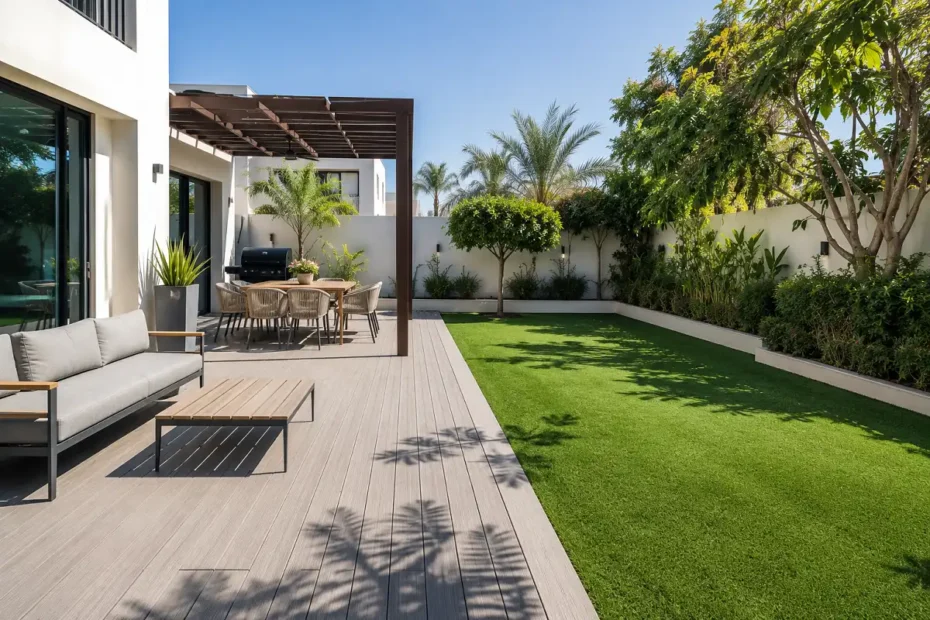
The best outdoor flooring for a UAE garden is zoned by use and chosen for the climate: composite (WPC) decking for seating, dining and pool terraces, and artificial grass for lawns and play areas. Both survive extreme heat, UV and rain far better than the alternatives, though nothing stays genuinely cool underfoot in peak summer. Match each zone to how it is used, and manage heat with shade and lighter tones.
What the UAE climate does to an outdoor floor
Here is the reframe that decides every outdoor flooring choice in this country: the climate rules the decision, not the look. A UAE outdoor floor has to survive sustained extreme heat, punishing UV that fades and degrades most materials over time, occasional heavy rain and constant irrigation water that has to drain away, and it has to stay walkable, often barefoot, around pools and terraces.
Building a floor outdoors in this heat means battling three things at once: the sun, which fades, dries and cracks materials; surface heat, which can make a floor too hot to walk on; and water, which warps and rots anything that absorbs it. Those conditions rule out a lot of popular materials and reward a few that are built for them. So the honest starting point is not “what looks nice” but “what survives a UAE summer, drains a downpour, and is still walkable”, and the rest of this guide follows from that.
Zoning a garden: why one outdoor space needs several floors
Here is what separates a garden from a balcony, and it is the key to getting an outdoor floor right: a villa garden is not one space, it is several, and the smart approach is to zone it rather than cover it in a single surface.
A typical garden has a dining and seating terrace, a lawn and play area, a pool surround, pathways, and sometimes an outdoor majlis, and each of those wants a different floor. Composite decking suits the seating and dining terrace and the pool deck, where you want a warm, handsome, walkable surface. Artificial grass suits the lawn and play zones, where you want green underfoot without the water and upkeep. A slip-safe surface belongs around the pool. One garden, in other words, is genuinely several floors, chosen zone by zone. This garden-scale zoning is the difference between an outdoor space that works and one that fights the climate, and it is where planning pays off most.
Outdoor flooring rated on heat, UV, drainage and upkeep
The table rates the realistic outdoor options on what actually matters in a UAE garden, heat underfoot, UV resistance, drainage and upkeep. Natural timber and porcelain pavers appear as honest context; Urban fits composite decking and artificial grass, not timber decking, pavers or stone.
| Floor | Heat / barefoot | UV resistance | Drainage | Upkeep | Best outdoor use |
|---|---|---|---|---|---|
| Composite (WPC) decking | Warm in sun (lighter cooler; runs hotter than wood) | High (UV-stable, capped) | Good (ventilated subframe) | Low (no oiling) | Terraces, dining, pool decks |
| Artificial grass | Warm in direct sun (warmer than natural) | High (UV-stable) | Good (permeable backing) | Low (rinse, brush) | Lawns, play, green zones |
| EPDM / rubber (play) | Warm in sun | High | Good (porous) | Low | Play areas with equipment |
| Natural timber decking (context, high-upkeep) | Warm (cooler than composite in sun) | Fades, needs oiling | Good | High (oil, sand, rot risk) | Beautiful but short-lived here |
| Porcelain pavers / stone (context, we do not fit) | Very hot in sun | High | Depends on laying | Low-moderate | Popular, but not our trade |
Composite (WPC) decking: the practical deck for UAE terraces
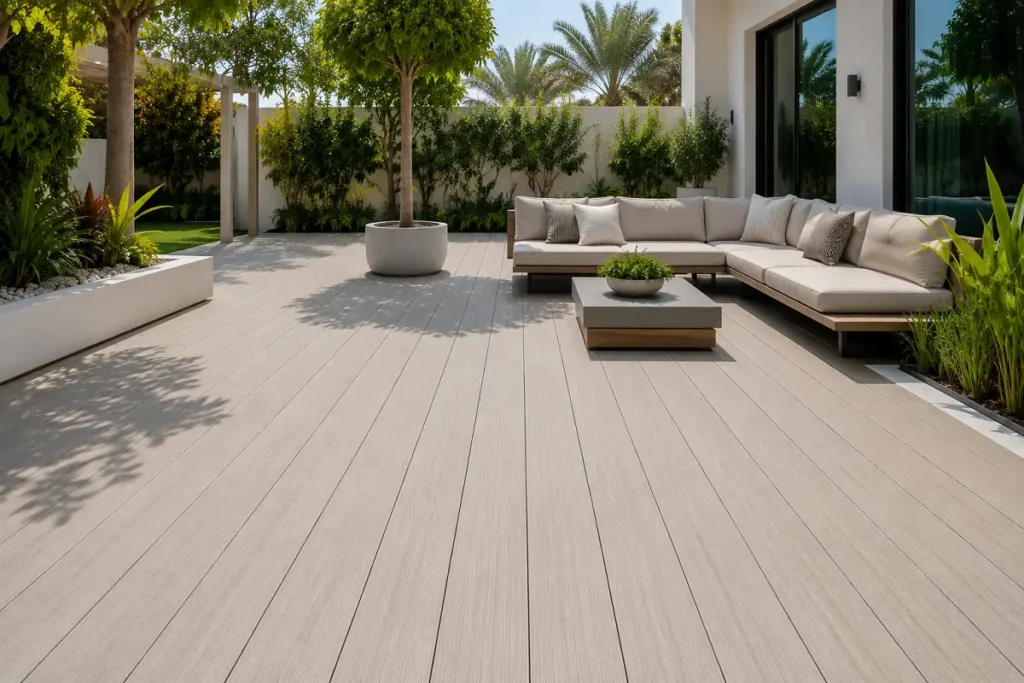
For a seating terrace, a dining area or a pool deck, composite decking is the honest lead, and the reason is longevity in this specific climate. Composite (WPC) decking gives the warm, handsome wood look people want outdoors, but unlike natural timber it is built to survive the UAE: it resists UV fade, it does not splinter, warp or rot, and it needs no annual oiling or sanding.
A quality capped or co-extruded board, which carries a tough protective outer layer, lasts around 20 to 30 years even around a pool, where an uncapped board might manage only 5 to 8. That durability is the whole case for composite here.
One honest correction is worth making, because it is widely misunderstood: composite does not stay cooler than wood. If anything it runs a little hotter in direct sun, because the polymer in the board retains more heat than the insulating fibres of natural timber. So composite’s advantage is longevity, UV-stability and near-zero maintenance, not coolness. Heat is managed, not avoided, by choosing a lighter colour and a capped board with reflective pigments, which run noticeably cooler than a dark board. Natural hardwood can look beautiful, but in UAE heat, sun and humidity it is high-maintenance and short-lived, which is why composite is the practical recommendation for a deck that lasts.
Artificial grass for lawns, play areas and green zones
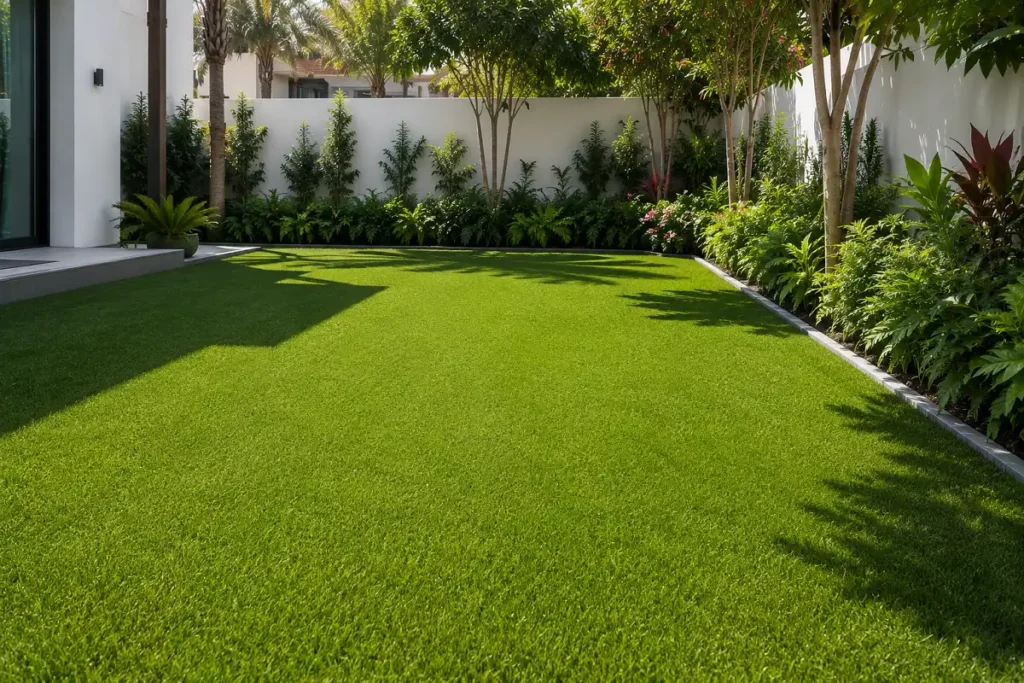
For the lawn and play zones of a garden, artificial grass is the honest lead in this climate, because a natural lawn is a genuine struggle here. A real lawn in the UAE needs enormous, constant irrigation and still fights pests, compacts to bare mud in high-traffic areas, and develops dead patches, while artificial grass stays green all year with no watering or mowing, tolerates heat, and takes heavy play without wearing to dirt.
It is popular for good reason: roughly 70 to 75% of Dubai villa gardens choose artificial grass over natural. For a villa lawn, a pile height around 30 to 35mm is the practical sweet spot (much lower looks thin), and a UV-stabilised polyethylene fibre performs best in the heat. The honest caveat, and it is the same heat truth as everywhere outdoors: artificial grass lacks natural grass’s evaporative cooling, so it runs warmer in direct sun. Cooling infills, a lighter fibre colour, and some shade all bring the surface temperature down. For a green lawn that survives the climate and the water bill, it is the sensible choice.
Pool surrounds: getting slip safety and barefoot heat right
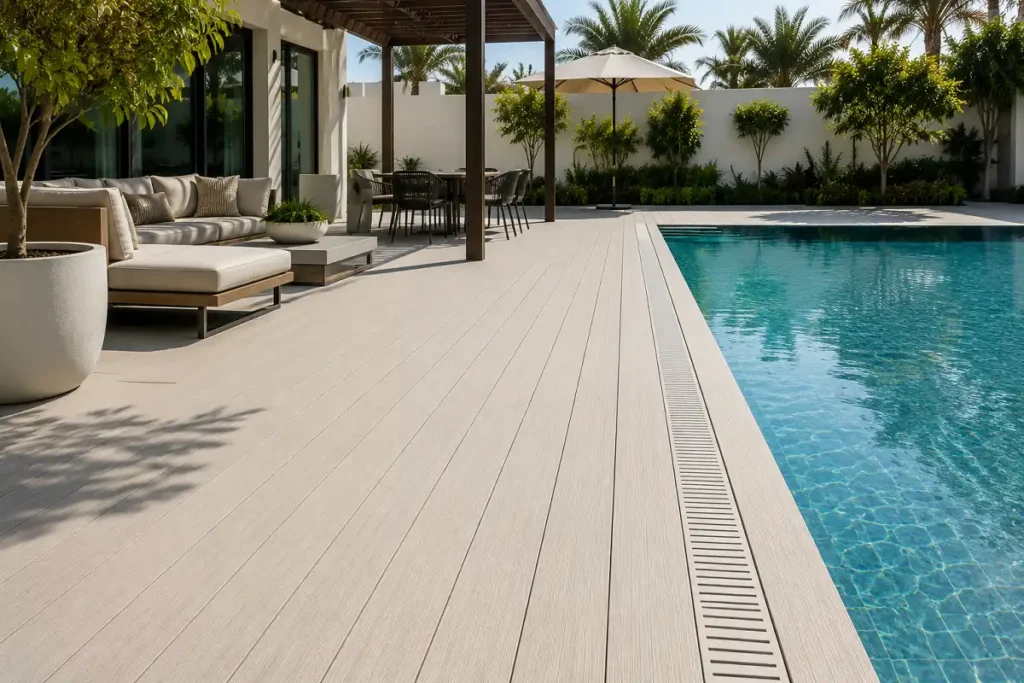
A pool surround has two demands no other garden zone shares as sharply, and both have to be met: it must be slip-safe when wet, and bearable to walk on barefoot. People walk around a pool with wet feet, so slip resistance is non-negotiable there, which is why a lighter, textured, anti-slip composite deck is the sensible pool-surround surface.
A good capped composite retains traction when wet, and its drainage channels and hollow structure shed water to keep the surface safer and longer-lived. The heat side matters just as much, because bare feet meet this floor straight out of the water, so a light or medium tone rather than a dark board keeps it walkable, and a shaded layout with a pergola or sail helps considerably. Specify light, textured, slip-resistant and drained for a pool deck, and it stays both safe and comfortable.
Garden play areas: safe surfaces for children outdoors
Where a garden includes play equipment for children, the surface underneath becomes a safety specification, not a style choice. A climbing frame or swing needs an impact-absorbing surface beneath it, and EPDM or rubber safety surfacing is the standard: it cushions falls, drains rain through its porous structure, and stands up to sun and heavy use.
The important detail is that the surface must be rated to the height of the equipment, the Critical Fall Height, so a taller frame needs a thicker, higher-rated surface. Our guide to the best flooring for schools and nurseries covers Critical Fall Height and playground safety surfacing in full. For a home garden play zone, match the impact surface to the equipment, and let the artificial grass handle the general play lawn around it.
Heat underfoot outdoors: the honest UAE truth
This is the honesty that builds trust, so it is worth stating without hedging: in peak UAE summer, nothing outdoors stays genuinely cool underfoot. Any outdoor floor in direct July sun gets hot, and the honest job is to manage it, not to pretend otherwise. The numbers are worth knowing.
A light grey or sandstone composite board sits around 45 to 55°C at a 35°C ambient temperature, warm but tolerable underfoot; a dark composite board, by contrast, can reach 65 to 80°C in full sun and can scald bare feet in under ten seconds. Artificial grass runs tens of degrees hotter than a natural lawn in direct sun, because it has no evaporative cooling. What genuinely helps: choosing lighter colours, specifying capped boards with reflective pigments, using cooling infills under artificial grass, and adding shade with sails, pergolas or trees, along with simply placing the barefoot zones where they catch afternoon shade. All of that reduces the heat noticeably, but none of it makes an outdoor floor cool barefoot at midday in July, and any supplier who promises that is not being straight with you.
Drainage and the occasional heavy UAE downpour
It is easy to forget in a desert climate, but drainage matters outdoors here, because when rain does come it often arrives as a heavy downpour, and irrigation water runs constantly. An outdoor floor has to shed that water rather than pool it.
Composite decking has a real advantage here: laid on a battened subframe, it drains and ventilates beneath the boards, which sheds water, and the airflow underneath also helps keep it cooler and longer-lived than a solid surface sitting flat on the ground. Artificial grass uses a permeable backing over a prepared free-draining base, so rain and rinse water pass straight through rather than sitting on top. Around a pool, drainage channels carry splash and rain away from the walking surface. Plan the drainage into the garden from the start, with the right subframe and base, and the floor handles both the daily irrigation and the occasional storm without pooling or damage.
What about pavers, stone and tile in a UAE garden?
It is worth being straight about the popular hard surfaces, because they are a genuine option, just not ours. Outdoor porcelain pavers and natural stone are common and durable UAE garden surfaces, and they are a valid choice for pathways, terraces and pool surrounds where someone wants that look, though they can get very hot in direct sun like everything else outdoors.
The honest point is simply this: Urban fits composite decking and artificial grass, not pavers, stone or tile, so if a paved or stone garden is what you are after, that is a different trade. For a warm deck that lasts and a green lawn that survives the climate, composite decking and artificial grass are what we do, and they cover the seating, dining, pool and lawn zones of most gardens well.
What outdoor and garden flooring costs in the UAE
Outdoor flooring prices vary widely by material and by the zone it covers, so budgeting by zone is the sensible approach. Composite decking is the premium surface at about AED 120 to 400+ per sqm supplied and fitted, while artificial grass covers a lawn from about AED 45 per sqm. The full bands:
Supplied and fitted, the indicative bands run: composite (WPC) decking about AED 120 to 400+/sqm (about AED 11.1 to 37.2+/sqft), artificial grass about AED 45 to 160/sqm (about AED 4.2 to 14.9/sqft), EPDM play surfacing about AED 90 to 250/sqm (about AED 8.4 to 23.2/sqft), and rubber about AED 50 to 250/sqm (about AED 4.6 to 23.2/sqft). The honest takeaway: composite decking is the premium outdoor surface, but it earns it in UAE longevity, outlasting and out-surviving natural timber that would need constant upkeep and replacement; artificial grass is far cheaper per square metre and greens a lawn for much less. This is exactly why zoning pays: put the premium deck where you sit and dine, and run the cheaper grass across the lawn, spending where it counts. All figures exclude 5% VAT, and outdoor projects are quoted per garden after a site visit. For the full breakdown across every floor type, see our flooring cost guide.
Which floor suits which outdoor zone?
The right outdoor floor follows the zone and how it is used, not a single choice for the whole garden. Decking goes where you sit, dine and walk barefoot from the pool. Grass goes where the lawn and general play are. Impact surfacing goes under equipment. Four cases cover most villa gardens.
- Seating and dining terrace, and pool deck: composite (WPC) decking, in a lighter, textured, slip-safe board.
- Lawn and general play areas: artificial grass, around a 30 to 35mm pile.
- Children’s play with equipment: EPDM or rubber impact surfacing rated to the equipment height.
- Pavers or natural stone: a valid look, but not our trade, we fit decking and grass.
For an apartment balcony or terrace rather than a garden, our guide to the best balcony flooring covers that smaller, membrane-first case. And if you are planning floors across the whole property, start with our guide on how to choose flooring.
Outdoor and garden flooring: frequently asked questions
Is composite decking better than wood for a UAE garden?
For the climate, yes. Composite (WPC) decking resists UV fade, does not splinter, warp, rot or need annual oiling, and quality capped boards last decades where natural timber would not. Timber can look beautiful but is high-maintenance and short-lived in UAE heat and sun. One honest caveat: composite runs a little hotter than wood in direct sun, so choose a light colour.
What is the best flooring for a UAE garden?
Zone it. Composite decking for seating, dining and pool terraces, and artificial grass for lawns and play areas, both survive extreme heat, UV and rain far better than the alternatives. Match each zone to its use rather than covering the whole garden in one surface, which lets you spend on a premium deck where you sit and save on grass across the lawn.
Does outdoor flooring get too hot in the UAE?
In peak summer, nothing outdoors stays genuinely cool underfoot. Dark composite can reach 65 to 80°C and scald bare feet, while light composite stays a more tolerable 45 to 55°C, and artificial grass runs warmer than natural grass. Lighter colours, capped boards, cooling infills, shade sails and careful placement reduce it noticeably, but no outdoor floor is cool barefoot in July.
Is artificial grass good for the UAE climate?
Yes, it is one of the most popular choices, with most Dubai villa gardens using it. It stays green year-round with no irrigation or mowing, tolerates heat, and takes heavy play without turning to mud, where a natural lawn struggles. A 30 to 35mm pile suits a villa lawn. It does run warmer than natural grass in direct sun, which cooling infills, shade and lighter colours help manage.
What is the best flooring for a pool surround?
A lighter, textured, anti-slip composite deck. Around a pool the surface must be slip-safe when wet and bearable barefoot, so a light or medium capped composite that keeps traction when wet, with drainage channels to shed water, is the sensible choice, ideally with some shade. Slip resistance is non-negotiable near water, and a lighter tone keeps the deck walkable underfoot.
How long does composite decking last in the UAE?
A quality capped or co-extruded composite board lasts around 20 to 30 years even around a pool, compared with roughly 5 to 8 years for an uncapped board, and far longer than natural timber in UAE heat and sun. The capped protective layer resists UV, moisture and wear, which is what gives composite its long service life in this climate with almost no maintenance.
What is the best low-maintenance garden flooring?
Composite decking and artificial grass. Composite needs no oiling, sanding or sealing, just an occasional wash, and artificial grass needs only a rinse and an occasional brush, no watering or mowing. Both are chosen largely because they remove the constant upkeep that natural timber and a real lawn demand in the UAE, which is a major part of their appeal for villa gardens.
Can you put outdoor flooring over sand or soil?
Not directly. Composite decking needs a level, drained subframe or joists rather than bare ground, and artificial grass needs a prepared, compacted free-draining base beneath it, not loose sand or soil. Laying either straight onto the ground causes movement, poor drainage and a short life. The groundwork and base preparation are what make an outdoor floor stable and long-lasting.
The bottom line: the best floors for a UAE garden or terrace
An outdoor floor in the UAE is chosen for the climate first, so the honest approach is to zone the garden and match each area to how it is used. Composite decking is the practical lead for seating, dining and pool terraces, because it outlasts natural timber and needs almost no maintenance, as long as you accept that it runs a little hotter than wood in the sun and choose a lighter board.
Artificial grass is the lead for lawns and play areas, staying green year-round without the water and upkeep a natural lawn demands. Play equipment needs impact-rated EPDM or rubber beneath it. And the honesty that matters most: nothing outdoors stays genuinely cool barefoot in peak summer, so lighter colours, capped boards, cooling infills and shade are how you manage the heat rather than avoid it. Pavers and stone are a valid look but not our trade. Zone the space, choose for the climate, and a free site visit will confirm the right floor for each part of your garden.
Plan your garden floor with a free site visit
Planning a garden, terrace or pool surround in Dubai or across the UAE? Message us on WhatsApp and a flooring specialist will help you zone the space and choose for the climate, composite decking for your seating, dining and pool areas, and artificial grass for the lawn and play zones, with honest advice on colour, shade and heat underfoot.
- WhatsApp us: +971 56 689 9831
- Call: +971 56 689 9831
- Request a free site visit and quote across Dubai and Abu Dhabi.
We have supplied and fitted garden decks and outdoor floors across the UAE since 2013, with more than 10,000 projects completed by our in-house team.

Junaid Rana is a content strategist with over 10 years of experience in the interior and fit-out industry, writing on flooring, finishes and fit-out across UAE homes and commercial spaces. His guides are reviewed for accuracy by Urban Flooring’s in-house experts.