
Reviewed for accuracy by Muhammad Gulbadin, founder and operations manager at Urban Flooring, 15+ years in UAE flooring.
The best school and nursery flooring is chosen zone by zone for safety, durability and low noise, because these are children’s spaces. Classrooms and corridors need durable, acoustic, low-VOC safety vinyl or linoleum; nurseries need warm, cushioned, low-VOC floors; and play areas need impact-absorbing rubber rated to a Critical Fall Height. There is no single floor, match each area to how children use it.
Why school and nursery flooring puts safety and durability first
Here is the reframe that governs every education flooring choice: in a building full of children, the floor is a safety and health decision long before it is a design one. An education floor has to take relentless daily traffic, prevent slips, cushion falls, control the classroom noise that genuinely affects learning, stay clean through spills and illness, and be low-VOC for developing lungs.
That last point carries real weight: children spend roughly 35 to 40 hours a week for nine months a year inside school buildings, so the air quality of the materials around them, flooring included, matters to their health and their concentration. So looks come last here, after safety, durability, acoustics, hygiene and low emissions. Every recommendation below follows from treating the floor as part of a safe, healthy learning environment.
Schools and nurseries: two different flooring problems
It is tempting to treat “education flooring” as one category, but that is the first mistake, because schools and nurseries are genuinely two different problems. A school for older children is about endurance and environment: durability under heavy footfall, acoustics for focus, hygiene through illness season, and slip safety across classrooms, corridors, halls and labs.
A nursery or an EYFS (Early Years Foundation Stage) setting is about the youngest children, who crawl, toddle and play at floor level all day, so it is about impact safety, warmth, softness and low-VOC materials, because falls and constant floor contact dominate their day. The priorities pull in different directions: a school corridor needs to survive a thousand feet an hour, while a toddler room needs to be soft, warm and safe to land on. Get the distinction right and the zoning of each building follows naturally.
UAE education flooring standards: KHDA, ADEK and MOE
Education flooring in the UAE sits within a real regulatory framework, and knowing who sets the rules helps when you specify a floor. Schools and nurseries are regulated by the Knowledge and Human Development Authority (KHDA) in Dubai, which oversees both schools and nurseries; the Department of Education and Knowledge (ADEK) in Abu Dhabi, which does the same there; and the Ministry of Education (MOE) at federal level and across the Northern Emirates.
There is an emirate nuance worth knowing: Sharjah runs its own Sharjah Private Education Authority (SPEA) for nurseries. Across all of them, school and nursery premises must meet facility health-and-safety requirements, including the UAE Fire and Life Safety Code and Civil Defence approval, and flooring falls within those premises and safety requirements.
It is worth being precise rather than overstating it, exactly as in healthcare: the regulators set the health-and-safety framework that flooring must support, while the detailed playground surfacing standards people reference, EN 1177 and ASTM F1292, are international best-practice benchmarks used in facility and play-area design rather than UAE-specific laws. Read together they point one way: children’s floors must be safe, and play surfaces in particular have a measurable safety standard to meet.
School and nursery flooring rated on safety, durability and noise
The table rates the realistic education options on what actually matters, safety, durability, acoustics and low-VOC hygiene. Hard tile appears only as the caution case, and Urban fits vinyl, rubber, linoleum and carpet, not tile.
| Floor | Slip / impact safety | Durability (traffic) | Acoustics (noise) | Hygiene / low-VOC | Best education use |
|---|---|---|---|---|---|
| Safety vinyl (sheet) | High (slip-rated) | High | Moderate | High, low-VOC grades | Classrooms, corridors, wet areas |
| Linoleum | Moderate-good | High | Moderate | High, natural / low-VOC | Classrooms, corridors: the classic |
| LVT | Moderate | High | Moderate (acoustic-backed) | Good, low-VOC grades | Warm classrooms, libraries |
| Carpet tiles | High (soft) | Moderate | Best | Good (spot-replace) | EYFS, reading corners, acoustic zones |
| Cushioned safety vinyl | High (impact) | High | Good | High, low-VOC | Nurseries, toddler rooms |
| Rubber / sports floor | High (impact) | Highest | Good | Good | Sports halls, activity rooms |
| EPDM wet-pour (playground) | Highest (to Critical Fall Height) | High | n/a (outdoor/play) | Good | Play areas with equipment |
| Hard tile / stone (caution, we do not fit) | Low (slippery, hard falls) | High | Poor (noisy) | High | Not ideal for children’s areas |
Classroom flooring: durable, quiet and low-VOC
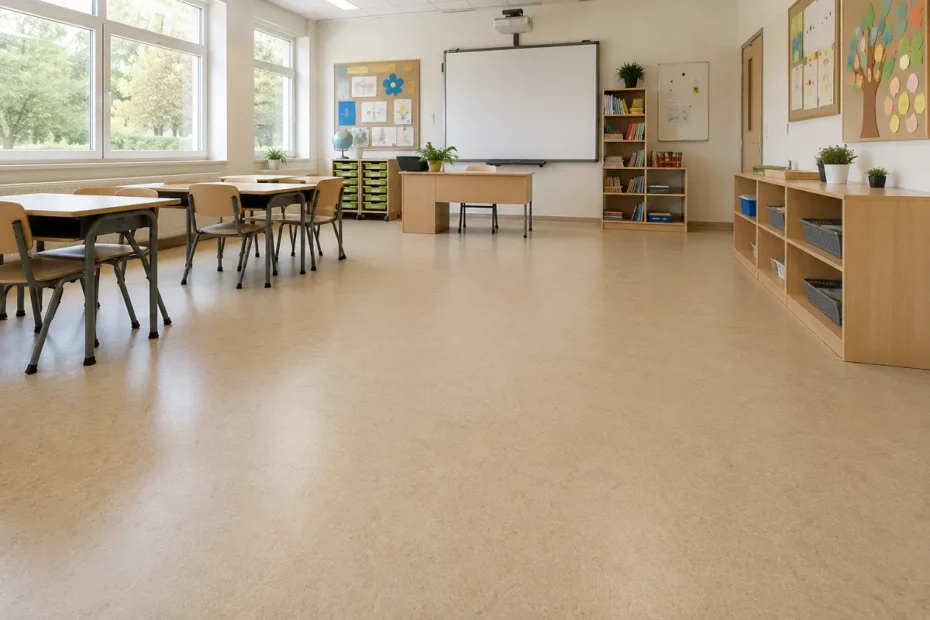
A classroom floor has to survive years of hard use while staying quiet and healthy to be in, and a few floors do that well. Durable safety vinyl with a slip-rated, low-VOC grade is a dependable all-rounder for classrooms and corridors, tough and easy to clean.
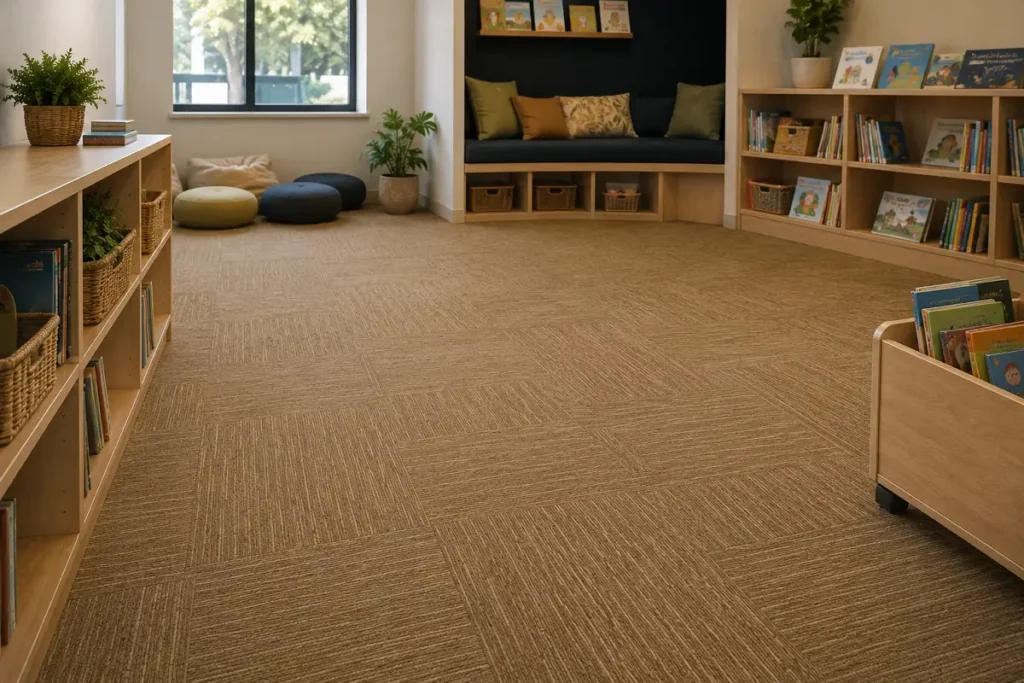
Linoleum is the natural classic of the school world for good reason: made from natural materials, it is low-emission, naturally hard-wearing and available in acoustic grades, which is why it has floored classrooms and corridors for generations. For a warmer, more homely classroom or a library, LVT in a low-VOC, acoustic-backed grade works well, and carpet tiles are ideal for reading corners and quiet zones where sound absorption matters, with the practical bonus that a stained or soiled tile lifts out and swaps individually. Match the floor to the room: hard-wearing vinyl or linoleum for the busy teaching and circulation areas, softer carpet tile for the calm zones.
Nursery and EYFS floors: soft, safe and warm for the youngest
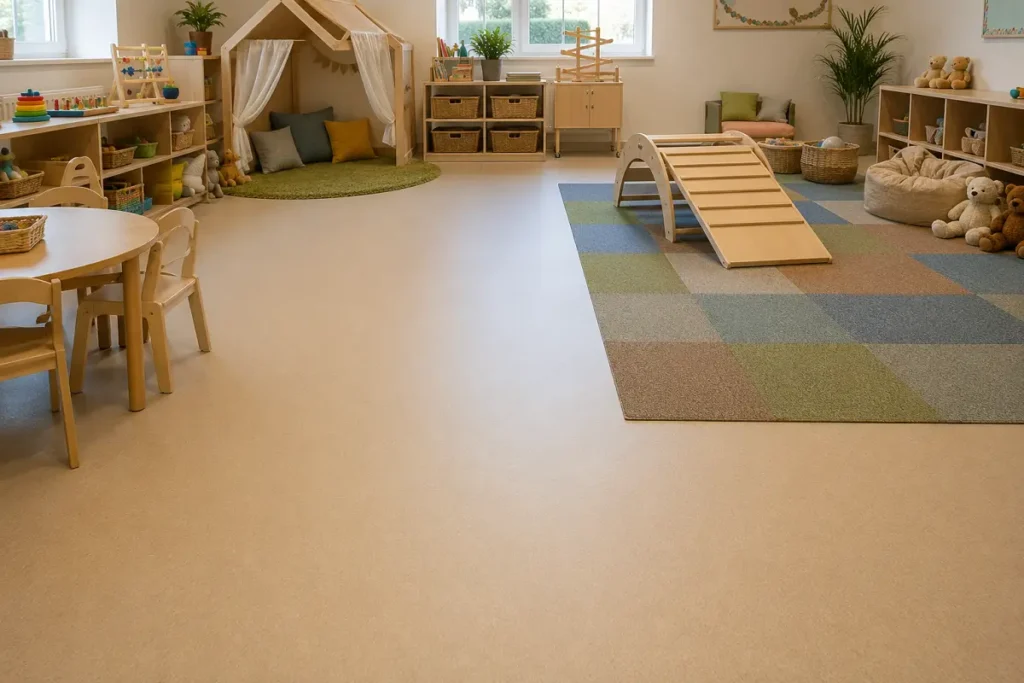
For the youngest children, the whole priority shifts to the floor itself as a play and safety surface, because they spend their day on it. A nursery or EYFS floor should be warm, cushioned, safe to fall on and low-VOC, not hard and cold.
Cushioned safety vinyl, which has an impact-absorbing layer built in, gives a warmer, softer, slip-resistant floor that still wipes clean after the inevitable spills, and it is a strong all-round nursery choice. Carpet tiles add warmth, softness and acoustic calm to toddler rooms and play corners, and their modularity is a real advantage with the youngest: a soiled tile is swapped out individually rather than replacing the floor. Impact matting adds extra cushioning under active play zones. Low-VOC materials matter most of all here, since crawling children live at floor level and breathe closest to it. Keep nursery floors warm, soft and low-emission, and reserve hard surfaces for the practical wet and messy-play areas.
Playground safety and Critical Fall Height: the impact-surface rule
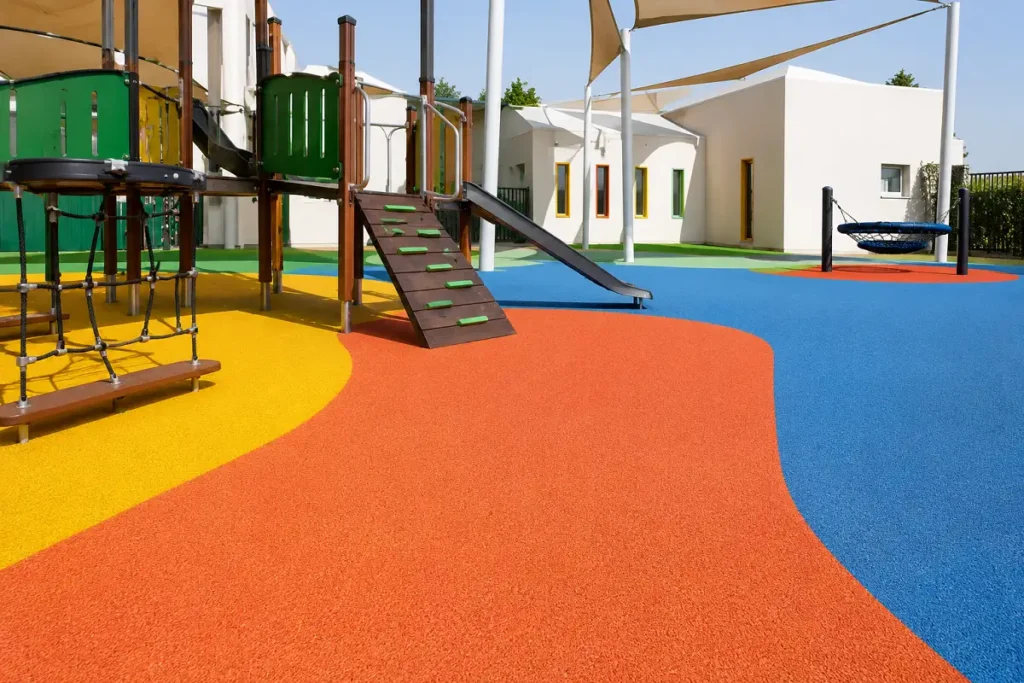
This is the most important safety concept in the whole guide, and the one most often overlooked in the UAE: any play area with equipment needs a floor rated to a Critical Fall Height. Critical Fall Height (CFH) is the maximum height from which a child can fall onto a surface without suffering a critical head injury.
The rule that governs a compliant playground is simple to state: the surface’s Critical Fall Height must meet or exceed the free fall height of the tallest equipment above it. A 2.5-metre climbing frame needs surfacing tested to at least a 2.5-metre CFH, no less.
The standard behind it is EN 1177, which tests a surface by dropping an instrumented headform onto it, and a surface passes at a given height when it keeps the Head Injury Criterion (HIC) below 1000 and the g-max below 200g at that rated height. Because performance depends on cushioning depth, the surfacing gets thicker as the fall height rises: roughly 25 to 30mm for a 1-metre fall, about 40mm for up to 1.5 metres, about 65mm for up to 2 metres, and around 100mm for up to 3 metres of Critical Fall Height. The standard systems are poured EPDM wet-pour, a coloured EPDM rubber top over a shock-absorbing SBR rubber base, and EPDM rubber tiles over a shock pad, both certified to EN 1177 or the equivalent ASTM standard, and EPDM handles UV and tropical rain well, which suits the UAE climate. Artificial grass over a shock pad is another play-area option. One honest limit matters and should never be skipped: compliant surfacing reduces the risk of serious head injury, it does not eliminate all injury, so it protects against the worst outcomes rather than guaranteeing none. Specify the surface to the equipment’s fall height, and the play area is genuinely safer.
Sports halls, corridors and dining areas
The high-traffic and sports zones of a school have their own demands, and they route to purpose-built floors. A sports hall or activity room needs a proper sports and rubber floor that absorbs impact, grips underfoot and takes heavy use, and rubber flooring as a material suits activity and multi-use rooms too.
Rather than repeat the detail here, our guide to the best gym flooring covers sports-floor thickness and specification in full. Corridors and dining halls, which take the heaviest continuous footfall in any school, want tough safety vinyl or linoleum for durability and easy cleaning, the same hard-wearing floors that serve the classrooms, specified in their most robust grades. Match the sports floor to the activity and the circulation floor to the traffic.
Acoustics and low-VOC: the two factors schools overlook
Two factors decide more about a school floor than most specifiers realise, and both are easy to miss: noise and air quality. Classroom acoustics genuinely affect learning, because background noise and echo make it harder for children to focus and for teachers to be heard, so sound-absorbing floors like carpet tiles and acoustic-backed vinyl or linoleum do real educational work, not just comfort.
Air quality is the other: children are more vulnerable to volatile organic compounds than adults, with lungs still developing, and they spend those 35 to 40 hours a week indoors, so low-VOC, low-emission floors and adhesives, ideally FloorScore or equivalent certified, matter more in a school than almost anywhere. Natural linoleum scores well on both counts at once, being low-emission and available acoustic. Our guide to eco-friendly and low-VOC flooring covers the air-quality side in depth. Weigh acoustics and emissions alongside durability, not as afterthoughts.
What to be cautious with: hard, slippery, cold floors
It is worth naming what to be careful with in children’s spaces, honestly. Hard ceramic and porcelain tile and stone are the main caution: they are slippery when wet and unforgiving in a fall, which is exactly the wrong combination for young children who fall often, and they are acoustically poor, bouncing noise around a room rather than absorbing it.
That does not make them useless everywhere, but it does make them a poor default for classrooms, nurseries and play areas, where softer, warmer, quieter, slip-safe floors are simply safer and better for learning. Urban does not fit tile or stone in any case, we fit vinyl, rubber, linoleum and carpet, and for children’s areas those are the safer, quieter, warmer choices. Where a hard floor is unavoidable in a wet or utility zone, specify a properly slip-rated safety surface rather than a glossy tile.
What school and nursery flooring costs in the UAE
Education flooring budgets stretch furthest when you zone them, spending where safety demands it and saving where it does not. Safety vinyl runs from about AED 22 per sqm supplied and fitted and linoleum from about AED 45, while impact-rated EPDM for play areas starts around AED 90. The full bands:
Supplied and fitted, the indicative bands run: safety and sheet vinyl about AED 22 to 180/sqm (about AED 2.0 to 16.7/sqft), linoleum about AED 45 to 220/sqm (about AED 4.2 to 20.4/sqft), LVT about AED 45 to 350/sqm (about AED 4.2 to 32.5/sqft), carpet tiles about AED 35 to 130/sqm (about AED 3.3 to 12.1/sqft), rubber and sports flooring about AED 50 to 250/sqm (about AED 4.6 to 23.2/sqft), EPDM about AED 90 to 250/sqm (about AED 8.4 to 23.2/sqft), and artificial grass about AED 45 to 160/sqm (about AED 4.2 to 14.9/sqft). The honest steer: run tough safety vinyl or linoleum through the high-traffic teaching and circulation areas, use carpet tiles for acoustic and EYFS zones, and reserve the higher spend for impact-rated EPDM only where play equipment needs a specified Critical Fall Height. Pay for safety surfacing where children fall from height, and save on standard specs elsewhere. All figures exclude 5% VAT. For the full breakdown across every floor type, see our flooring cost guide.
Which floor suits which school or nursery zone?
The right education floor follows the zone and the age of the children using it, not one specification throughout. Durability and acoustics lead in classrooms and corridors. Warmth and cushioning lead in nursery rooms. Impact rating leads wherever there is equipment to fall from. Five cases cover a whole building.
- Classrooms and corridors: durable safety vinyl, linoleum or warm LVT, with carpet-tile acoustic zones.
- Nurseries and EYFS rooms: cushioned safety vinyl and carpet tiles, warm, soft and low-VOC.
- Play areas with equipment: EPDM wet-pour or rubber rated to the equipment’s Critical Fall Height.
- Sports halls and activity rooms: rubber and sports flooring.
- Caution: avoid hard, slippery, cold tile in children’s areas.
If you are planning a whole facility and want the full method, start with our guide on how to choose flooring.
School and nursery flooring: frequently asked questions
What is Critical Fall Height in playground flooring?
Critical Fall Height is the maximum height from which a child could fall onto a surface without a serious head injury, tested to standards like EN 1177. The rule is simple: the surface’s Critical Fall Height must meet or exceed the fall height of the tallest equipment above it, so play surfacing such as poured EPDM rubber is specified thick enough to match that height.
What is the best flooring for a classroom?
Durable, quiet, low-VOC flooring: slip-rated safety vinyl, natural linoleum, or warm acoustic-backed LVT, with carpet tiles for reading corners and quiet zones. Classrooms take heavy traffic and need to stay clean and calm, so the floor should be hard-wearing, sound-absorbing and low-emission. Match the hardest-wearing floors to the busiest areas and softer carpet tile to the calm zones.
What is the safest flooring for a nursery?
Warm, cushioned, low-VOC flooring: cushioned safety vinyl and carpet tiles suit the youngest children best, since they crawl and fall at floor level all day. These give softness, warmth, slip resistance and easy cleaning, and a soiled carpet tile swaps out individually. Avoid hard, cold, slippery floors in nursery and toddler rooms, where impact safety and warmth matter most.
What flooring is used in school playgrounds?
Impact-absorbing surfacing rated to a Critical Fall Height, usually poured EPDM wet-pour (a coloured rubber top over a shock-absorbing base) or rubber tiles over a shock pad, certified to EN 1177 or the equivalent. The thickness is set by the height of the equipment, and the surface resists UV and rain well. It reduces serious head-injury risk, though it does not remove all injury.
Is carpet or vinyl better for a school?
Both have a place, zoned by use. Safety vinyl and linoleum suit high-traffic classrooms, corridors and wet areas, being durable and easy to clean, while carpet tiles suit reading corners, libraries and EYFS rooms for their warmth and sound absorption. The best schools use both: hard-wearing floors where traffic is heavy, soft acoustic carpet tile where calm and quiet matter.
What flooring is best for a school sports hall?
A purpose-made sports and rubber floor that absorbs impact, grips underfoot and withstands heavy use and equipment. Rubber sports flooring protects both children and the subfloor and handles the constant activity a hall sees. The specification, especially thickness, depends on the activities, which our gym flooring guide covers in full. Match the sports floor to how the hall is actually used.
Why does low-VOC flooring matter in schools?
Because children are more vulnerable to volatile organic compounds than adults, with developing lungs, and they spend roughly 35 to 40 hours a week indoors at school. Low-VOC, low-emission floors and adhesives, ideally FloorScore or equivalent certified, protect indoor air quality and support concentration. Natural linoleum and certified low-VOC vinyl and carpet tiles are strong choices for healthy classroom air.
What flooring meets UAE school and nursery requirements?
UAE schools and nurseries are regulated by KHDA in Dubai, ADEK in Abu Dhabi and the MOE federally, with SPEA for Sharjah nurseries, and premises must meet facility health-and-safety requirements including fire and civil-defence rules that cover flooring. There is no single mandated product, but a compliant floor is safe, slip-resistant, low-VOC and, for play areas, rated to the right Critical Fall Height.
The bottom line: the best floors for UAE schools and nurseries
School and nursery flooring is a safety and health decision first, so it is chosen zone by zone rather than as one floor throughout. Classrooms and corridors want durable, acoustic, low-VOC safety vinyl or the natural linoleum that has floored schools for generations, with warm LVT and carpet-tile quiet zones.
Nurseries and EYFS rooms want warm, cushioned, low-VOC floors for children who live at floor level. Play areas with equipment need impact-absorbing EPDM rubber rated to the right Critical Fall Height, the single most important safety specification, remembering it reduces rather than removes injury risk. Sports halls want proper rubber sports floors, and hard slippery tile is the one to be cautious with around young children. UAE schools answer to KHDA, ADEK and the MOE, whose safety requirements the floor must support. Zone each area to how children use it, and a free site visit will confirm the safest floor throughout.
Floor your school or nursery safely with a free site visit
Planning or refurbishing a school or nursery in Dubai or across the UAE? Message us on WhatsApp and a flooring specialist will help you zone it safely, durable low-VOC safety vinyl or linoleum for classrooms and corridors, warm cushioned floors and carpet tiles for nursery and EYFS rooms, and impact-rated EPDM to the right Critical Fall Height for play areas.
- WhatsApp us: +971 56 689 9831
- Call: +971 56 689 9831
- Request a free site visit and quote across Dubai and Abu Dhabi.
We have supplied and fitted specialist floors across the UAE since 2013, with more than 10,000 projects completed by our in-house team.

Junaid Rana is a content strategist with over 10 years of experience in the interior and fit-out industry, writing on flooring, finishes and fit-out across UAE homes and commercial spaces. His guides are reviewed for accuracy by Urban Flooring’s in-house experts.