
Reviewed for accuracy by Muhammad Gulbadin, founder and operations manager at Urban Flooring, 15+ years in UAE flooring.
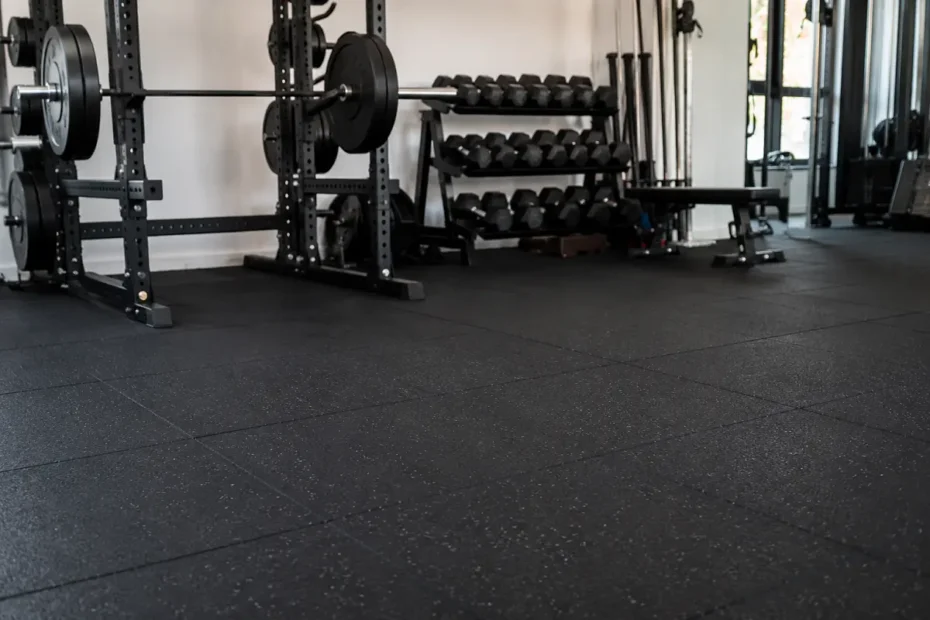
The best gym flooring is rubber, because a gym floor is protective equipment, not decor: it must absorb dropped-weight impact, take heavy loads, grip when sweaty and control noise. The key decision is thickness matched to use, thick rubber for heavy lifting, medium for functional training, thinner rubber or vinyl for cardio and studios. Foam suits only light bodyweight work. Match the floor to how you train.
Why gym flooring is performance equipment, not decor
Here is the reframe that separates a good gym floor from a bad one, and it is worth stating plainly: gym flooring is performance equipment, not decoration. Unlike any floor in a living space, its job has almost nothing to do with looks.
It has to absorb the impact of dropped weights, protect the subfloor and the equipment from damage, grip underfoot when it is slick with sweat, deaden the noise of training, and give racks and benches a stable, level base. Skipping the floor to save money is one of the most common gym-build mistakes there is, and the wrong floor leads to cracked concrete, damaged equipment, noise complaints and injuries. So the whole decision is a performance one: impact absorption, load durability, grip and sound control decide a gym floor, and looks come a distant last. Get that order right and everything else follows.
What a gym floor must do: the five performance demands
Because a gym floor is judged on function, it helps to name the specific jobs it has to do rather than judge it on appearance. Five demands decide whether a gym floor works: impact absorption, load durability, grip when wet, noise control and hygiene. One more ties them together. Taken in order:
- Impact absorption, to soak up the energy of dropped dumbbells and barbells before it cracks the slab or bounces the bar.
- Load durability, to take the sustained weight of racks, machines and stacked plates without denting or compressing.
- Grip and slip resistance, because a training floor gets wet with sweat, and a slip under load is dangerous, so slip resistance here is non-negotiable.
- Sound and impact-noise control, to keep a dropped weight from booming through the building.
- Hygiene and easy cleaning, since a gym floor takes constant sweat and needs to wipe down.
Tying them together is equipment stability: racks, benches and machines sit flatter and grip better on rubber than on bare concrete, which is safer under load. Judge any gym floor against these, not against how it looks.
Gym flooring rated on impact, durability, grip and cost
The table rates the realistic gym options on what actually matters, impact absorption, load durability, grip when sweaty and sound control, rather than on appearance. Rubber leads on every performance column in its three formats. Foam and vinyl each have one narrow use. Read the last column first, because it names the job each surface is actually for.
| Floor | Impact absorption | Load durability | Grip (sweat) | Sound control | Best gym use |
|---|---|---|---|---|---|
| Rubber rolls | High | High | High | High | Large continuous gym areas |
| Rubber tiles (interlocking) | High | High | High | High | Home gyms, DIY, spot zones |
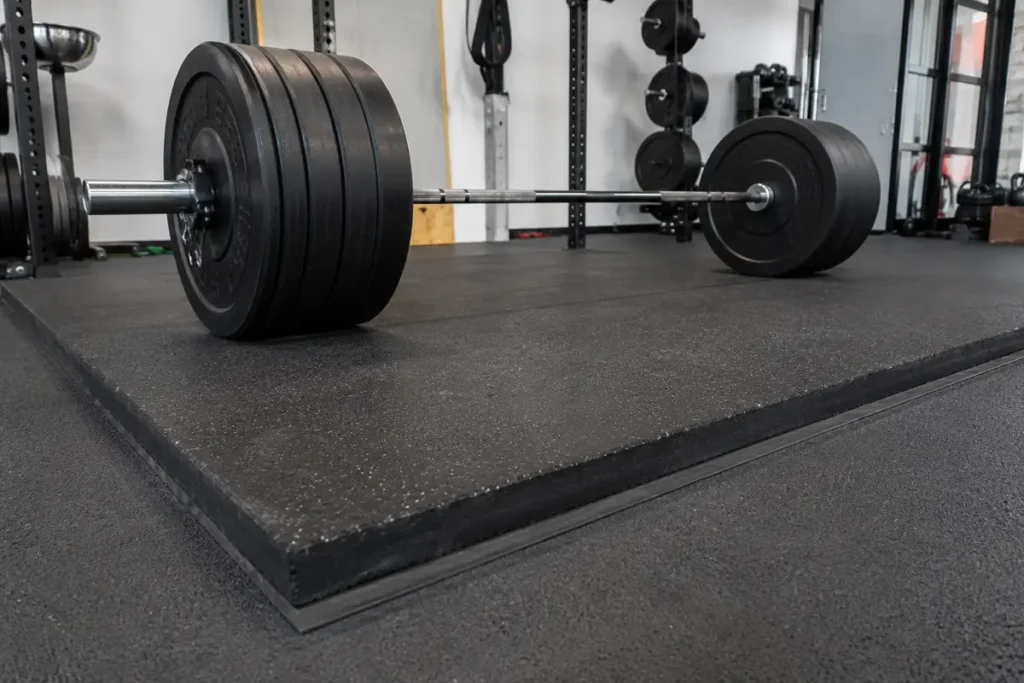
| Rubber stall mats (thick) | Highest | Highest | High | Highest | Heavy-lifting and drop platforms |
| EPDM / coloured rubber | High | High | High | High | Premium, multi-colour, play crossover |
| Foam / EVA tiles | Low-moderate | Low (compresses) | Moderate | Moderate | Yoga, stretching, light bodyweight only |
| Vinyl / LVT | Low | Moderate | Moderate | Low-moderate | Studio, cardio-light, reception |
| Artificial turf strip | Moderate | High | High | Moderate | Sled tracks, functional lanes |
Rubber flooring: the industry-standard gym floor
For almost every gym, home or commercial, rubber is the honest default, and it is the industry standard for a simple reason: it does all five core jobs at once. Gym rubber flooring absorbs dropped-weight impact, resists heavy loads without denting, grips when wet with sweat, deadens noise and gives equipment a stable base. It comes in three formats, each suited to a different job.
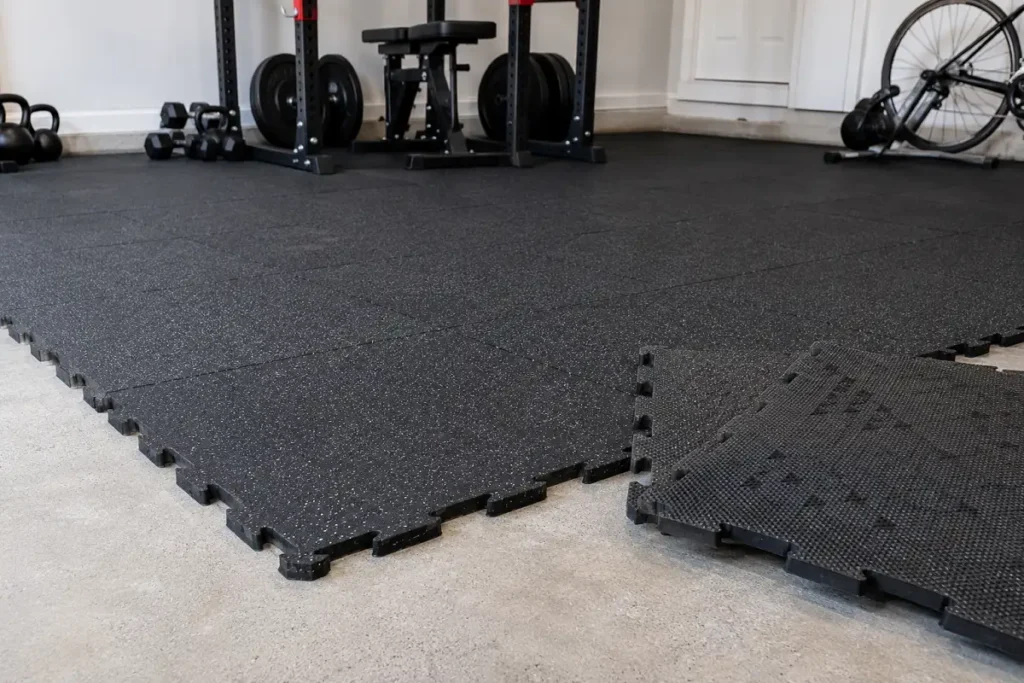
Rubber rolls cover large, continuous areas with very few seams, ideal for a big permanent gym floor, though they are heavy to handle. Interlocking rubber tiles suit home gyms, DIY installs and spot zones, since they need no adhesive and a damaged one lifts out and swaps in. Thick rubber stall mats go under drop platforms and the heaviest-impact zones. As a material in its own right, beyond the gym, rubber flooring has wider uses too, but for a training space, gym-grade rubber in the right format is the standard.
Matching rubber thickness to how you train
This is the single most useful decision in the whole guide, and the one most people get wrong: match the rubber thickness to how you actually train. Too thin under heavy weights damages both the subfloor and the weights, while paying for maximum thickness under a treadmill is money wasted. The honest bands, in millimetres with inches alongside, are:
- 6mm (about 1/4 inch): the minimum, and only for cardio machines and light, stationary work. It does not protect a subfloor from dropped weights.
- 8mm (about 5/16 inch): the popular all-round home-gym and light-commercial thickness, fine for mixed cardio and strength, dumbbells and most machines, and moderate free weights.
- 10 to 15mm (about 3/8 to 1/2 inch): for dedicated weightlifting, power cages and squat racks with dropped barbells at moderate loads. As a rule, 15mm is the minimum wherever weights are used, and 10mm is the floor for multi-storey noise control.
- 19 to 20mm and up, or stall mats and a lifting platform: for Olympic lifting and heavy barbell drops, the CrossFit-style dropping of loaded bars.
Get the thickness right for your heaviest regular lift, and concentrate the thickest rubber in the drop zone rather than paying for it across the whole room.
EPDM and coloured rubber for premium gyms and play areas
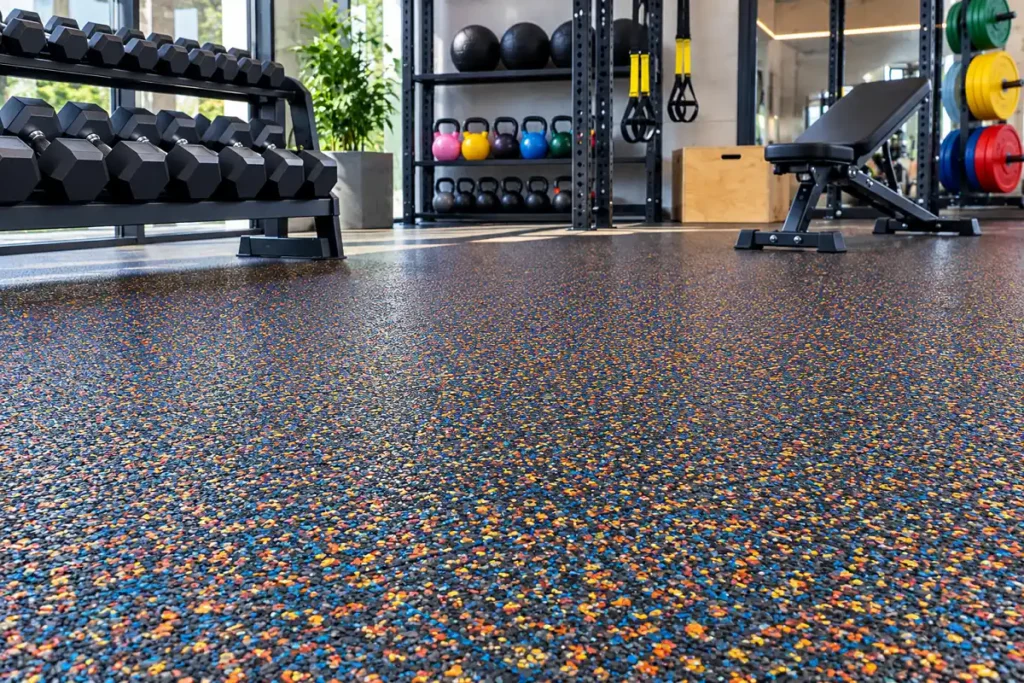
If you want colour, a premium finish or a floor that crosses into play areas, EPDM is the option to know. EPDM flooring is a synthetic rubber that is denser and less porous than standard recycled rubber, so it is more durable, easier to clean, better at resisting UV and lower in odour, and it is what most brightly coloured and multi-colour gym floors are made from.
It comes as coloured rubber-granule tiles or as a poured wet-pour surface, and that same material is what surfaces playgrounds and outdoor activity areas, so it carries a genuine play and outdoor crossover. The trade-off is a slightly higher price for the coloured, poured, premium finish. For a branded commercial gym, a colour-coded studio or a floor that doubles for a kids’ activity zone, EPDM is the premium pick.
Foam tiles: fine for light training, wrong under weights
Foam deserves an honest placement rather than a blanket dismissal, because it has a real but narrow use. Interlocking foam and EVA tiles are cheap, soft and perfectly fine for yoga, stretching, floor work and light bodyweight training, and they are comfortable for a mat-based session.
The honest limit is load: foam compresses, dents and tears under weights and heavy equipment, so it is not a floor for a weights area, and it will not survive a rack or a dropped dumbbell for long. Be especially wary of ultra-lightweight foam tiles with a thin rubberised sticker on top, which look tougher than they are and compress and tear under load. So use foam where the work is light and mat-based, and put rubber where anything gets lifted or dropped. Some home floors pair an EVA-foam base with an EPDM-rubber top for mixed light use, but a true weights zone still wants proper rubber.
Vinyl and turf for studio, cardio and functional zones
Not every zone of a gym is a weights floor, and matching the surface to the zone is part of doing it well. In a studio, a cardio-machine area or a reception where nothing heavy is dropped, a hard, smooth, wipe-clean surface like vinyl or LVT works well and cleans easily.
For functional training, a strip of artificial turf laid over rubber with a shock pad gives a sled track or an agility lane, the classic turf-down-the-centre layout, combining push-sled grip with rubber’s impact protection underneath. These are zone tools, not whole-gym floors: the weights area still wants rubber, but a smart gym uses the right surface in each zone rather than one floor everywhere. All the vinyl options sit within the wider vinyl flooring range.
Home gym or commercial gym: how the flooring differs
Home and commercial gyms follow the same principles but differ in scale and grade, and it is worth being clear which you are fitting out. A home gym usually needs a corner of thick interlocking tiles or a stall-mat platform under the rack, with a thinner all-round floor elsewhere, and 8mm handles most of it.
A commercial gym needs zoned specs across the whole space, thick rubber in the free-weights and platform areas, medium rubber through functional zones, and thinner rubber or vinyl in cardio and studio, all in a commercial grade dense enough for constant footfall. Both, though, are Urban’s own on-domain work, and both route to the same place for a quote: our gym flooring page covers home and commercial fit-outs alike. The difference is scale and grade, not principle.
Noise, subfloors and protecting the room below your gym
Here is the factor most gym-flooring guides skip entirely, and in the UAE, with so many apartment and upper-floor gyms, it matters a lot: dropped weights transmit impact and noise straight into the building’s structure. Every dropped barbell sends energy down into the slab and through to the room below, which is how you get noise complaints and, over time, structural stress. The fix is thickness plus isolation.
Thicker rubber has more material to absorb impact energy before it reaches the structural slab, so it controls both noise and vibration far better, which is exactly why you rarely go under 10mm on a multi-storey or apartment gym floor. For heavy lifting above an occupied space, add a dedicated lifting platform or an extra isolation layer under the drop zone to protect the room below. If your gym sits over another room, treat the floor as soundproofing as much as training surface, and spec the thickness accordingly.
What gym flooring costs in the UAE
Gym flooring is priced by thickness and grade more than by anything else, which makes budgeting straightforward once you know how you train. Rubber runs about AED 50 to 250 per sqm supplied and fitted, with thin cardio matting at the low end and thick lifting tiles at the top. The full bands:
Supplied and fitted, the indicative bands run: gym and rubber flooring about AED 50 to 250/sqm (about AED 4.6 to 23.2/sqft), EPDM about AED 90 to 250/sqm (about AED 8.4 to 23.2/sqft), artificial turf for functional lanes about AED 45 to 160/sqm (about AED 4.2 to 14.9/sqft), and vinyl or LVT for studio zones about AED 45 to 350/sqm (about AED 4.2 to 32.5/sqft). The honest steer: rubber price tracks thickness, thin cardio matting sits at the low end and thick heavy-lifting tiles and stall mats at the high end, so you pay for the impact protection your training actually needs, and EPDM costs a little more for the coloured, poured finish. Spend on thickness where you drop weights, and save on thinner specs where you do not. All figures exclude 5% VAT and depend on grade and site. For the full breakdown across every floor type, see our flooring cost guide.
Which gym floor is right for your space?
The right gym floor follows how you train and at what scale, not what the room looks like. Thickness is the variable that changes, and it steps up with the weight being dropped. Rubber covers four of the five cases below; foam covers one, and only one. Match yours to the heaviest thing you lift.
- Heavy lifting, Olympic or CrossFit-style dropping: thick rubber tiles or stall mats at 20mm or more, or a dedicated lifting platform.
- Functional or mixed training: medium rubber rolls or tiles around 10 to 15mm.
- Cardio and studio zones: thinner rubber, or vinyl and LVT where nothing is dropped.
- Premium, coloured or a play-area crossover: EPDM and coloured rubber.
- Light bodyweight or yoga only: foam is acceptable, but only there.
If you are planning floors across a whole space and want the full method, start with our guide on how to choose flooring.
Gym flooring: frequently asked questions
How thick should gym flooring be?
Match thickness to use. About 6 to 8mm (1/4 to 5/16 inch) suits cardio and light training, 10 to 15mm handles functional training and moderate weights, and 20mm or thicker tiles or stall mats are needed for heavy free weights and Olympic lifting. As a rule, 15mm is the minimum wherever weights are used. Too thin under heavy weights damages the subfloor.
What is the best flooring for a home gym?
Rubber. Interlocking rubber tiles suit most home gyms, with thicker tiles or stall mats under a squat rack or lifting platform. They absorb impact, protect the floor below, grip when sweaty and deaden noise, and 8mm is the popular all-round thickness. Foam suits only light bodyweight or yoga areas, not spaces where you lift or drop weights.
Is rubber the best gym flooring?
Yes. Rubber is the industry standard because it does the core jobs: it absorbs dropped-weight impact, takes heavy loads without denting, grips when wet with sweat, controls noise, and stabilises racks and benches. Rolls suit large continuous areas, interlocking tiles suit home gyms and DIY, and thick stall mats suit lifting platforms. Match the format and thickness to your training.
Can you use foam tiles in a gym?
Only for light work. Foam and EVA tiles are fine for yoga, stretching and light bodyweight training, but they compress, dent and tear under weights and heavy equipment, so they are not a weights-area floor. Be wary of thin foam tiles with a rubberised sticker top, which fail quickly under load. Use rubber anywhere you lift or drop weights.
What is EPDM gym flooring?
EPDM is a denser, more durable synthetic rubber, less porous, easier to clean, and better at resisting UV and odour than standard recycled rubber. It is what most brightly coloured and multi-colour gym floors are made from, available as tiles or a poured wet-pour surface, and it crosses into playground and outdoor use. It costs a little more for the premium coloured finish.
What gym flooring protects the room below?
Thick rubber. The thicker the rubber, the more impact energy it absorbs before it reaches the structural slab, so it controls both noise and vibration into the room below. For a multi-storey or apartment gym, rarely go under 10mm, and for heavy lifting add a dedicated platform or an extra isolation layer under the drop zone to protect the space beneath.
What is the best flooring for a garage gym?
Rubber, in interlocking tiles or a roll, with thick tiles or a stall-mat platform under the rack. Rubber protects the garage slab from dropped weights, grips underfoot, deadens noise and handles the temperature swings a garage sees. Choose 8mm for general use and step up to 15mm or thicker where you lift, matching the thickness to your heaviest training.
Do you need different flooring for cardio and weights?
Ideally, yes. Cardio and studio zones only need thinner rubber or a wipe-clean vinyl, since nothing heavy is dropped there, while weights areas need thick rubber to absorb impact and protect the subfloor. Zoning a gym this way, thin where it is light, thick where it is heavy, gives better performance and value than one thickness everywhere.
The bottom line: the best floor for a UAE gym
A gym floor is protective equipment, so judge it on performance, not looks. Rubber is the honest default because it absorbs impact, takes heavy loads, grips when sweaty and controls noise, and the decision that matters most is thickness matched to training: 6 to 8mm for cardio and light use, 10 to 15mm for weights (15mm the minimum wherever weights are dropped), and 20mm or more, or a platform, for Olympic and heavy lifting.
EPDM adds colour and a premium poured finish, foam is for light bodyweight work only, and vinyl or turf suit studio, cardio and functional zones. In an apartment or upper-floor gym, treat thickness as soundproofing and protect the room below. Match the floor to how you train, and a free site visit will confirm the right spec zone by zone.
Get the right gym floor with a free site visit
Fitting out a home or commercial gym in Dubai or across the UAE? Message us on WhatsApp and a flooring specialist will spec it by how you train, thick rubber where you lift, medium rubber for functional zones, thinner rubber or vinyl for cardio and studio, EPDM for a coloured premium finish, and proper impact protection for the room below.
- WhatsApp us: +971 56 689 9831
- Call: +971 56 689 9831
- Request a free site visit and quote across Dubai and Abu Dhabi.
We have supplied and fitted gym and rubber floors across the UAE since 2013, with more than 10,000 projects completed by our in-house team.

Junaid Rana is a content strategist with over 10 years of experience in the interior and fit-out industry, writing on flooring, finishes and fit-out across UAE homes and commercial spaces. His guides are reviewed for accuracy by Urban Flooring’s in-house experts.