
Reviewed for accuracy by Muhammad Gulbadin, founder and operations manager at Urban Flooring, 15+ years in UAE flooring.
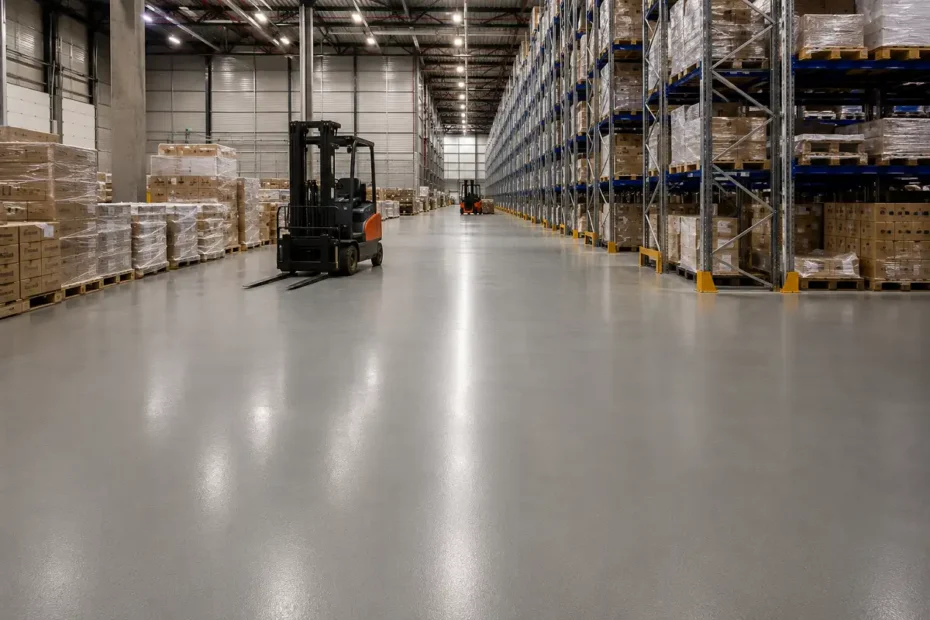
The best warehouse and industrial flooring is a resin system, epoxy or polyurethane, matched to the duty, because an industrial floor is engineered for load, abrasion and chemical resistance, not looks. A thin coating dust-proofs light-duty units; self-levelling epoxy suits medium forklift traffic; a heavy-duty PU screed takes the harshest loads and thermal shock. Specify the system, and the floor flatness, to how the floor is actually used.
Why warehouse flooring is an engineering decision, not a finish
Here is the reframe that changes how you choose an industrial floor: a warehouse or factory floor is closer to structural engineering than interior design. Its job has nothing to do with looks and everything to do with performance.
It has to carry forklift point loads and the concentrated leg loads of high racking without cracking, resist the relentless abrasion of wheeled traffic, shrug off chemical and oil spills, absorb the impact of dropped goods, keep staff safe from slips, and stop bare concrete from shedding the fine dust that contaminates stock and equipment. Every one of those is an engineering demand, not a decorating one. So the whole decision is driven by load, abrasion, chemistry and dust control, and the floor is treated as part of the building’s structure. Get that mindset right and the rest of the choices below fall into place.
What an industrial floor must do: the performance demands
Because an industrial floor is engineered, it helps to set out exactly what it has to withstand rather than what it should look like. Load, abrasion, chemical attack, impact, slips, dust, flatness and static are the eight demands that decide an industrial floor. Each one is measurable and specifiable. In order:
- Point and rolling loads, carrying forklifts, pallet trucks and loaded racking legs without cracking or denting.
- Abrasion resistance, taking constant wheeled traffic over the same routes without wearing through.
- Chemical and oil resistance, standing up to spills, from hydraulic oil to processing chemicals, without degrading.
- Impact resistance, surviving dropped goods and handled loads.
- Slip safety, giving traction in walkways and wet or oily zones, often with an anti-slip aggregate.
- Dust-proofing, sealing the concrete so it does not shed fine dust into the air and onto stock.
- Flatness, staying within tolerance so forklifts and high racking operate safely (its own section below).
- Static control (ESD), where electronics or flammable atmospheres require it.
Judge an industrial floor against this engineering checklist. Appearance does not appear on it.
Industrial flooring rated on load, abrasion and chemical resistance
The table rates the realistic industrial options on what actually matters, load, abrasion, chemical resistance and dust-proofing. Ceramic tile appears only as the failure case, and Urban fits resin, microcement and specialist floors, not tile.
| Floor | Load / point-load | Abrasion resistance | Chemical resistance | Dust-proofing | Best industrial use |
|---|---|---|---|---|---|
| Epoxy coating (thin) | Moderate | Moderate | Good | Yes | Light-duty storage, dust-proofing |
| Self-levelling epoxy (2-3mm) | High | High | High | Yes | Medium-duty, MHE traffic, smooth finish |
| PU / epoxy screed (4-9mm) | Highest | Highest | Highest | Yes | Heavy industry, food-grade, thermal shock |
| Anti-static (ESD) resin | High | High | High | Yes | Electronics, flammable-atmosphere areas |
| Microcement | Moderate-high | High | High | Yes | Lighter decorative-industrial, showroom-warehouse |
| Sealed / dust-proofed concrete | High (slab-dependent) | Moderate | Low-moderate | Partial (wears) | Budget light-duty storage |
| Rubber (anti-fatigue) | n/a (mats) | Moderate | Moderate | n/a | Standing workstations, workshops |
| Ceramic tile (fails, we do not fit) | Low (cracks) | Moderate | High | Yes | Unsuitable for industrial loads |
Resin flooring: the industrial standard for warehouses and factories
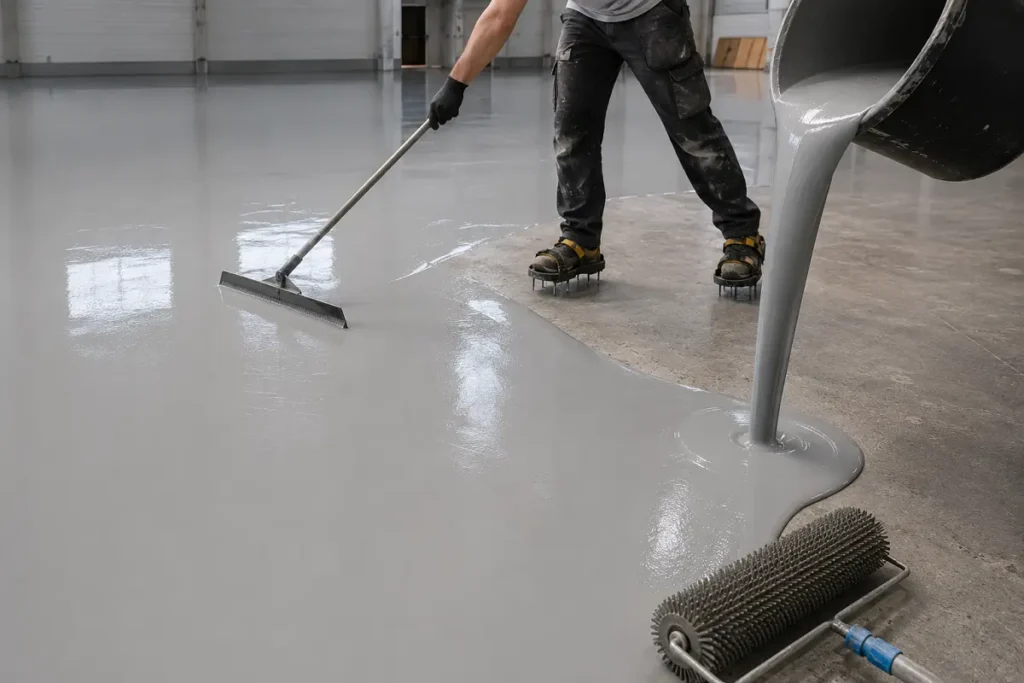
For almost every warehouse and factory, resin is the honest default, and it is the industrial standard for a clear reason. An epoxy or resin floor, whether epoxy or polyurethane, is applied over the concrete slab as a monolithic, jointless, hard-wearing, chemical-resistant surface that bonds to the concrete, seals the dusting, and takes heavy traffic without the joints and grout lines that would fail under industrial use.
Because it is poured and cures as one continuous surface, there are no seams for dirt, chemicals or wheel loads to attack, and it can be specified from a thin protective film up to a thick, high-strength screed. That range is exactly why resin dominates industrial flooring: it is one material family that can be tuned from light-duty dust-proofing to the heaviest food-and-chemical duty. The next section is where that tuning happens, and it is the decision that matters most.
Matching the resin system to the duty: coating, self-levelling or screed
This is the single most important and most misunderstood point in industrial flooring, so it is worth stating plainly: “epoxy” is not one product, it is a family of systems matched to duty, and choosing the wrong tier is the classic, expensive mistake. There are three broad tiers.
- A thin coating, a few hundred microns, roller-applied. It dust-proofs and seals the floor, gives a cleanable, abrasion-resistant surface, and suits light-to-medium-duty storage and leased units. It is not designed for heavy impact or scraping.
- A self-levelling resin, about 2 to 3mm, in epoxy or PU. Much thicker and longer-lasting than a coating, it gives a smooth, durable medium-duty floor for forklift routes, labs and electronics.
- A heavy-duty screed, a PU or epoxy screed or urethane mortar around 4 to 9mm, with a troweled roughly 6mm urethane mortar being the heaviest-duty of all. It takes the harshest loads, thermal shock, impact and food-grade duty.
The expensive mistake is specifying a thin coating where a screed is needed: it wears through, chips and fails early under loads it was never designed for. There is an honest epoxy-versus-PU nuance too: epoxy is harder and better under concentrated forklift point loads, while polyurethane is more flexible and better at handling thermal shock, moisture and food environments, which is why a urethane-cement screed picks up exactly where a PU coating would fail under heavy forklift traffic. Match the resin system to the real duty of the floor, and it lasts; mismatch it, and it fails.
Floor flatness for forklifts and high-bay racking
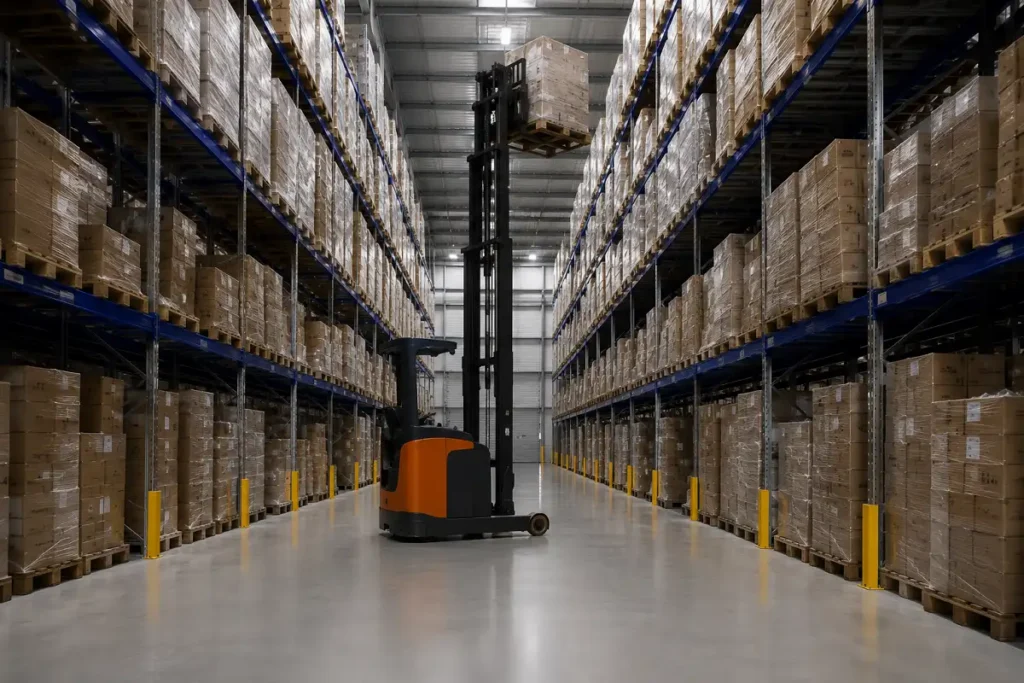
Here is the specification most buyers overlook entirely, and it becomes critical the moment forklifts and high racking are involved: floor flatness is a real, measurable, specifiable requirement, not a nicety. The concept splits two ways. In Free Movement (FM) areas, materials-handling equipment moves randomly across open floor; in Defined Movement (DM) aisles, Very Narrow Aisle (VNA) trucks run on fixed paths at height and need much tighter flatness.
The recognised benchmarks are the Concrete Society’s TR34, which sets FM1 to FM4 flatness classes with FM2 the class most commonly specified for general forklift use and wide-aisle racking, along with DIN 15185 and EN 15620 for narrow-aisle defined movement and DIN 18202 or BS 8204 (SR2) for general slabs. The reason it matters is safety: an out-of-tolerance floor causes mast sway, tyre bounce and racking instability that get dramatically worse the higher a truck lifts.
Two honest points keep this accurate. First, these are international best-practice benchmarks used in design and tender specifications, not UAE-specific laws, so treat them as the engineering standard rather than a local legal requirement. Second, and importantly, flatness is built into the concrete slab, not the coating: a resin topping follows the profile of the slab beneath it rather than correcting it, so flatness is won or lost when the slab is laid, and only local critical zones can be ground or re-topped afterwards. Specify the slab flatness up front wherever forklifts and high racking will run.
Chemical resistance, anti-static and food-grade requirements
Beyond general duty, certain industries need a resin system engineered for their specific hazard, and matching it honestly matters. For electronics assembly, server rooms and any area handling flammable solvents or fine powders, an anti-static (ESD) conductive resin system linked to earth safely dissipates static charge, protecting both staff and sensitive equipment.
For food and beverage production, a food-grade urethane-cement or PU screed is the standard: it is HACCP-friendly, withstands steam-cleaning and the thermal shock of hot and cold wash-downs, resists food acids and fats, and cures as an impervious surface with no seams to harbour bacteria. For chemical processing and cold storage, chemical-resistant and cold-rated systems handle aggressive spills and low temperatures. The rule is simple: match the resin system to the industry’s real hazard, chemical, static or hygiene, rather than fitting a general-purpose floor and hoping it copes.
Sealed concrete, microcement and lighter-duty options
Not every unit needs a heavy resin system, and honesty means saying where a cheaper floor is genuinely enough, and where it is a false economy. Sealed or dust-proofed concrete, hardened with a densifier or a thin sealer, is the honest budget entry point for light-duty storage: it is cheap, it dust-proofs a lightly-used unit, and for low-traffic storage it can be all you need.
The caveat is real, though: under heavy materials-handling traffic, sealed concrete wears and begins to dust again over time, so for a busy operation a proper resin system is actually the cheaper choice across the floor’s life. For lighter decorative-industrial spaces and showroom-warehouse zones, microcement offers a hard-wearing, refined finish. If you are weighing resin against microcement for a given space, our guide comparing epoxy and microcement covers that choice in detail. And for standing workstations and workshop benches, anti-fatigue rubber matting adds comfort over a hard floor; a light-industrial workshop or garage-style workspace is a related fit-out in its own right. Match the spend to the duty: cheap where it genuinely suffices, resin where the traffic demands it.
Line marking, dust control and safety demarcation
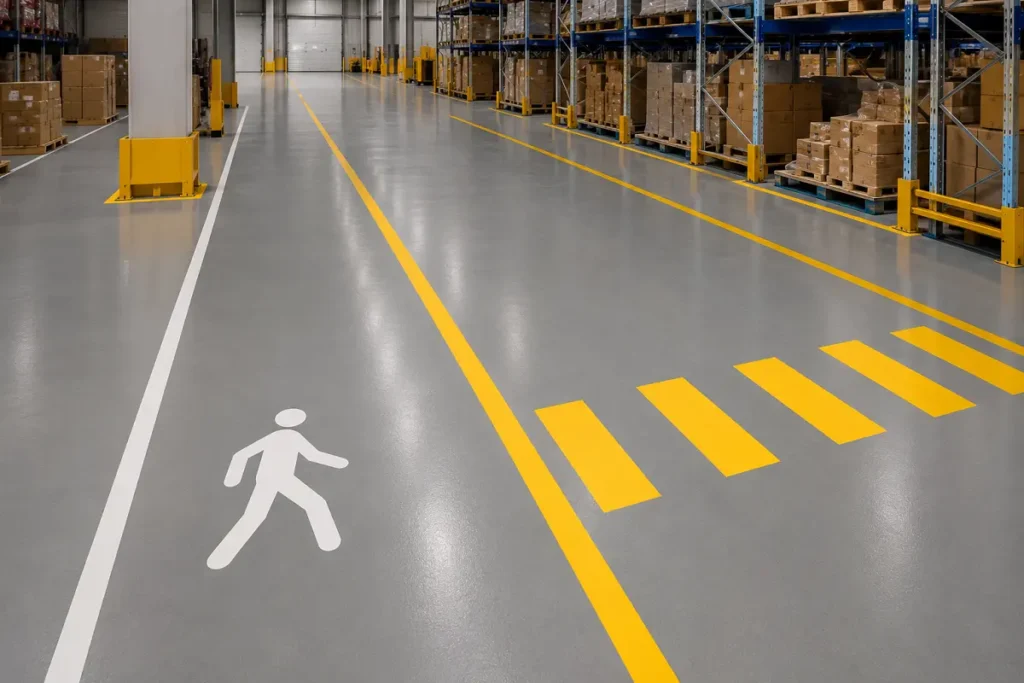
An industrial floor does operational work beyond simply bearing loads, and this layer is part of the specification, not an afterthought. Line marking and traffic-route demarcation separate pedestrian walkways from forklift lanes, mark racking and storage zones, and flag hazards, all of which are core to warehouse safety and are built into or applied over the resin floor.
Anti-slip aggregate is broadcast into walkways, ramps and wet or oily zones to give traction where people walk, while keeping the main traffic areas smooth for wheels. Dust control ties back to the whole point of sealing the floor: a bonded resin surface stops the concrete dusting that would otherwise settle on stock and machinery. Treat marking, anti-slip zoning and dust control as part of the floor’s job from the outset, and the finished floor works as a safety system, not just a surface.
What warehouse and industrial flooring costs in the UAE
Industrial flooring is priced by the system and its thickness more than anything else, which makes budgeting logical once the duty is known. Resin runs about AED 50 to 250 per sqm supplied and fitted, with a thin dust-proofing coating at the low end and a heavy-duty screed at the top. The full bands:
Supplied and fitted, the indicative bands run: epoxy and resin systems, from thin coatings up to heavy build-ups, about AED 50 to 250/sqm (about AED 4.6 to 23.2/sqft), microcement about AED 150 to 500/sqm (about AED 13.9 to 46.5/sqft), rubber matting about AED 50 to 250/sqm (about AED 4.6 to 23.2/sqft), and VCT for light-industrial back-office areas about AED 45 to 140/sqm (about AED 4.2 to 13.0/sqft). The honest steer: resin cost tracks the system, a thin dust-proofing coating sits at the low end, a self-levelling floor in the middle, and a heavy-duty PU screed at the top, so you pay for the duty the floor actually takes. Sealed concrete is the cheapest functional option for light-duty storage, but under heavy traffic it wears and dusts, making a proper resin system the cheaper choice over the floor’s life. Specify to the load, not the sticker price. All figures exclude 5% VAT, and industrial floors are quoted per facility after a site visit and slab assessment. For the full breakdown across every floor type, see our flooring cost guide.
Which floor suits which industrial use?
The right industrial floor follows the duty and the industry, not a single default specification. Thickness rises with the load the floor carries. Chemistry, static and hygiene each change the system rather than just the depth. Six cases cover almost every UAE warehouse, factory and industrial unit.
- Light-duty storage and leased units: sealed concrete or a thin resin coating to dust-proof and seal.
- Medium-duty with forklift traffic: a self-levelling epoxy floor around 2 to 3mm.
- Heavy industry, food and thermal shock: a heavy-duty PU or urethane screed around 4 to 9mm.
- Electronics and flammable-atmosphere areas: an anti-static ESD resin system.
- Lighter decorative-industrial or showroom-warehouse: microcement.
- Not suitable: ceramic tile, which cracks under industrial loads.
And specify the slab flatness wherever forklifts and high racking will run. If you are planning a whole facility and want the full method, start with our guide on how to choose flooring.
Warehouse and industrial flooring: frequently asked questions
What is the difference between an epoxy coating, self-levelling and a screed?
They are duty tiers. A thin coating (a few hundred microns) dust-proofs light-duty floors, self-levelling epoxy (about 2 to 3mm) gives a smooth medium-duty floor for forklift traffic, and a heavy-duty PU or epoxy screed (about 4 to 9mm) takes the harshest loads, thermal shock and impact. Match the system to the load, since a coating where a screed is needed fails early.
What is the best flooring for a warehouse?
A resin system matched to the duty. A thin epoxy coating dust-proofs light storage, a self-levelling epoxy around 2 to 3mm handles medium forklift traffic, and a heavy-duty PU screed takes the harshest loads and thermal shock. Resin bonds to the slab as a jointless, hard-wearing, chemical-resistant surface, which is why it is the industrial standard. Specify to the actual load.
How thick should warehouse epoxy flooring be?
It depends on the duty. A dust-proofing coating is a few hundred microns, a medium-duty self-levelling floor is about 2 to 3mm, and a heavy-duty screed is about 4 to 9mm, with a troweled roughly 6mm urethane mortar among the toughest. Thicker systems carry heavier loads and impact, so the thickness follows the traffic the floor takes, not a single figure.
What is floor flatness and why does it matter for forklifts?
Floor flatness is how level and even the slab is within tolerance, specified by benchmarks like the Concrete Society TR34 (with FM2 the common class for forklift use). It matters because an out-of-tolerance floor causes mast sway, tyre bounce and racking instability that worsen at height. Flatness is built into the concrete slab, so it is specified when the slab is laid.
What flooring stops concrete dust in a warehouse?
A bonded resin coating or a concrete densifier. Bare concrete sheds fine dust under traffic that settles on stock and machinery, and even a thin epoxy coating or a lithium-silicate densifier seals the surface and stops the dusting. It is the honest, low-cost first step; for heavier traffic, a self-levelling resin or screed both dust-proofs and strengthens the floor.
What is the best flooring for a food factory?
A food-grade urethane-cement or PU screed. It is HACCP-friendly, withstands steam-cleaning and the thermal shock of hot and cold wash-downs, resists food acids and fats, and cures as an impervious, jointless surface with nowhere for bacteria to collect. It is the industry standard for food and beverage production, where hygiene and thermal-shock resistance are essential.
Is sealed concrete good enough for a warehouse?
For light-duty storage, often yes. A densified or sealed concrete slab is cheap, dust-proofs a lightly-used unit and can be all a low-traffic store needs. But under heavy materials-handling traffic it wears and starts to dust again over time, so for a busy operation a proper resin system is the cheaper choice over the floor’s life. Match the floor to the traffic.
What flooring is used in electronics and cleanroom areas?
An anti-static (ESD) conductive resin system, linked to earth so it safely dissipates static charge that could damage sensitive electronics or ignite a flammable atmosphere. It protects both staff and equipment in electronics assembly, server rooms and solvent or powder areas, and is specified as a self-levelling or self-smoothing resin with built-in conductivity. It is the standard for static-sensitive environments.
The bottom line: the best floor for a UAE warehouse or factory
Warehouse and industrial flooring is an engineering decision, so it is led by load, abrasion and chemistry, never by looks. A resin system is the industrial standard because it bonds to the slab as a jointless, hard-wearing, chemical-resistant surface, and the decision that matters most is matching the system to the duty.
A thin coating dust-proofs light units, a self-levelling epoxy around 2 to 3mm handles medium forklift traffic, and a heavy-duty PU screed around 4 to 9mm takes the harshest loads, thermal shock and food-grade duty. Specifying a thin coating where a screed is needed is the classic costly mistake. Wherever forklifts and high racking run, specify the slab flatness too, since it is built into the concrete, not the coating. Sealed concrete suits genuinely light-duty storage, ESD resin suits electronics, food-grade screeds suit production, and tile simply cracks under industrial loads. Specify to the duty, and a free site visit and slab assessment will confirm the right system.
Specify an industrial floor with a free site visit
Fitting out or refurbishing a warehouse, factory or industrial unit in Dubai or across the UAE? Message us on WhatsApp and a flooring specialist will assess your slab and your operation, and specify the right system, a dust-proofing coating for light storage, self-levelling epoxy for forklift traffic, a heavy-duty PU screed for the harshest loads, or an ESD or food-grade system where the industry demands it.
- WhatsApp us: +971 56 689 9831
- Call: +971 56 689 9831
- Request a free site visit and quote across Dubai and Abu Dhabi.
We have supplied and fitted industrial and specialist floors across the UAE since 2013, with more than 10,000 projects completed by our in-house team.

Junaid Rana is a content strategist with over 10 years of experience in the interior and fit-out industry, writing on flooring, finishes and fit-out across UAE homes and commercial spaces. His guides are reviewed for accuracy by Urban Flooring’s in-house experts.