
Reviewed for accuracy by Muhammad Gulbadin, founder and operations manager at Urban Flooring, 15+ years in UAE flooring.
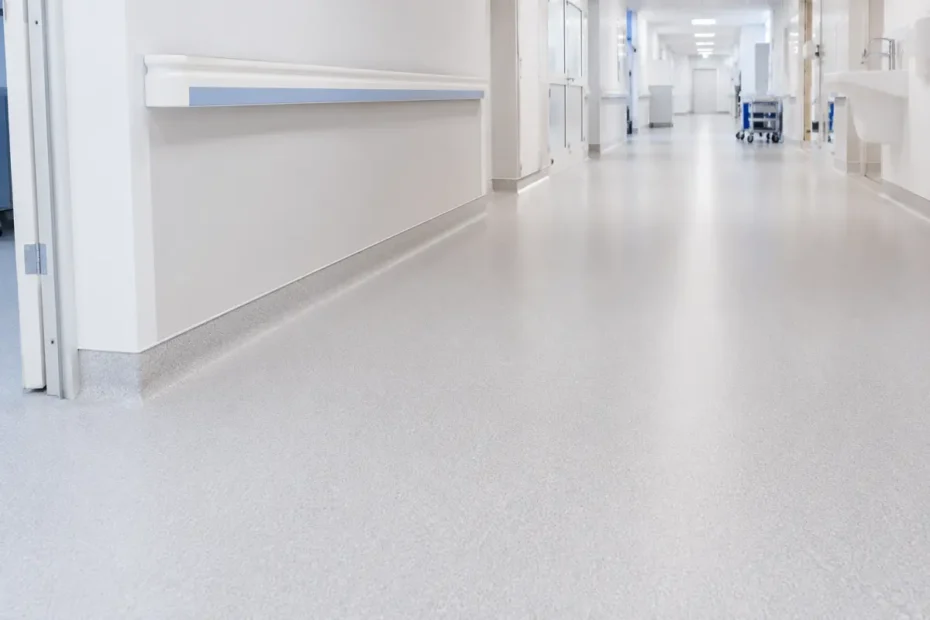
The best healthcare flooring is heat-welded, joint-free sheet vinyl with coved skirting, the clinical standard, because a healthcare floor is an infection-control and safety device, not a design choice. It leaves no seams for bacteria, survives constant disinfection, resists slips and takes heavy trolley traffic. Resin suits labs and theatres; softer LVT suits waiting areas. The decision is driven by hygiene and slip standards, not looks.
Why healthcare flooring is an infection-control decision, not a design one
Here is the reframe that governs every healthcare flooring choice, and it is unlike any home or retail floor: a healthcare floor is part of infection control and patient safety. Its job is not to look good but to perform clinically, to deny bacteria anywhere to hide, to survive constant disinfection with hospital-grade chemicals.
It must also prevent slips for staff on their feet all day and for mobility-limited patients, and take the relentless traffic of trolleys and beds.
The stakes are real: research has found that hospital floors can harbour pathogens such as C. difficile, MRSA and VRE when surfaces are not properly sealed or maintained, which is precisely why a joint-free, fully disinfectable floor matters so much.
So in healthcare, standards lead and looks and even cost come after. Every recommendation below follows from treating the floor as clinical equipment.
What a healthcare floor must do: the clinical performance demands
Because a healthcare floor is judged clinically, it helps to set out exactly what it has to deliver. Every one of these is a licensing and infection-control matter rather than a preference, and a floor that fails any of them is the wrong floor whatever it costs. The demands are:
- Joint-free hygiene, a continuous surface with no seams, gaps or corners where bacteria can collect, so it can be fully cleaned and disinfected.
- Slip safety, traction for staff and patients, especially in wet and spill-prone areas.
- Disinfectant and chemical resistance, standing up to the quaternary ammonium, bleach and hydrogen peroxide used in clinical cleaning without degrading.
- Heavy-traffic durability, taking rolling trolleys, wheelchairs and beds and heavy point loads without denting or wearing.
- A non-shedding, low-particulate surface, important in sterile and clean-room settings.
- Comfort and acoustics, because staff stand all day and patients need calm, so underfoot comfort and quiet matter where hygiene allows.
- Static control (ESD) and low-VOC, where sensitive equipment or air quality require it.
Judge any healthcare floor against this clinical checklist, not against appearance.
UAE healthcare flooring standards: DHA, DOH and MOHAP
Healthcare flooring in the UAE sits within a real regulatory framework, and knowing who sets the rules matters when you specify a floor. UAE healthcare facilities are licensed and regulated by three authorities: the Dubai Health Authority (DHA) in Dubai, the Department of Health (DOH) in Abu Dhabi, and the Ministry of Health and Prevention (MOHAP), the federal authority that also serves as the primary regulator for the Northern Emirates.
Private health facilities are licensed under Federal Law No. 4 of 2015 on Private Health Facilities, and licensing requires meeting design and layout requirements that include infection control, patient safety and accessibility. Flooring falls squarely within those infection-prevention and facility-safety requirements, so a clinical floor has to meet the hygiene and slip-safety expectations these regulators enforce.
It is worth being precise here rather than overstating it: the regulators set infection-control and safety requirements that flooring must support, and the detailed clinical benchmarks people often reference, such as the FGI guideline for a minimum integral coved base in operating rooms, or the USP 797 standards for pharmacy clean rooms, are international best-practice standards used in facility design rather than UAE-specific regulations. Read together, they point the same way: a compliant clinical floor is joint-free, coved, disinfectable and slip-safe.
Healthcare flooring rated on hygiene, slip safety and durability
The table rates the realistic healthcare options on what actually matters clinically, hygiene, slip safety, chemical resistance and durability. Ceramic tile appears only as the clinical danger case to avoid, and Urban fits vinyl, resin and specialist floors, not tile.
| Floor | Hygiene (joint-free) | Slip safety | Disinfectant / chemical resistance | Durability (trolley/bed) | Best clinical use |
|---|---|---|---|---|---|
| Heat-welded sheet vinyl (coved) | Highest | Good (safety grades available) | High | High | Wards, corridors, treatment: the clinical standard |
| Safety vinyl (slip-resistant) | High | Highest | High | High | Wet rooms, sluice, entrances, bathrooms |
| Epoxy / resin | Highest (monolithic) | Good (with additive) | Highest | Highest | Labs, pharmacies, theatres, mortuaries |
| Microcement | High (jointless) | Moderate-good | High | High | Modern clinics, wet-area feature zones |
| LVT | Moderate (has joints) | Moderate | Moderate | High | Waiting rooms, offices, non-clinical |
| VCT | Moderate (joints, needs sealing) | Moderate | Moderate | High | Budget corridors, back-of-house |
| Carpet tiles | Low (not clinical) | High | Low | Moderate | Admin and waiting areas only |
| Ceramic tile + grout (avoid clinically, we do not fit) | Low (grout harbours bacteria) | Variable | High | High | Avoid in clinical areas |
Sheet vinyl: the clinical gold standard for healthcare floors
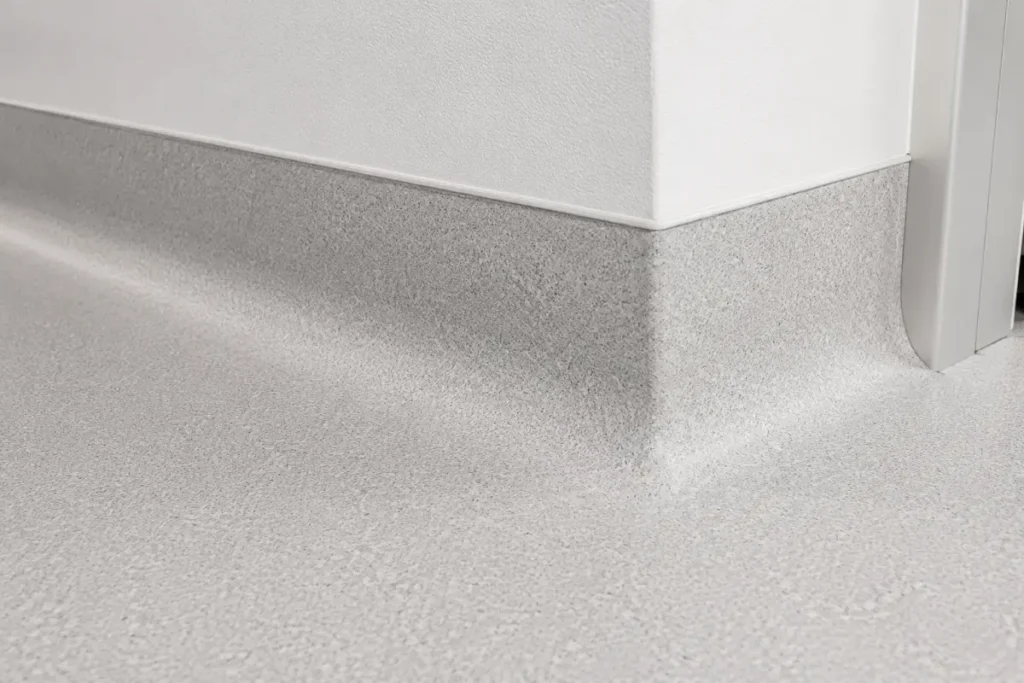
For clinical areas, one floor leads clearly, and it is the honest first recommendation: heat-welded sheet vinyl with coved skirting. Sheet vinyl and PVC flooring is laid in large continuous rolls with the seams heat-welded into a joint-free surface, and the flooring is curved continuously up the wall as an integral cove base, typically 4 to 6 inches, which removes the 90-degree floor-to-wall joint where dirt and pathogens otherwise collect.
The result is a monolithic clinical floor with no seams, gaps or corners to harbour bacteria, one that wipes and disinfects completely, resists clinical chemicals and takes heavy rolling loads. Clinical homogeneous sheet typically runs around 2 to 2.5mm, stepping to about 3mm for operating theatres. This is the single most important healthcare flooring recommendation, and it is why sheet vinyl, not tile or plank, is the clinical standard across wards, corridors and treatment rooms.
Safety vinyl for wet rooms and slip-risk areas
Wet and spill-prone areas need more grip than a standard clinical floor, so they call for a specific product: slip-resistant safety vinyl. Entrances, sluice rooms, bathrooms and any area regularly exposed to fluids need a safety vinyl with engineered slip resistance, rated against recognised measures such as DIN 51130 R-values or pendulum (PTV) testing.
The honest nuance that a good specifier watches for: the slip texture must be effective without being so aggressive that it traps contaminants and undermines cleanability, since a floor that grips but cannot be properly cleaned defeats the clinical purpose. It is a genuine hygiene-versus-grip balance, and the right safety vinyl is engineered to hold both. Specify safety grades for the wet zones and standard coved sheet for the dry clinical areas.
Epoxy and resin for labs, pharmacies and operating theatres
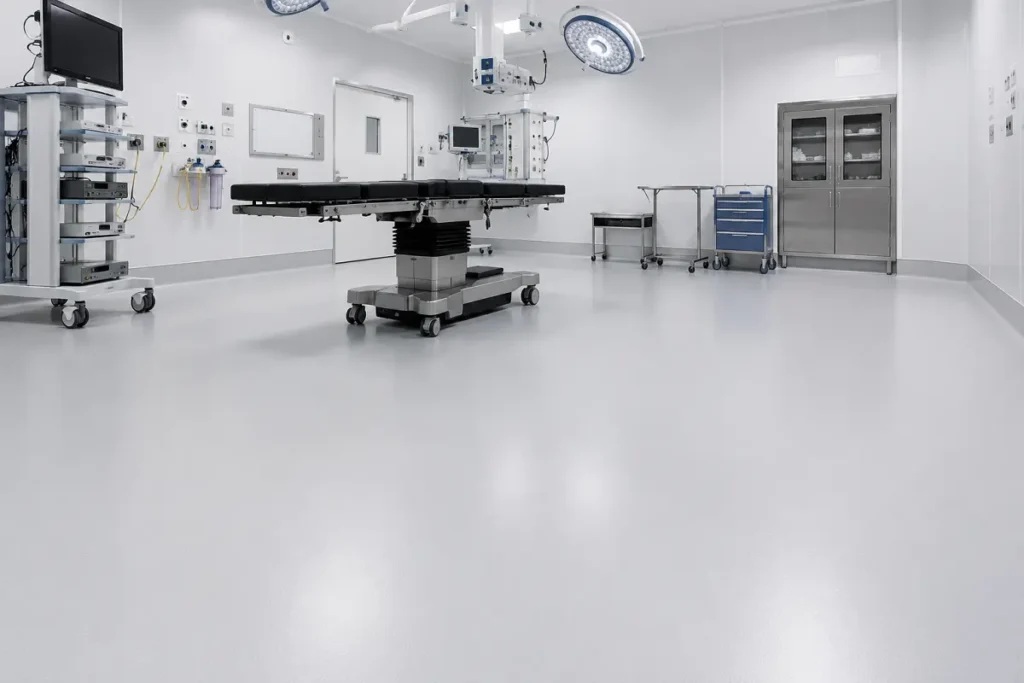
Some zones face harsher chemistry and heavier point loads than sheet vinyl is built for, and there resin leads. A joint-free, monolithic epoxy or resin floor, poured with an integral cove base, is preferred for the most demanding sterile and harsh-chemistry areas, laboratories, pharmacy clean rooms, operating theatres and mortuaries, because it offers the highest chemical resistance, a non-shedding surface and exceptional heavy point-load durability, with static-control (ESD) properties where equipment requires them.
The honest comparison by zone: resin beats vinyl where chemicals are aggressive, sterile compounding is involved, or point loads are heavy, while vinyl beats resin on patient comfort, warmth, acoustics and a quieter, softer feel underfoot. So resin goes in the labs and theatres, and coved sheet vinyl goes in the wards and patient areas. A modern clinic can also use microcement as a jointless, hard-wearing feature surface in the right zones.
LVT and softer floors for waiting rooms and admin areas
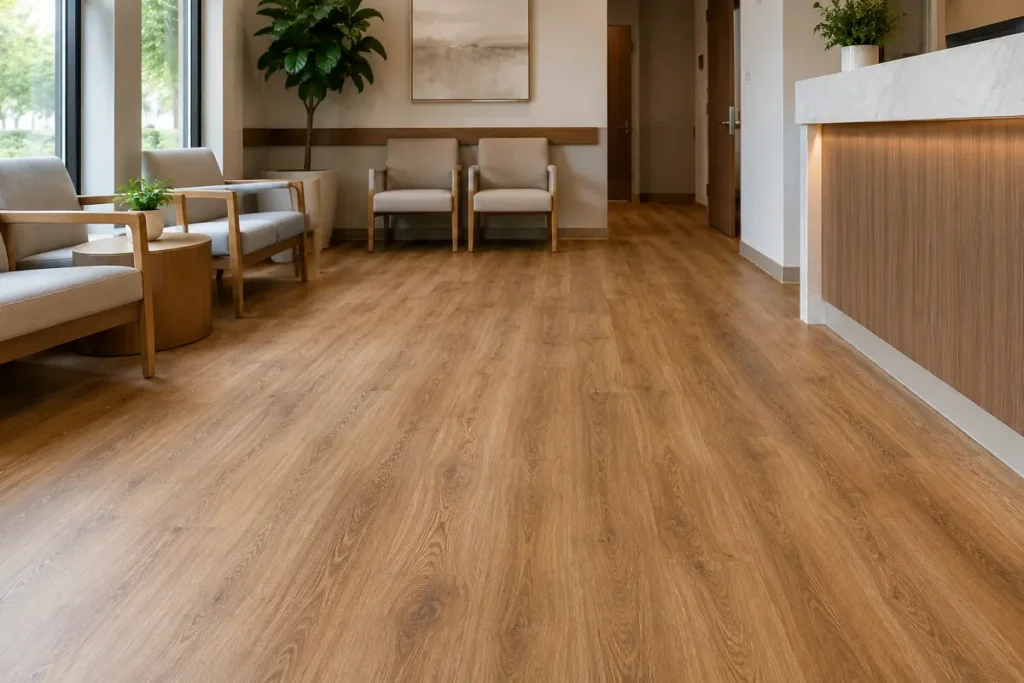
Not every part of a clinic is a clinical area, and in the non-clinical zones the rules relax sensibly toward comfort. Waiting rooms, reception, offices and admin areas are not sterile spaces, so warmer, more welcoming floors are perfectly appropriate there. LVT flooring gives a warm, realistic, comfortable finish for these areas, and carpet tiles add softness, warmth and acoustic calm to a waiting room or office.
The important caveat, and it is the lane rule that matters clinically: LVT is disqualified from clinical zones because it has a joint at every plank, which is exactly the seam a clinical floor cannot have, so it belongs only in these non-clinical areas, never in wards, treatment rooms or theatres. For the admin and office side of a facility, our guide to office flooring covers the workspace zones in more detail.
Zoning a clinic: matching the floor to each area
The real skill in healthcare flooring is not picking one floor but zoning the facility, matching each area to the right surface. A well-specified clinic typically runs several floors: heat-welded coved sheet vinyl through the clinical core of wards, corridors and treatment rooms.
Slip-resistant safety vinyl goes in wet rooms, sluice rooms and entrances; monolithic resin in laboratories, pharmacy clean rooms and operating theatres; warmer LVT or carpet tiles in the non-clinical waiting and admin areas; and, where budget is tight, VCT as a back-of-house or utility-corridor option, noting it is porous, needs sealing and cannot be flash coved, so it stays out of clinical zones. Zoning this way meets the hygiene standard where it is required and allows comfort where it is not, which is exactly how a compliant, humane facility is floored.
What to avoid in clinical areas: tile, grout and carpet
Just as important as what to specify is what to keep out of clinical areas, because two popular floors are genuinely wrong there. Ceramic and porcelain tile with grout is a clinical hygiene problem: the grout lines harbour bacteria and resist proper disinfection, so a grouted floor cannot deliver the joint-free surface a clinical area needs, whatever the tile itself is like.
Carpet is worse still in clinical zones, it traps contaminants, holds moisture and cannot be disinfected, so it has no place in a ward, treatment room or corridor. Both are floors to rule out clinically, and Urban does not fit tile in any case, we fit vinyl, resin and specialist floors.
Carpet tiles are the one nuance: acceptable in a non-clinical waiting room or office for warmth and acoustics, never in a clinical space. In the clinical core, joint-free is the rule, and tile-and-grout and carpet break it.
What healthcare flooring costs in the UAE
Healthcare flooring is priced as much by installation as by material, which is the key to budgeting it properly. Supplied and fitted, the indicative material bands run: sheet vinyl and PVC about AED 22 to 180/sqm (about AED 2.0 to 16.7/sqft).
Epoxy and resin run about AED 50 to 250/sqm (about AED 4.6 to 23.2/sqft), microcement about AED 150 to 500/sqm (about AED 13.9 to 46.5/sqft), LVT about AED 45 to 350/sqm (about AED 4.2 to 32.5/sqft), VCT about AED 45 to 140/sqm (about AED 4.2 to 13.0/sqft), and carpet tiles about AED 35 to 130/sqm (about AED 3.3 to 12.1/sqft). The honest point about clinical sheet vinyl: the material is mid-range, but the real value is in correct installation, the heat-welded seams and coved skirting are skilled specialist labour, and a poorly welded clinical floor fails on hygiene however good the roll was. Moisture testing and mitigation before laying prevent early failure. So budget for specialist fitting, not just the material, and expect clinical floors to be quoted per facility after a site visit. All figures exclude 5% VAT. For the full breakdown across every floor type, see our flooring cost guide.
Which floor suits which clinical space?
The right healthcare floor follows the zone and its clinical demands. A ward, a sluice room, a laboratory and a waiting room are four different specifications, and the line between clinical and non-clinical is what decides each one. Match the floor to the zone:
- Wards, corridors and treatment rooms: heat-welded, coved sheet vinyl, the clinical standard.
- Wet rooms, sluice rooms and entrances: slip-resistant safety vinyl.
- Labs, pharmacies and operating theatres: monolithic epoxy or resin.
- Waiting rooms, reception and admin: warmer LVT or carpet tiles, non-clinical only.
- Never in clinical areas: tile-and-grout or carpet.
If you are planning a whole facility and want the full method, start with our guide on how to choose flooring.
Healthcare flooring: frequently asked questions
Why is sheet vinyl used in hospitals and clinics?
Because heat-welded, joint-free sheet vinyl with coved skirting leaves no seams, gaps or corners for bacteria, wipes and disinfects fully, resists clinical chemicals and takes heavy trolley traffic. It is installed in large continuous rolls with the seams heat-welded and the skirting curved up the wall, making it the clinical standard for infection control and patient safety.
What is coved skirting in healthcare flooring?
Coved skirting is where the floor curves continuously up the wall instead of meeting it at a 90-degree angle, forming an integral cove base usually 4 to 6 inches high. It removes the floor-to-wall joint where dirt and bacteria collect, so the floor and skirting clean as one continuous surface. It is a defining feature of a clinical floor.
Is vinyl or epoxy better for a clinical floor?
It depends on the zone. Heat-welded coved sheet vinyl suits wards, corridors and treatment rooms, warmer and quieter for patients and staff. Monolithic epoxy or resin suits labs, pharmacies and operating theatres, where chemical resistance, heavy point loads and sterile compounding demand it. Vinyl wins on comfort and acoustics; resin wins on harsh chemistry and durability.
What flooring is best for a dental clinic?
Heat-welded, joint-free sheet vinyl with coved skirting, the clinical standard, in the surgery and treatment areas, for full disinfection and infection control. Slip-resistant safety vinyl suits any wet or sluice areas, and warmer LVT or carpet tiles suit the non-clinical waiting room and reception. The clinical treatment zones need the joint-free coved floor.
Is antimicrobial flooring necessary in a clinic?
It helps but is not a substitute for the system. Antimicrobial-treated vinyl inhibits surface bacteria and fungi and adds a layer of defence, but clinical hygiene comes from the whole system: a joint-free heat-welded floor, coved skirting and proper disinfection. Antimicrobial treatment supports that system rather than replacing joint-free installation and regular cleaning.
Can you use LVT or laminate in a hospital?
Only in non-clinical areas. LVT has a joint at every plank, so it is disqualified from clinical zones that need a joint-free surface, though it is fine in waiting rooms, offices and admin areas. Laminate is not a clinical floor at all, as it is not built for constant disinfection or heavy wet-area use. Clinical zones need heat-welded coved sheet vinyl.
What flooring is best for an operating theatre?
A joint-free, monolithic floor, either heat-welded sheet vinyl at around 3mm with coved skirting, or a poured resin floor with an integral cove base, often with static-control properties. Both give a continuous, disinfectable, chemical-resistant surface with no seams for bacteria. International design guidance calls for a coved base in operating rooms, which both options provide.
Is carpet allowed in healthcare facilities?
Not in clinical areas. Carpet traps contaminants and moisture and cannot be disinfected, so it has no place in wards, treatment rooms or corridors. Carpet tiles are acceptable only in non-clinical waiting rooms, offices and admin areas, where they add warmth and acoustic comfort. Clinical zones need a joint-free, fully disinfectable floor such as heat-welded sheet vinyl.
The bottom line: the best floor for a UAE clinic or hospital
Healthcare flooring is the most standards-driven flooring decision there is, so hygiene and patient safety lead and looks come last. Heat-welded, joint-free sheet vinyl with coved skirting is the clinical gold standard for wards, corridors and treatment rooms, because it leaves nowhere for bacteria and disinfects completely; slip-resistant safety vinyl handles wet and sluice areas; and monolithic resin suits the labs, pharmacies and theatres where chemistry and point loads are harshest.
Warmer LVT and carpet tiles belong only in non-clinical waiting and admin areas, never in clinical zones, and tile-and-grout and carpet are ruled out of clinical space entirely. UAE facilities answer to DHA, DOH and MOHAP, whose licensing builds infection control and safety into the design, and the value of a clinical floor is as much in the specialist welded-and-coved installation as in the material.
Zone the facility properly, and a free site visit will confirm a compliant floor area by area.
Specify a compliant healthcare floor with a free site visit
Planning or refurbishing a clinic, hospital or medical facility in Dubai or across the UAE? Message us on WhatsApp and a flooring specialist will help you specify a compliant floor zone by zone, heat-welded coved sheet vinyl for the clinical areas, safety vinyl for wet rooms, resin for labs and theatres, and warmer options for waiting and admin, installed to the hygiene standard your facility has to meet.
- WhatsApp us: +971 56 689 9831
- Call: +971 56 689 9831
- Request a free site visit and quote across Dubai and Abu Dhabi.
We have supplied and fitted specialist floors across the UAE since 2013, with more than 10,000 projects completed by our in-house team.

Junaid Rana is a content strategist with over 10 years of experience in the interior and fit-out industry, writing on flooring, finishes and fit-out across UAE homes and commercial spaces. His guides are reviewed for accuracy by Urban Flooring’s in-house experts.