

Reviewed for accuracy by Muhammad Gulbadin, founder and operations manager at Urban Flooring, 15+ years in UAE flooring.
Four things separate a good Dubai flooring company from a bad one: a valid trade licence, who actually does the fitting, what the written quote covers, and what happens when something goes wrong. The nine questions below test those four. Ask them of every company you shortlist, including this one.
How to Choose a Flooring Company in Dubai
Judge a Dubai flooring company on four things and ignore the rest. First, a valid UAE trade licence you can verify yourself. Second, whether the company fits the floor or only sells it. Third, whether the written quote names the product, the rate and the preparation work. Fourth, what the company does when the floor fails six months later.
Everything else is noise. The table below turns those four into nine checks.
| What to check | Good sign | Warning sign |
|---|---|---|
| Trade licence | Licence number shown on the website, invoices and quotes, and it matches the company name when you search it | Number not published, or the licensed name differs from the trading name with no explanation |
| Supply and install | One company supplies the material and fits it, so one party owns the outcome | Material sold by one party and fitted by another with no single point of responsibility |
| Fitting team | A straight answer, whether in-house or subcontracted, plus who supervises the crew and who returns for a callback | Vague answer, or “our partners” without naming who is accountable |
| Written quote | Product named by brand and range, rate per sqm, preparation and finishing listed as separate lines | A single lump sum with no breakdown, or a verbal price only |
| Site measurement | Free, no obligation, and the quantity is stated in the quote | Pressure to sign at the visit, or a fee that is only refundable against an order |
| Workmanship guarantee | A stated period in writing, separate from the manufacturer’s product warranty | “We stand behind our work” with no period and nothing on paper |
| Completed projects | Named UAE projects with real photographs of their own work | Stock photography only, or images with no location or material stated |
| Subfloor problems | The company inspects before quoting and says in advance how extra work is priced | No subfloor discussion at all before the quote is issued |
| After installation | A named contact, a stated response time, and a clear split between product and workmanship | No process described, or every fault referred to the manufacturer |
Does the Flooring Company Hold a Valid UAE Trade Licence?
Every business trading legally in Dubai holds a trade licence, and you can check one yourself in about a minute. Invest in Dubai runs a public service called Search License Information, which lets you search by licence number, Dubai Unified Licence number, English business name or Arabic business name. A company that will not give you its number is telling you something.
A licence matters for a practical reason rather than a bureaucratic one. If the work goes wrong and you need to escalate, you need a licensed entity to escalate against. An unlicensed operator leaves you with nothing to point at.
Two details are worth checking. The licensed name often differs from the trading name, which is normal, but the company should explain the link without hesitating. And the licensed activity should cover flooring or fit-out work rather than something unrelated.
Do They Supply and Install, or Supply Only?
Supply-and-install means one company sells the material and fits it, so one party is responsible when something goes wrong. Supply-only means you buy the material and arrange your own fitter, which is cheaper and puts the risk on you. The difference matters most when a floor fails, because a supplier and an independent fitter will each point at the other.
Most flooring failures are arguable. A lifting plank can be a manufacturing fault, a subfloor moisture problem, or a fitting error, and often nobody can prove which. Where one company did both, that argument does not happen.
Supply-only is a legitimate choice and worth saying so plainly. If you already have a fitter you trust, or you are covering a large area on a tight budget, buying material directly and paying a fitter separately can save real money. Go in knowing that you are taking on the coordination and the risk yourself.
Is the Flooring Fitting Team In-House or Subcontracted?
In-house means the company employs the fitters. Subcontracted means it hires crews for each job. Both models work in Dubai, and subcontracting is normal across the fit-out trade rather than a warning sign in itself. What matters is whether the company supervises the crew, stands behind the work regardless of who did it, and sends someone back when there is a callback.
The honest case for in-house is consistency. The same team learns the company’s standards, and there is no gap between who sold the job and who performed it.
The honest case for subcontracting is capacity and specialism. A firm that subcontracts can put a resin crew on a resin job and a carpet crew on a carpet job rather than asking one team to be good at everything, and it can scale to a large villa without making you wait. Plenty of well-run Dubai contractors work this way.
The question to ask is not which model they use. It is: who supervises the crew on site, and who comes back if a joint opens in three months? A company that answers both clearly is fine either way. A company that says “our partners handle that” has told you nobody owns the problem.
What Does the Written Flooring Quote Actually Include?
A complete flooring quote names the product by brand and range, states the rate per square metre, gives the measured area, and lists preparation and finishing as separate lines. Anything presented as a single lump sum is hiding where the money goes, and it makes comparing two quotes impossible. Get it in writing before you commit to anything.
The lines most often missing are the ones that cost money later. Subfloor preparation and levelling. Underlay, where the floor needs one. Removal and disposal of the existing floor. Skirting or scotia beading. Transition strips at doorways. Door trimming. Waste allowance on the material order.
None of those are optional extras invented to inflate a bill. They are part of nearly every job. A quote that omits them is not cheaper, it is incomplete, and the difference turns up as a variation once the work has started.
Two quotes are only comparable when both list the same scope. If one names a specific product and the other says “premium vinyl”, you are not comparing prices, you are comparing a specification against a guess.

Is the Site Measurement Free, and Is It Binding?
A free site measurement should mean two separate things, and buyers usually only check the first. It should cost nothing and carry no obligation to order. It should also produce a measured quantity that appears in the written quote, so you know what area you are being charged for. Ask both questions, because free and binding are not the same promise.
The reason this matters is that area drives the whole price. If the quote gives a rate per square metre but no measured area, the total can move after the order without anyone appearing to change the rate.
Ask what happens if the measured quantity turns out to be wrong. A company that measured the space should carry that risk rather than passing a shortfall to you mid-job. Be wary of a surveyor who needs a signature today, because that is a sales visit rather than a measurement.
What Workmanship Guarantee Is Offered, and in Writing?
A workmanship guarantee covers the fitting. A product warranty covers the material. They are different promises from different parties, and most flooring disputes fall into the gap between them. Ask for the workmanship guarantee as a stated period in writing, because a manufacturer’s warranty does not cover a floor that was laid badly or over a subfloor that was never tested.
Here is how the gap works in practice. A plank lifts at a joint. The manufacturer says the board is sound and the problem is installation. The fitter says the board failed. Without a written workmanship guarantee, you are in the middle of that argument with nothing to enforce.
What a good answer looks like: a defined period, a description of what is covered, and what voids it. What a poor answer looks like: “we stand behind our work”, with nothing written down and no period named.
Get it before you sign, not after. A guarantee offered verbally at the quote stage and never documented does not exist when you need it.
Can They Show Completed Flooring Projects in the UAE?
Real evidence is a named UAE project with photographs of that company’s own work, the material stated, and enough detail that the job could be verified. Stock photography proves nothing, and neither does a gallery of images with no location, no material and no date. Ask to see work of the same type and scale as yours.
The detail separates evidence from decoration. A genuine write-up says what the space was, what was laid and what the subfloor needed. Type also matters more than volume: a company with a hundred carpet jobs and no resin work is the wrong choice for a resin floor, whatever the total project count says.
Our completed projects page is the standard to compare against, with each job documented by material, property type and what the fitting involved.
How Do They Handle Subfloor Problems Found on the Day?
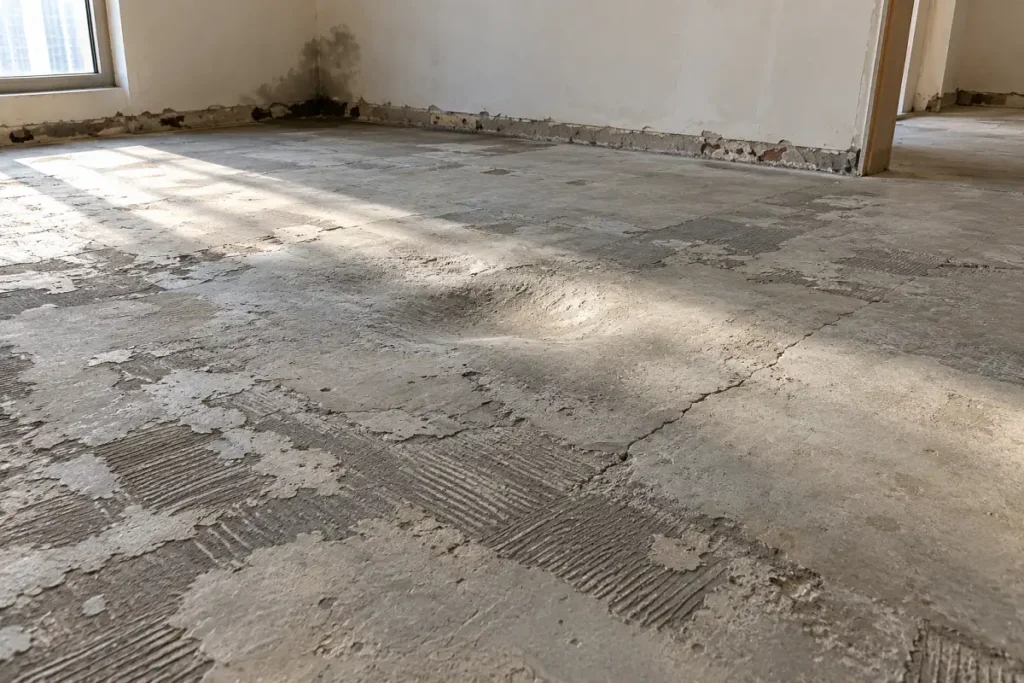
Subfloor problems are the single most common reason a flooring bill goes up mid-job. A damp slab, a floor out of level, or an old adhesive bed that has to come off all turn into extra work once the fitters arrive. The right answer is that the company inspects the subfloor before quoting and tells you in advance how any extra work will be priced.
The wrong answer is silence. A quote issued without anyone looking at the subfloor is a quote that will change, and by then you have an empty room and a crew on site.
Ask three things. Will someone inspect the subfloor before the quote is issued? How is extra preparation priced? And who decides whether it is necessary?
The last one matters most. A company that can declare extra work necessary and price it on the spot, with your furniture already moved, has you in a weak position. Agree the mechanism before anyone starts.
What Happens If the Floor Fails After Installation?
Ask who you call, what is covered, and how quickly someone comes out. A good answer names a contact, gives a response time, and separates a product fault from a fitting fault so you know which promise applies. A company that refers every problem to the manufacturer has quietly told you it takes no responsibility for its own work.
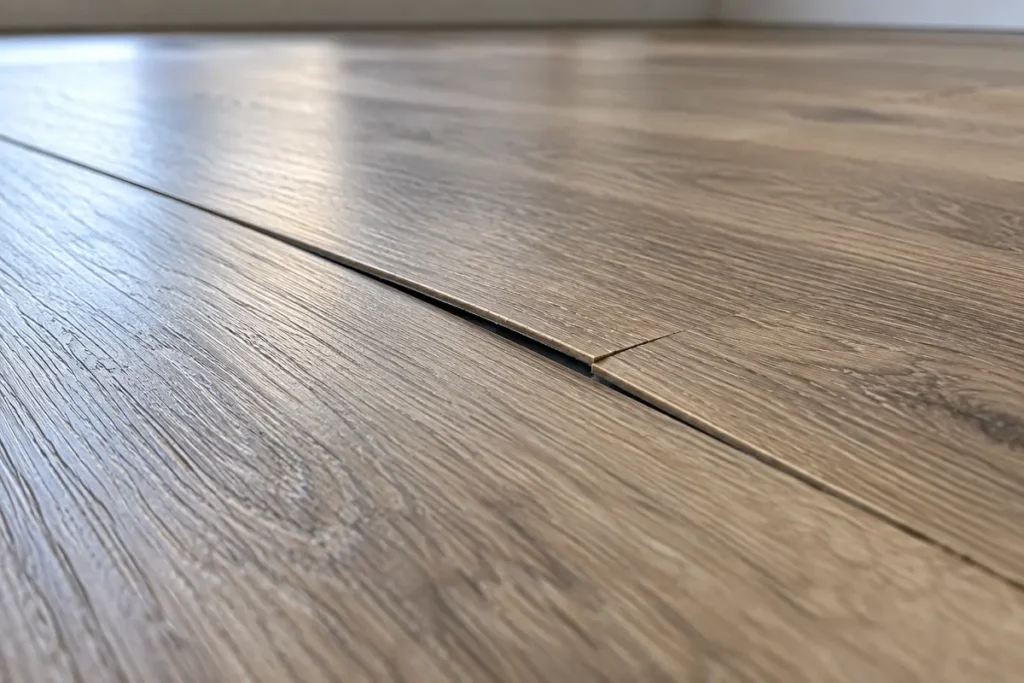
Most post-installation problems are small and fixable: a joint opening, a lifted edge, a transition strip working loose. Find out whether the company keeps a record of what was laid in your property. Matching a replacement plank two years on is straightforward if the range and batch are on file, and close to impossible if they are not.
Red Flags in a Dubai Flooring Quote
Check any flooring quote against these warning signs before you sign. A lump sum with no breakdown. No product brand or range named. No measured area. No mention of the subfloor. A discount that expires today. A large deposit demanded before any material is ordered. No trade licence number anywhere. No written guarantee. Cash only, with no formal invoice.
Any one of these on its own may have an explanation worth hearing. Three or more together is a pattern, and the pattern usually ends with a variation you did not expect or a floor nobody will come back to fix.
The deposit one deserves particular attention. A deposit covering material is normal, because the company has to order your floor. A deposit that covers most of the job before anything is delivered is not.
What a good answer looks like in practice. Urban Flooring has supplied and fitted floors across Dubai and Abu Dhabi since 2013, with more than 10,000 completed projects, an in-house fitting team rather than subcontractors, and a trade licence, 130570, registered in Al Quoz, Dubai. Our company background sets all of that out, and it is there so you can check it rather than take it on trust. Run the nine questions against us the same way you would run them against anyone else.
Choosing a Flooring Company FAQs
How do I check if a Dubai flooring company is licensed?
Search the company on Invest in Dubai’s Search License Information service, which accepts a licence number, a Dubai Unified Licence number, or the business name in English or Arabic. Ask the company for its licence number first, in writing. A licensed company publishes it on quotes and invoices and will give it without hesitation.
Should I buy flooring and hire a fitter separately?
Only if you already have a fitter you trust. Buying material and arranging fitting separately is cheaper, but it splits responsibility, so a supplier and a fitter can each blame the other when a floor fails. Supply and install from one company costs more and gives you a single party to hold accountable.
Is an in-house fitting team better than subcontractors?
Not automatically. Subcontracting is normal in Dubai fit-out and works well where the contractor supervises the crew and stands behind the result. In-house teams give more consistency. What matters is whether one company owns the outcome, so ask who supervises on site and who returns for a callback, rather than which model they use.
What should be included in a flooring quote in Dubai?
The product named by brand and range, the rate per square metre, the measured area, and separate lines for subfloor preparation, underlay, removal of the old floor, skirting or beading, transition strips and waste allowance. A lump sum with no breakdown cannot be compared against another quote and usually grows later.
Do flooring companies in Dubai charge for site measurement?
Many offer it free, but check what free means. It should cost nothing, carry no obligation to order, and produce a measured quantity that appears in your written quote. Ask who carries the risk if the measurement is wrong. Be wary of a surveyor who needs a signature before leaving the property.
What guarantee should a flooring company give?
Ask for a workmanship guarantee in writing, with a stated period, covering the installation itself. That is separate from the manufacturer’s product warranty, which covers the material only. Most disputes fall in the gap between the two, because a product warranty does not cover a floor laid badly or over an untested subfloor.
Who pays if the subfloor needs extra work?
Agree this before work starts, not on the day. A good company inspects and tests the subfloor before issuing the quote, and states in advance how any extra preparation is priced. If nobody has looked at your subfloor before quoting, expect the price to change once the fitters arrive.
What are the warning signs of a bad flooring quote?
A lump sum with no breakdown, no product brand named, no measured area, no mention of the subfloor, a discount expiring today, a large deposit before material is ordered, no licence number, no written guarantee, and cash only with no invoice. One may be explainable. Three together is a pattern.
Take These Nine Questions to Every Company You Shortlist
These nine questions work because they test what a flooring company actually controls: whether it is licensed, who lays the floor, what the quote really covers, and what it does when something fails. None of them require you to know anything about flooring materials.
If you are still deciding what to lay rather than who should lay it, that is a different question, and our guide to choosing the right floor for each room works through traffic, moisture, climate and budget in order.
Ask all nine of every company on your list. Ask them of us too. A company that gives straight answers to all nine has earned the job, and one that dodges two of them has told you what working with it will be like.
Get a Free Site Visit and a Written Quote
Ready to put these questions to us? Message us on WhatsApp or request a free site visit. We will measure your space, put the product name, the rate and the preparation work in writing, and answer every one of the nine questions above before you commit to anything.
Get Free Quote WhatsApp Us Call +971 56 689 9831
Established 2013. More than 10,000 projects. In-house fitting team. Free site measurement.

Junaid Rana is a content strategist with over 10 years of experience in the interior and fit-out industry, writing on flooring, finishes and fit-out across UAE homes and commercial spaces. His guides are reviewed for accuracy by Urban Flooring’s in-house experts.