
Reviewed for accuracy by Muhammad Gulbadin, founder and operations manager at Urban Flooring, 15+ years in UAE flooring.
The UAE climate rewards floors that stay dimensionally stable in heat and humidity and resist fading. SPC and rigid-core vinyl lead for most homes, stable, waterproof and heat-tolerant. Engineered wood holds its shape where solid wood moves; epoxy and microcement are hard and humidity-proof. Organic floors like solid wood, laminate, cork and bamboo need dry, air-conditioned interiors. Match the floor to the exposure.
What the UAE climate actually does to a floor
Before choosing a floor here, it helps to understand what the UAE actually puts one through, because the climate stresses a floor in four distinct ways, and each shows up as a specific defect. Heat, humidity swings, the concrete slab and the sun each leave their own mark:
- Sustained heat. High temperatures make materials expand and contract, and even dimensionally stable floors move a little, which is why expansion gaps and the right adhesive matter. Heat also stresses glues under a stuck-down floor.
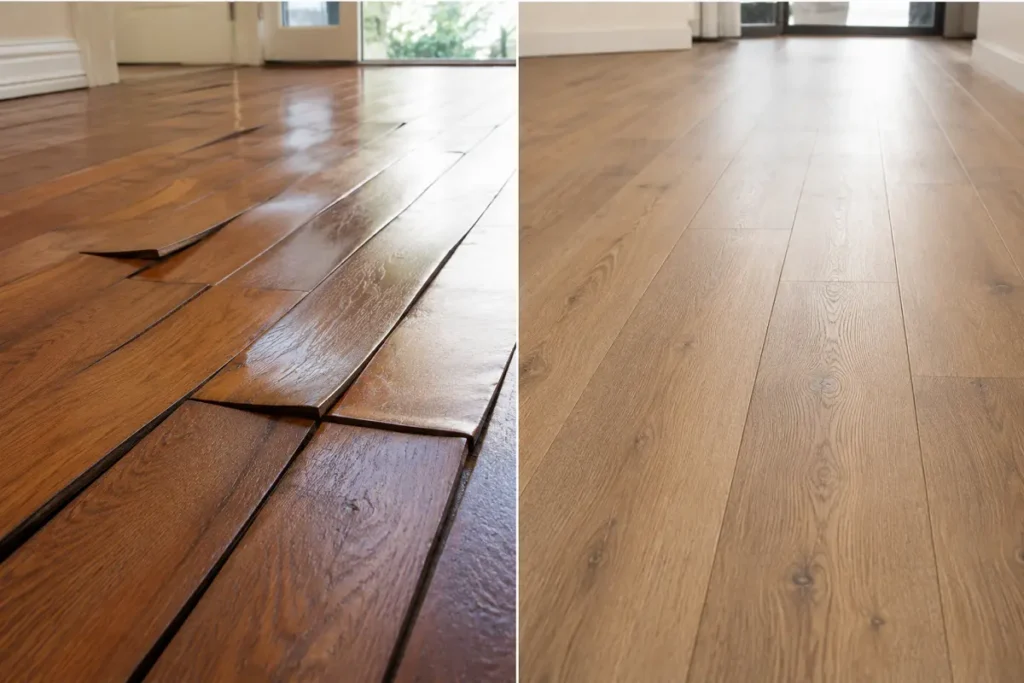
- Big humidity swings. This is the real culprit. Air conditioning cycles the indoor humidity up and down, and organic materials absorb moisture from the air and swell, then shrink as it drops. That constant back-and-forth is what creates gaps, cupping (where board edges rise higher than the middle) and buckling.
- The concrete slab. Almost every UAE home sits on a concrete or screed base. Boards laid over it expand at different rates and gaps can open between them, and slab moisture can attack the adhesive bond.
- Strong UV through glazing. Sun pouring through floor-to-ceiling windows fades and discolours floors over time, a factor covered in its own section below.
There is a useful benchmark that ties it all together: holding an interior at around 30 to 50% relative humidity and a stable temperature keeps even organic floors calm. In other words, it is the swings, not the steady heat on its own, that do the damage. A floor that survives the UAE is dimensionally stable, heat-tolerant and, ideally, fade-resistant.
UAE flooring rated for heat, humidity and sun: the comparison table
The table rates the realistic options against the three climate stressors that decide a floor here. Porcelain tile appears as honest context, the most climate-proof surface on the physics, but Urban fits vinyl, wood and resin, not tile.
| Floor | Heat stability | Humidity tolerance | Fade resistance | Best UAE use |
|---|---|---|---|---|
| SPC / rigid vinyl | High | High (waterproof, stable) | Good (UV-stable specs) | Most homes, all-rounder |
| LVT | High | High (water-resistant) | Good | Living areas, design-led |
| Porcelain tile (context, we do not fit) | Highest | Highest | Highest | The traditional default |
| Engineered wood | High | Moderate-high (stable core) | Moderate (darker fades) | Dry living areas, real-wood look |
| Epoxy / microcement | High | High (humidity-proof) | Good | Hard-use, showrooms, wet-prone |
| Solid wood / parquet | Moderate | Low (moves, gaps) | Moderate | Managed-humidity interiors only |
| Laminate | Moderate | Low-moderate (HDF core swells) | Moderate | Dry, AC-controlled rooms |
| Cork / bamboo | Moderate | Low-moderate (organic) | Moderate | Dry interiors, humidity managed |
The most climate-stable floors: SPC, rigid vinyl and the tile you would expect
For most UAE homes, the standout climate floor is rigid-core vinyl. SPC flooring is made from PVC with a dense stone core, and that build makes it dimensionally stable, waterproof and heat-tolerant over concrete, so it does not warp, swell or buckle the way wood and laminate can through heat and humidity swings.
It is the all-rounder for UAE conditions, and it happens to be among the most affordable floors too. LVT flooring is close behind, stable and water-resistant with the most realistic wood and stone looks. The wider rigid-vinyl family, including waterproof, stable WPC flooring and PVC and sheet vinyl, shares the same climate advantage, and all of it sits within the vinyl flooring category.
Here is the honest concession the physics demands: porcelain tile is actually the most climate-proof floor of all. It is cool underfoot, totally dimensionally stable, absorbs under 0.5% of its weight in water and does not fade, which is exactly why it is the traditional UAE default. We will not pretend a vinyl beats it on pure climate resistance. What we will say is that tile is cold and hard underfoot, and that Urban fits vinyl, wood and resin, not tile, so for buyers who want warmth, quiet and a realistic wood or stone look without tile’s hardness, the stable floors above are the practical answer.
Wood in UAE heat and humidity: why engineered beats solid
Real wood can work in the UAE, but the type matters enormously, and the honest rule is to choose engineered over solid. Engineered wood flooring has a cross-layered core that resists the movement, cupping and gapping that solid timber suffers as humidity swings, especially over a concrete slab, while still giving a genuine hardwood surface.
Solid wood, being one piece of timber, absorbs and releases moisture and moves the most, which is why it is the riskiest wood floor here and needs carefully managed humidity. Engineered is the stable-wood exception, not waterproof, so still for dry interiors rather than wet areas, but far better suited to UAE homes. For the full head-to-head on this, see our engineered vs solid wood guide.
Epoxy and microcement: hard resin floors that ignore humidity
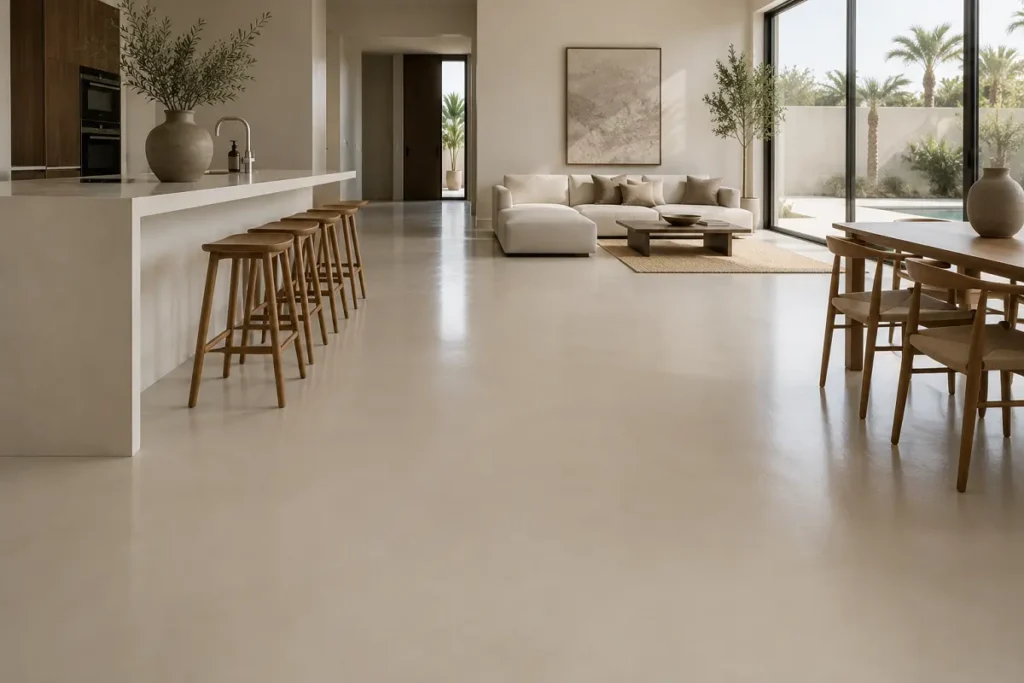
For hard-use spaces, resin floors are about as climate-indifferent as a floor gets. Epoxy flooring and microcement flooring are poured as a jointless, monolithic surface that is heat-stable and effectively unaffected by humidity, with no boards to gap and no organic core to swell.
That makes them a strong choice for showrooms, hard-use areas and humidity-prone spaces where a stable, continuous floor matters. They cost more than vinyl, and microcement in particular is a premium finish, but in the right space they earn it by simply not reacting to the conditions that move other floors.
Which floors need humidity care: solid wood, laminate, cork and bamboo
Some floors are not ruled out in the UAE, but they come with an honest condition: keep them dry and humidity-managed. Solid wood moves, cups and gaps as humidity swings, worst of all over concrete. Laminate has a fibreboard core that swells if moisture or sustained high humidity reaches it. Cork and bamboo are organic too, so they shift with the conditions.
None of these is a bad floor, and all are fine in a dry, air-conditioned interior held around 30 to 50% humidity, but none belongs in a damp or wet-prone area. If you love one of these looks, the trick is controlling the indoor humidity and keeping it out of the bathroom and kitchen. The wood-stability detail is covered in our engineered vs solid wood guide, and the natural-floor options in our eco-friendly flooring guide.
Sunlight and fade: the UV factor most UAE flooring guides ignore
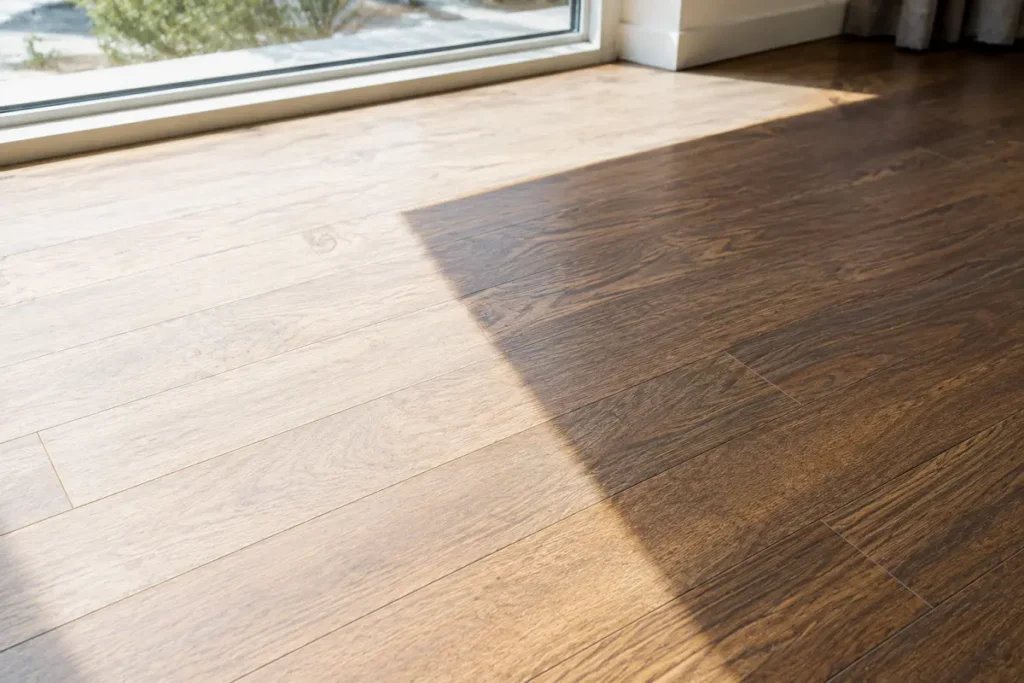
Here is the stressor most flooring guides skip entirely, and in a country this sunny that is a real omission: strong UV through glazing fades floors over time. Sun pouring through large windows gradually discolours and lightens a floor, and darker woods show it fastest, with some vinyls fading too if they are not UV-stable. In a sun-flooded UAE room, this is a genuine long-term factor, not a footnote.
The good news is that it is manageable once you plan for it. Specify a UV-stable or fade-resistant finish, many quality vinyls, laminates and engineered woods carry UV-cured or aluminium-oxide coatings that resist it, and avoid the very darkest woods in the most sun-exposed rooms. Then cut the UV reaching the floor: blinds or curtains on sun-facing windows, and solar or window film on the glazing, both noticeably reduce fading and heat build-up. Porcelain, for the record, is fade-proof, but a UV-stable vinyl or engineered floor plus sensible shading holds its colour well.
Heat, humidity and wet areas: where waterproofing takes over
It is worth drawing one clear line, because two different things get muddled: ambient heat and humidity are not the same as standing water. Everything above is about a floor staying stable in hot, humid air. A bathroom, a shower or a wet-prone utility area is a different question, there, the deciding factor is outright waterproofing, not just dimensional stability.
Rather than repeat that here, our guide to the best waterproof flooring options in the UAE covers which floors genuinely handle water contact and how to detail a wet area properly. For ambient climate, read on; for wet rooms, start there.
What climate-suitable flooring costs in the UAE
Climate-suitable flooring does not have to be expensive, and that is the reassuring part. Supplied and fitted, the indicative bands run: SPC about AED 35 to 150/sqm (about AED 3.3 to 13.9/sqft), LVT about AED 45 to 350/sqm (about AED 4.2 to 32.5/sqft).
Engineered wood runs about AED 100 to 300+/sqm (about AED 9.3 to 27.9+/sqft), epoxy about AED 50 to 250/sqm (about AED 4.6 to 23.2/sqft), and microcement about AED 150 to 500/sqm (about AED 13.9 to 46.5/sqft). The honest takeaway: the most climate-stable all-rounder, SPC, is also among the cheapest, so climate-proofing your floor does not mean overspending, while resin and engineered wood cost more but earn it in the right space. All figures exclude 5% VAT and depend on grade and site. For the full breakdown across every floor type, see our flooring cost guide.
Which floor suits which UAE space?
The right floor follows the room and, above all, its exposure to sun and moisture. A sun-flooded living room, a humid utility space and a dry air-conditioned bedroom each point to a different floor, and a wet room is a separate question altogether. Match the floor to the exposure:
- Sun-facing living areas: stable SPC, LVT or engineered wood in a UV-stable, fade-resistant finish, with blinds or solar film.
- Hard-use or humidity-prone spaces: SPC or a resin floor, epoxy or microcement, for a stable surface that ignores humidity.
- Dry, air-conditioned bedrooms: engineered wood, or cork if you keep the humidity managed, for warmth underfoot.
- Wet areas (bathrooms, kitchens): waterproofing decides here, so see the waterproof flooring guide.
The single most reliable all-rounder across UAE conditions remains stable, waterproof SPC, which is why it is the default recommendation for most homes.
Flooring for the UAE climate: frequently asked questions
What is the best flooring for the UAE climate?
SPC and rigid-core vinyl are the best all-round choice for most UAE homes, dimensionally stable, waterproof, heat-tolerant and affordable. Engineered wood suits those wanting a real-wood look that holds its shape, and epoxy or microcement suit hard-use spaces. The key in the UAE is dimensional stability through heat and big humidity swings, which is exactly where these floors hold up.
Does flooring expand or warp in UAE heat and humidity?
Organic floors can. Solid wood absorbs and releases moisture, so it moves, cups and gaps as humidity swings; laminate’s fibreboard core swells if moisture reaches it; cork and bamboo shift too. SPC, LVT and resin floors stay dimensionally stable through heat and humidity, which is why they suit the UAE. Keeping interiors around 30 to 50% humidity also helps every floor stay calm.
Is vinyl flooring good for hot climates?
Yes, SPC and rigid-core vinyl are among the best UAE choices. Made largely from PVC with a stone core, they are dimensionally stable, waterproof and heat-tolerant over concrete, so they do not warp, swell or buckle the way wood and laminate can. Quality vinyl handles the heat and big humidity swings that move solid wood and swell laminate cores.
Can you have real wood flooring in the UAE?
Yes, but choose engineered over solid. Engineered wood’s cross-layered core resists the movement, cupping and gapping that solid wood suffers in heat and humidity, especially over a concrete slab, while still giving a genuine hardwood surface. Keep it in dry, air-conditioned interiors rather than damp or wet-prone areas, and it performs well in UAE homes.
Which flooring does not fade in UAE sunlight?
Porcelain and quality UV-stable vinyl resist fading best. Darker woods and some vinyls can fade in strong direct sun over time, a real factor in sun-flooded UAE rooms that many guides ignore. Choosing a UV-stable or fade-resistant finish, and using blinds or solar window film on sun-facing floors, noticeably reduces fading and keeps the colour true for longer.
Is laminate flooring OK for UAE humidity?
Only in dry, air-conditioned rooms. Laminate’s fibreboard core can swell if moisture or sustained high humidity reaches it, so keep it away from damp and wet-prone areas. It handles dry heat reasonably and often includes UV protection, but for a similar wood look with far better humidity tolerance, SPC is the more climate-proof choice in the UAE.
What flooring is best for a sun-facing room in the UAE?
A dimensionally stable, UV-stable floor: SPC, LVT or engineered wood in a fade-resistant finish. Pair it with blinds or solar film to cut UV and heat build-up through the glazing. Avoid very dark woods, which show fade fastest in strong direct sun. The goal is a floor that holds both its shape and its colour under sustained sunlight.
Is porcelain tile the only option for the UAE climate?
No. Porcelain is the most climate-proof floor, stable, waterproof and fade-proof, but it is cold and hard underfoot. For warmth, quiet and a wood or stone look, stable SPC, LVT, engineered wood and resin floors are practical alternatives that handle UAE heat and humidity well. We fit those rather than tile, so we would guide you to the right stable option.
The bottom line: the best floor for the UAE climate
The UAE climate comes down to one demand: dimensional stability through heat and big humidity swings, with fade resistance a close second. Judged against that, SPC and rigid-core vinyl lead for most homes, stable, waterproof, heat-tolerant and among the most affordable floors you can lay. Engineered wood gives a real-wood look that holds its shape where solid wood moves, and epoxy and microcement are hard resin floors that simply ignore humidity.
Organic floors, solid wood, laminate, cork and bamboo, are not ruled out, but they belong in dry, air-conditioned interiors held around 30 to 50% humidity, not damp or wet-prone areas. Porcelain is the most climate-proof surface of all, though we fit vinyl, wood and resin rather than tile.
Whatever you choose, mind the fade on sun-facing floors. Match the floor to the exposure, and a free site visit will confirm the right one for your space.
Get a climate-right floor with a free site visit
Choosing a floor that can handle UAE heat, humidity and sun in Dubai or across the UAE? Message us on WhatsApp and a flooring specialist will assess your space, its sun exposure, its humidity and whether it is over a concrete slab, and recommend the right stable, climate-suited floor, SPC for a waterproof all-rounder, engineered wood for a real-wood look, or resin for hard-use spaces, with fade care where the sun is strong.
- WhatsApp us: +971 56 689 9831
- Call: +971 56 689 9831
- Request a free site visit and quote across Dubai and Abu Dhabi.
We have supplied and fitted climate-suited floors across the UAE since 2013, with more than 10,000 projects completed by our in-house team.

Junaid Rana is a content strategist with over 10 years of experience in the interior and fit-out industry, writing on flooring, finishes and fit-out across UAE homes and commercial spaces. His guides are reviewed for accuracy by Urban Flooring’s in-house experts.