
Reviewed for accuracy by Muhammad Gulbadin, founder and operations manager at Urban Flooring, 15+ years in UAE flooring.
The best stair flooring puts safety first, because a slip on the stairs is dangerous in a way it is not on a flat floor. Carpet is the safest and quietest option, gripping, cushioning falls and defining each step. Wood and wood-look stairs look premium but need a proper anti-slip nosing, and often a runner. Choose grip and a defined edge over looks alone.
Why choosing stair flooring is a safety decision, not just a style one
Stairs are the one place in a home where the wrong floor is not just an aesthetic mistake but a genuine safety hazard, and that changes the whole basis of the choice. Everywhere else, looks and durability can lead; on a staircase they cannot, because a slip there causes real harm in a way it rarely does on a flat floor.
The scale is worth stating plainly, using international home-safety data, since no UAE-specific stair-fall figures exist and the principle is universal: stair-related injuries average roughly 1 million emergency-department visits a year in US studies, ranking as the second leading cause of accidental injury after motor vehicles, and toddlers and older adults are the most vulnerable to serious injury.
That is why the honest order of priorities on stairs is grip first, a clearly defined step edge (a nosing) second, then durability, and only then looks. It is the one room where the safest option should win over the prettiest, and where we will steer you that way.
What makes a stair floor safe: grip, a defined nosing and edge wear
A safe staircase floor comes down to a few specific things, and knowing them makes the whole choice clearer. Grip on the tread, a step edge you can see and feel, and a surface that survives concentrated wear on that edge matter more here than anywhere else in the home. What actually makes a stair floor safe is:
- Slip resistance, grip underfoot on the tread, especially for socked feet, so the surface texture and finish matter more here than anywhere.
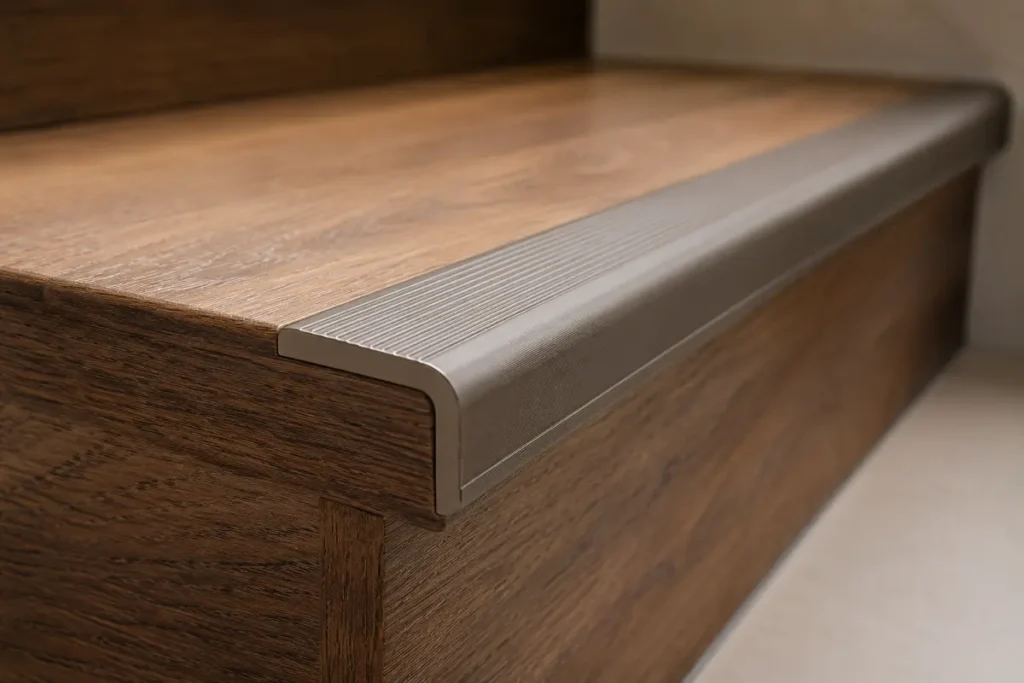
- A clearly defined step edge, a nosing on the front of each tread that both grips where feet land and marks the edge visually, with a little contrast to aid depth perception on a steep run.
- Edge-wear durability, because the front edge of each tread takes concentrated traffic and wears faster than a flat floor.
- Sound, since a hard staircase can be noisy, and a softer or cushioned surface quiets it.
- Fall-cushioning, a softer surface reduces the harm if someone does slip.
Judge any stair floor against grip and a defined edge first. A floor that looks beautiful but fails on those is the wrong floor for a staircase.
Stair flooring rated on grip, safety, wear and looks
The table rates the realistic stair options on what matters most on a staircase, grip and safety first, looks last. Polished tile and marble appear only as the danger case to avoid, and Urban fits carpet, wood and vinyl, not tile or marble.
| Floor | Grip / slip safety | Fall cushioning | Quiet | Edge-wear durability | Look | Best stair use |
|---|---|---|---|---|---|---|
| Stair carpet | Highest | Highest | Best | High (good grade) | Soft, traditional | Safety-first, kids/elderly homes |
| Carpet runner over a hard stair | High (walking line) | High (centre) | Very good | High | Best of both | The safe-and-handsome compromise |
| Engineered wood (with nosing) | Moderate (needs nosing) | Low | Moderate | Moderate (edges wear) | Premium, continuous | Premium look with anti-slip nosing |
| SPC / LVT (with stair nosing) | Moderate-good (textured) | Low | Moderate | High | Realistic, practical | Durable wood-look with nosing |
| Laminate (matte, nosed) | Lower (can be slippery) | Low | Moderate (can be clicky) | Moderate | Budget wood-look | Only if matte, textured, well-nosed |
| Polished tile / marble (avoid, we do not fit) | Lowest (dangerous) | None (hard) | Poor | High | Luxury but hazardous | Avoid on stairs |
Stair carpet: the safest and quietest way to floor a staircase
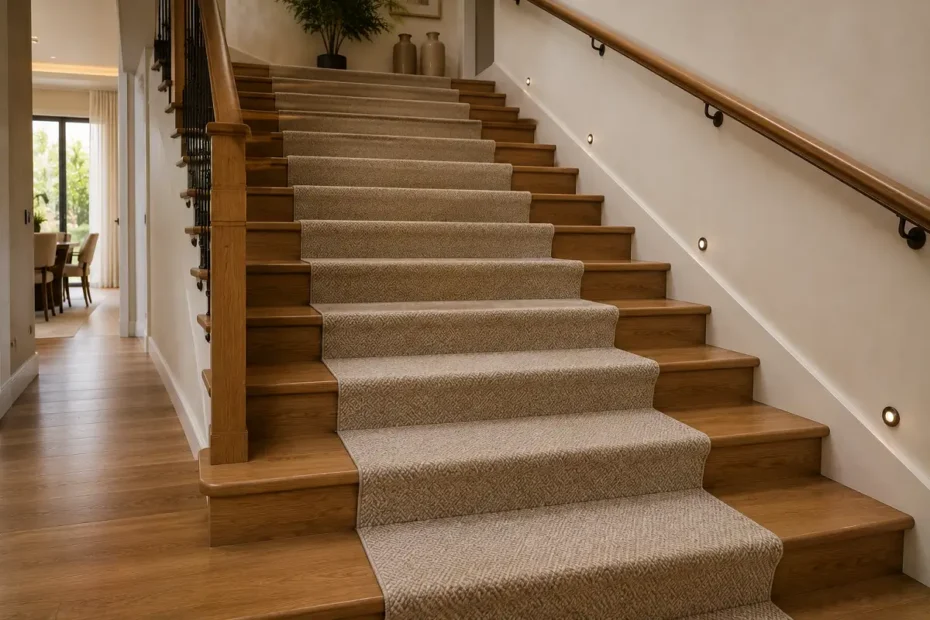
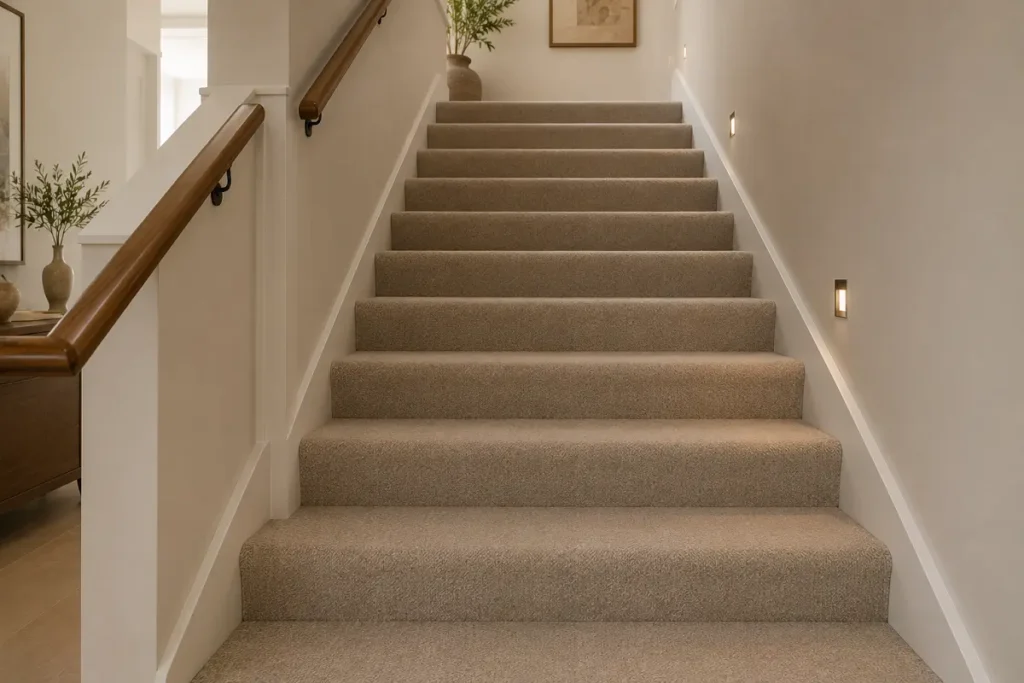
If safety is the priority, and on stairs it should be, carpet is the honest first recommendation, because it is the safest stair surface there is. Stair carpet grips underfoot so feet do not slip, it cushions the impact if someone does fall, it quiets a staircase that would otherwise echo through the house, and it clearly defines each step edge.
US home-safety guidance rates low-pile carpet among the safer stair surfaces for exactly these reasons. The spec point that matters: a low-pile, dense, contract-rated carpet is better on stairs than a deep plush one, because it holds its shape over the nose of each tread and wears better under the concentrated traffic a staircase takes. For a home with young children or elderly members, where a slip would be most dangerous, fully carpeted stairs are the safest floor you can choose.
Wood and wood-look stairs: a premium look that needs proper grip
Wood and wood-look stairs give a beautiful, continuous flow from the floor above onto the staircase, but honesty demands a clear caveat: a bare hard tread can be slippery, especially in socks, so it is only stair-safe with the right details.
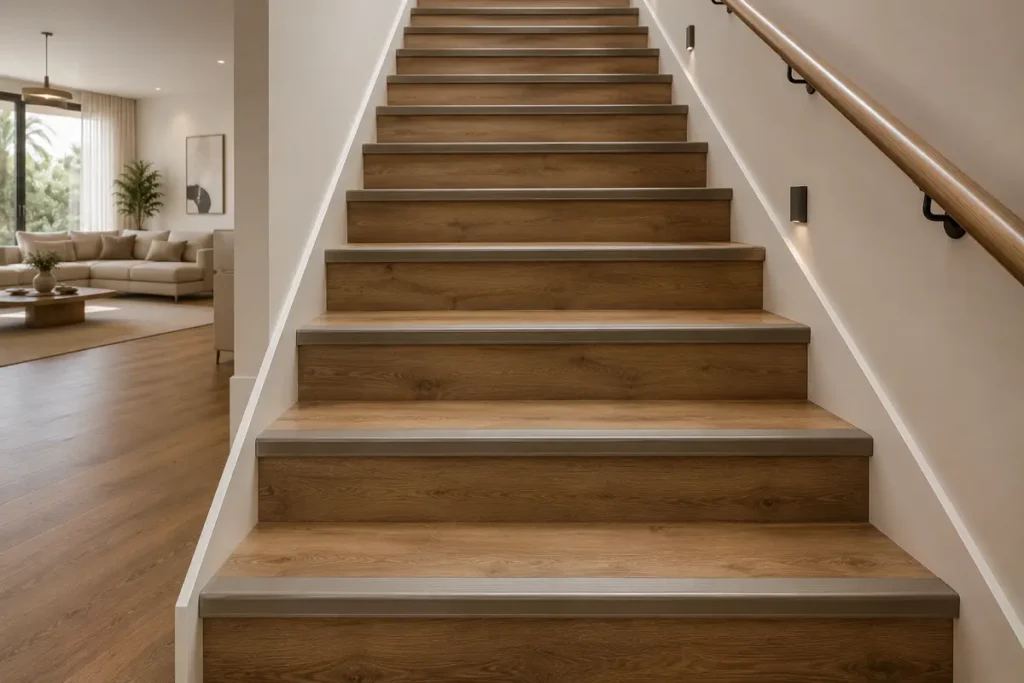
Engineered wood flooring gives a genuine timber staircase, and a textured or wire-brushed finish grips far better than a high-gloss one. SPC and LVT flooring work well on stairs too, using matching stair-nose profiles for a secure, finished edge, and they are waterproof and scratch-resistant with a textured, grippy surface.
Laminate can be used but is more slippery, so choose a matte, textured board with a proper nosing and never a high-gloss finish on steps. The non-negotiable across all of them is a secure anti-slip nosing on every tread, and many of these staircases are safest with a carpet runner down the middle. All of these sit within the wider wood flooring range. Do not treat a bare hard staircase as safe without the nosing.
Stair runners: the safe and handsome compromise
For buyers torn between the safety of carpet and the looks of wood, there is a genuine best-of-both answer, and it is having a real resurgence: the stair runner. A carpet runner laid down the centre of a wood or vinyl staircase gives you grip, cushioning and quiet exactly where you walk, along the middle of each tread, while the handsome hard surface shows at the edges.
You get the architectural look of a wood staircase with carpet’s slip resistance and softness in the actual walking path, plus a little sound control. It is the smart compromise for a household that wants a premium-looking staircase without giving up stair safety, and a stair runner is often the recommendation we reach for when looks and safety both matter.
What to avoid on stairs: the slippery floors that cause falls
Just as important as what to choose is what to avoid, because some genuinely popular floors are hazardous on a staircase. Polished tile, marble and high-gloss laminate are the danger cases: they are slippery underfoot, hard and unforgiving in a fall, and the slip risk on a polished hard surface without traction is exactly what causes stair accidents.
These are floors to keep off your stairs, whatever they look like on a flat floor. Urban does not fit tile or marble in any case, we fit carpet, wood and vinyl, and the same caution applies within those: even a wood or laminate stair must be specified matte, textured and well-nosed rather than high-gloss to be safe. On stairs, a slippery finish is not a style choice, it is a hazard.
Open risers, winders and why stair fitting is a specialist job
Stairs are the single most technically demanding floor to fit in a home, and it is worth understanding why, because the fit itself is a safety matter. Every tread needs a precise cut and a secure, well-defined nosing on its front edge.
Any inconsistency between steps, an uneven riser height, a tread that sits slightly off, is a documented cause of trips, because people climb stairs on muscle memory and a step that is not where the foot expects it causes a stumble. Open risers (with a gap behind each tread) and winder steps (the wedge-shaped turning steps) complicate the fit further and demand real skill.
This is the part of a flooring job where do-it-yourself most often goes wrong and where professional fitting genuinely matters, not as an upsell but because a poorly fitted staircase is itself a hazard. A properly fitted stair floor, with consistent steps and a secure nosing on every tread, is a safety feature in its own right.
Stair safety for homes with children, elderly or pets
If your household includes young children, elderly members or pets, stair safety moves from important to essential, because these are exactly the people most at risk. Toddlers and older adults are the most vulnerable to serious injury from a stair fall.
So for these homes the grip and fall-cushioning of a soft surface matter most: fully carpeted stairs or a carpet runner reduce both the chance of a slip and the harm if one happens, and pets, too, get far surer footing on carpet than on a slick hard tread. This is the clearest case for putting safety ahead of looks on the stairs. Our guide to the best flooring for pets and families covers the wider household-safety picture in more detail.
What stair flooring costs in the UAE
Stair flooring is priced differently from a flat room, and it is worth knowing why before you compare quotes. Supplied and fitted, the materials sit in these indicative bands: stair carpet within the broadloom range about AED 30 to 450/sqm (about AED 2.8 to 41.8/sqft).
Engineered wood runs about AED 100 to 300+/sqm (about AED 9.3 to 27.9+/sqft), SPC about AED 35 to 150/sqm (about AED 3.3 to 13.9/sqft), LVT about AED 45 to 350/sqm (about AED 4.2 to 32.5/sqft), and laminate about AED 45 to 160/sqm (about AED 4.2 to 14.9/sqft). But stairs cost more per square metre to floor than a flat room, because fitting each step, cutting treads, securing a nosing on every one, and handling winders and open risers, is skilled, time-consuming labour, so a staircase quote reflects fitting complexity as much as material and is best quoted per staircase after a site visit. Stair carpet and runners are often the most cost-effective safe option, while a fully wood-clad staircase with per-step nosings is the most labour-intensive. All figures exclude 5% VAT. For the full breakdown across every floor type, see our flooring cost guide.
Which stair floor is right for your home?
The right staircase floor follows your priority, and on stairs safety should weigh heaviest. A home with young children or elderly members, a household that wants the premium look, and one that wants both point to different answers, but every one of them needs grip and a defined step edge. Match the floor to your priority:
- Safety first, or a home with children or elderly: stair carpet, for maximum grip, fall-cushioning and quiet.
- Looks and safety both: a carpet runner over a wood or vinyl staircase, the best-of-both compromise.
- A premium continuous wood look: engineered wood or wood-look SPC or LVT, always with a proper anti-slip nosing on every step, ideally with a runner.
- Never: a polished tile, marble or high-gloss surface on a staircase, whatever the look.
If you are choosing floors for the whole home and want the full method, start with our guide on how to choose flooring.
Stair flooring: frequently asked questions
Is carpet or wood safer on stairs?
Carpet is safer. It grips underfoot, cushions a fall and defines each step edge, which is why safety-first homes, especially with children or elderly members, often choose it. Wood stairs look more premium but can be slippery, particularly in socks, so they need a proper anti-slip nosing on every step and often a carpet runner to be genuinely stair-safe.
What is the safest flooring for stairs?
Carpet or a carpet runner, for grip, fall-cushioning and quiet, which is why low-pile carpet is rated among the safer stair surfaces. If you prefer a hard floor, wood or wood-look vinyl is safe only with a proper anti-slip nosing on every step. Avoid polished tile, marble and high-gloss finishes, which are genuinely hazardous underfoot on a staircase.
What is a stair nosing and why does it matter?
A nosing is the rounded, often anti-slip edge fitted to the front of each step. It defines the step visually, protects the edge from the concentrated wear stairs take, and provides grip exactly where feet land. On any hard stair a secure, slightly contrasting nosing is essential for safety, since a clearly visible, grippy step edge prevents both slips and missteps.
Are wood stairs slippery?
Bare wood treads can be slippery, especially in socks, so wood stairs need an anti-slip nosing on each step and often a carpet runner down the middle. A textured or wire-brushed finish grips better than high-gloss. With proper nosing and finish, wood stairs are both safe and handsome; without them, they are a genuine trip risk.
Can you put vinyl or laminate on stairs?
Yes. SPC and LVT work well on stairs with matching stair-nosing profiles and a textured finish for grip, and are waterproof and scratch-resistant. Laminate can be used but is more slippery, so choose a matte, textured board with a proper nosing, and never a high-gloss finish on steps. Matching stair-nose parts give a secure, finished edge.
Is a stair runner better than fully carpeting stairs?
Both are safe. A runner over a wood or vinyl staircase gives grip and quiet down the walking line while showing a handsome hard surface at the edges, the best-of-both look, and it is a resurgent style. Full carpet maximises grip, cushioning and quiet, so it is the safest option where a slip would be most dangerous.
What is the best stair flooring for a home with children or elderly?
Carpet or a carpet runner, for maximum grip and fall-cushioning where a slip is most dangerous, since toddlers and older adults are the most vulnerable to serious stair injuries. The soft, gripping surface reduces both the chance and the harm of a fall. Our pets and families guide covers the wider household safety picture in more detail.
Why does flooring stairs cost more than a flat floor?
Because fitting a staircase is skilled, time-consuming labour: each tread is cut to fit, a nosing is secured on every step, and winders and open risers add complexity. So a stair quote reflects fitting work as much as material, and stairs are quoted per staircase after a site visit. Stair carpet and runners are usually the most cost-effective safe option.
The bottom line: the safest, best-looking floor for your stairs
Stairs are the one place in the home where the floor is a safety decision first and a style decision second, because a slip on the stairs genuinely hurts. Carpet is the safest and quietest stair floor, gripping, cushioning and defining each step, and it is the honest first choice for homes with children or elderly members.
Wood and wood-look SPC or LVT give a premium, continuous look, but only with a proper anti-slip nosing on every tread, and often a runner, so treat a bare hard staircase as unfinished until the nosing is on. The runner over a hard stair is the smart best-of-both, safe down the walking line, handsome at the edges.
Keep polished tile, marble and high-gloss finishes off your stairs entirely. And because a poorly fitted staircase is a hazard in itself, this is the floor to have fitted by professionals. Put grip and a defined edge first, and a free site visit will confirm the safest, best-looking floor for your stairs.
Get your stairs floored safely with a free site visit
Planning to floor a staircase in Dubai or across the UAE? Message us on WhatsApp and a flooring specialist will assess your stairs, straight, winding, open-riser or standard, and recommend the safest, best-looking option, stair carpet or a runner for maximum grip, or a wood or wood-look staircase with a proper anti-slip nosing on every step, all fitted precisely by our own team.
- WhatsApp us: +971 56 689 9831
- Call: +971 56 689 9831
- Request a free site visit and quote across Dubai and Abu Dhabi.
We have supplied and fitted staircases across the UAE since 2013, with more than 10,000 projects completed by our in-house team.

Junaid Rana is a content strategist with over 10 years of experience in the interior and fit-out industry, writing on flooring, finishes and fit-out across UAE homes and commercial spaces. His guides are reviewed for accuracy by Urban Flooring’s in-house experts.