
Reviewed for accuracy by Muhammad Gulbadin, founder and operations manager at Urban Flooring, 15+ years in UAE flooring.
Get a Measured Carpet Quote · Ask About Carpet on WhatsApp · Call us on +971 56 689 9831
How Much Does Carpet Cost in Dubai?
Carpet costs AED 30 to 450 per sqm (about AED 2.80 to 42 per sqft) in Dubai, supplied and fitted. Budget synthetic runs AED 30 to 80, mid-range nylon and blends AED 80 to 180, and premium wool AED 180 to 450. Those figures include the carpet, the fitting labour and the perimeter work, which is why they sit above a supply-only price.
The spread is wide because carpet is not one product. A polypropylene bedroom carpet and a wool stair runner are both carpet and they are eight times apart per square metre. What moves you up the band is fibre first, then pile weight, then whether the room needs anything unusual at its edges.
Supply-only prices you see elsewhere are not comparable to the figures above. A supply-only price is the carpet on a roll. Ours is the carpet laid, trimmed, gripped at the perimeter and finished at the doorways, which is the number you actually pay. The cross-material view, carpet against vinyl, wood and resin, is in the flooring cost guide.
Figures researched November 2026 and quoted as an indicative supply-and-fit guide.
Carpet Cost by Type
Broadloom runs AED 30 to 450 per sqm (about AED 2.80 to 42 per sqft) supplied and fitted. Carpet tiles run AED 35 to 130, stair carpet AED 60 to 250 on material, and exhibition carpet AED 10 to 30. Those four are different products with different jobs, so the cheapest one is only the right answer when it suits the room. The table below sets them against each other.
As an indicative supply-and-fit guide:
| Carpet type | Per sqm (AED) | Per sqft (AED approx) | Typical use |
|---|---|---|---|
| Broadloom, budget synthetic | 30 to 80 | 2.8 to 7.4 | Bedrooms, rentals, low-traffic rooms |
| Broadloom, mid-range nylon or blend | 80 to 180 | 7.4 to 16.7 | Living rooms, family homes, hotels |
| Broadloom, premium wool | 180 to 450 | 16.7 to 42.0 | Principal rooms, where it has to look and feel it |
| Carpet tiles, loose-lay | 35 to 80 | 3.3 to 7.4 | Home offices, lettings, rooms that get altered |
| Carpet tiles, contract grade | 45 to 130 | 4.2 to 12.1 | Offices, corridors, heavy traffic |
| Office broadloom | 60 to 200 | 5.6 to 18.6 | Boardrooms, executive floors |
| Stair carpet, material only | 60 to 250 | 5.6 to 23.2 | Staircases, fitting priced separately |
| Exhibition carpet | 10 to 30 | 1.0 to 3.0 | Stands and event floors, laid for days |
Broadloom against carpet tiles on cost
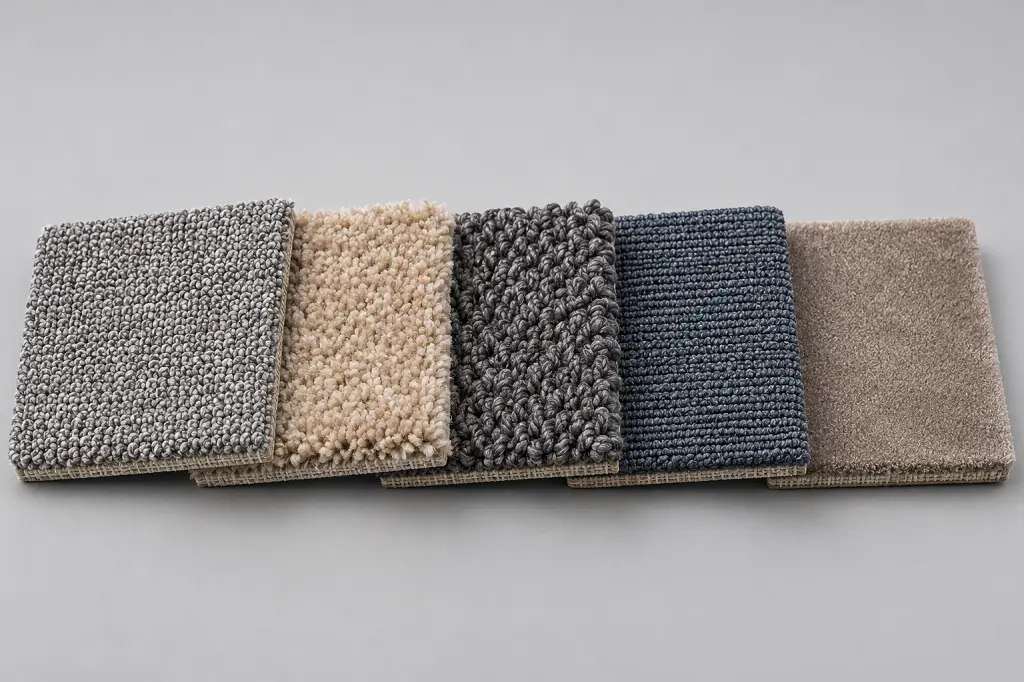
Tiles start higher per square metre and finish lower. A loose-lay tile at AED 35 beats budget broadloom at AED 30 by a few dirhams, and a contract tile tops out at AED 130 where broadloom runs to 450. So for a cheap floor broadloom wins on the headline, and for a floor that takes traffic tiles win on the ten-year figure, because a damaged tile is swapped rather than the room relaid.
The most expensive carpet is premium wool, and people pay for it because wool recovers from crushing, holds colour and feels different underfoot in a way no synthetic matches. In a principal room that is worth the money. In a hallway it is money spent where polypropylene would have survived better. Carpets covers the fibres and pile constructions behind those tiers, and carpet tiles covers the modular formats. Prayer-hall carpet is priced separately on mosque carpet, and majlis flooring is covered on best living room flooring.
What Pile Weight and Density Do to the Price
Pile weight and density are the two numbers that move a carpet price most inside a single fibre. Pile weight is how much yarn sits in a square metre, measured in grams. Density is how tightly that yarn is packed. Two polypropylene carpets at AED 40 and AED 80 per sqm are the same fibre at different weights, and that difference is what you are paying for.
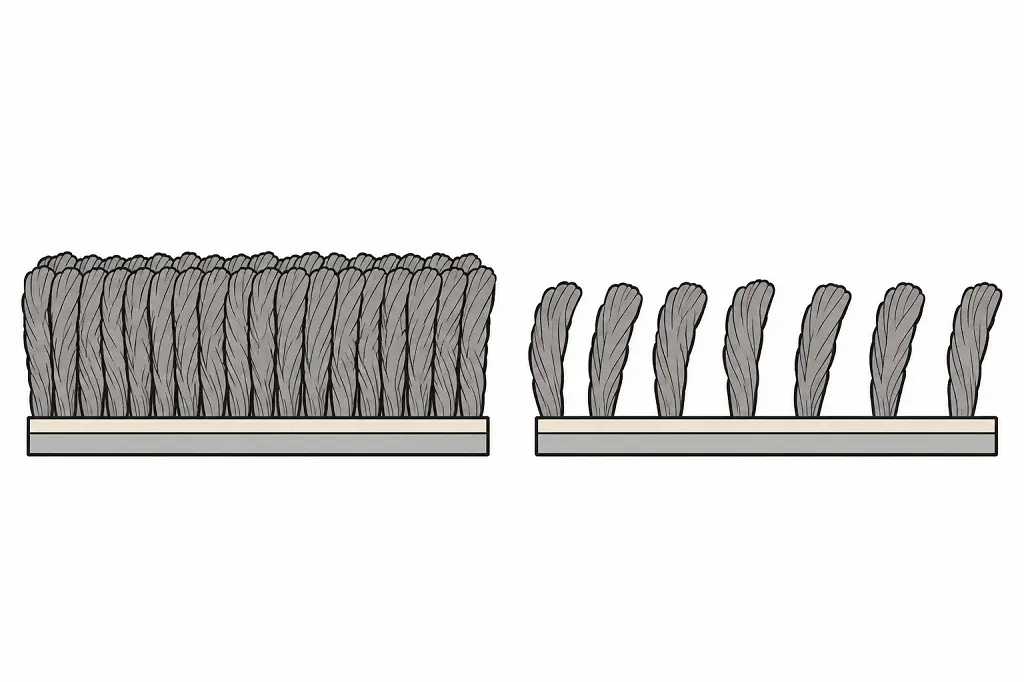
Pile weight is the straightforward one. More yarn costs more to make, so a heavier carpet costs more per square metre. It is the single biggest reason two carpets that look identical on a sample board are priced apart.
Density is the one that decides whether the money was well spent. A dense carpet holds its pile upright under a foot, so the traffic path through a room stays looking like the rest of the room. A loose one flattens along that path within months, and no cleaning brings it back. Density is why a heavier carpet in a hallway is not an indulgence.
The practical rule is short. Match the weight to the traffic, not to the budget. A light carpet in a bedroom lasts years because nothing walks on it. The same carpet on a landing is the one that gets replaced first, and replacing it costs the whole figure again.
Backing, Fibre and Grade
Inside one price band the money goes to three things: the fibre, the backing and the grade. Fibre sets the floor and the ceiling of what a carpet can cost. Backing decides whether it can be stretched over gripper or has to be stuck down. Grade is the manufacturer’s own split between domestic and contract, and a contract grade costs more for the same look.
Fibre is the biggest single lever and it is covered properly on carpets, which owns fibres and pile construction.
Backing matters to the price because it decides the fitting method. An action-backed carpet is stretched over gripper and needs no adhesive. A felt or rubber-backed carpet is laid differently again. A carpet that has to be bonded to the floor costs more to fit, and on a large floor that difference is real rather than nominal.
Grade is the one buyers miss. Manufacturers sell the same pattern in a domestic and a contract version, and the contract one has more yarn, a tougher backing and a longer warranty from the mill. It costs more and it is the right call anywhere a domestic grade would be replaced twice.
What Else Lands on a Carpet Quote
Beyond the carpet, a quote carries underlay, gripper, door bars, thresholds and any stair work. Underlay runs AED 10 to 40 per sqm (about AED 0.90 to 3.70 per sqft) depending on grade. The rest are quoted with the job rather than at a published rate, because the figure follows the perimeter length and the number of doorways rather than the floor area.
Underlay is the one with a real number and it is worth understanding, because a thin underlay is the commonest way a quote is made to look cheaper. Foam sits at the bottom of the band, felt in the middle and rubber or combination grades at the top. What goes under your carpet is specified against the floor and the room on the site visit, and flooring underlay covers the grades we supply.
Gripper, door bars and threshold strips are perimeter work. The cost follows how many metres of perimeter and how many doorways a room has, so a small room with four doorways carries more edge work than a large one with two. We quote those with the job and they sit inside the figures above rather than appearing afterwards.
Pattern matching costs more, and it is a wastage cost rather than a labour one. A patterned carpet has to be cut so the pattern lines up across a seam and at a doorway, and the offcuts that creates are paid for. On a plain carpet that waste does not exist.
Lifting and disposing of an old carpet is quoted with the job. Published UAE rates for it contradict each other outright, so we do not carry a figure for it, and we tell you what it comes to on your floor rather than guessing at a rate.
Why Stairs Cost More Per Square Metre Than a Room
A staircase costs more per square metre than any room in the house, and a full staircase runs AED 800 to 4,000 or more supplied and fitted. The reason is labour per square metre rather than material. A flight of thirteen steps is around four square metres of carpet and most of a day of skilled fitting, where four square metres of bedroom is twenty minutes.

Every step is a separate piece of work. The carpet is cut, wrapped over the nosing, tucked into the back of the tread and secured, and that happens thirteen or more times on a single flight. A room is one or two drops, trimmed once at the perimeter.
That is also why stairs are quoted differently. A room is priced on area. A staircase is priced on the staircase, by the number of steps, the material and whether it is a straight flight or has winders and a turn. A quote that prices your stairs on square metres alone has either misunderstood the job or is leaving the fitting out.
Material matters more on stairs than anywhere else, because a stair nosing takes the most concentrated wear in a building. Stair carpet covers the grades and the fitting styles.
Carpet Cost for an Office or Commercial Space
Commercial carpet costs more than domestic for the same look, and that is the specification rather than a markup. Contract carpet tiles run AED 45 to 130 per sqm (about AED 4.20 to 12.10 per sqft) and office broadloom AED 60 to 200. Both start above the domestic equivalent because they carry more yarn, a tougher backing and a mill warranty written for commercial traffic.
The gap between domestic and contract is not cosmetic. An office corridor takes more footfall in a month than a bedroom takes in a decade, and a domestic grade laid in one is replaced inside two years. Paying the contract premium once is cheaper than paying the domestic price twice plus the disruption of a second fit-out.
Format changes the commercial figure too. Tiles let a worn area be lifted and replaced without touching the rest of the floor, which matters in an occupied office where closing a whole floor is the real cost. Broadloom reads more premium and has no visible joins, which is why boardrooms and hotel floors take it.
Office carpet covers the contract specifications and carpet tiles the modular formats.
What Makes One Quote Cheaper Than Another
Two quotes for the same room differ for four reasons, and only one of them is the carpet. A cheaper quote is supply-only rather than fitted, or carries a thinner underlay, or prices the measured area rather than the cut area, or has substituted a domestic grade for the contract one specified. Check which before comparing the totals.
Supply-only against fitted is the biggest single gap and the easiest to miss, because both are written as a per-square-metre figure. A supply-only price is the carpet and nothing else: no fitting, no underlay, no gripper, no door bars. Compared against a fitted price it looks like a bargain and is not a comparison at all. The flooring cost guide sets out the difference across every material.
Underlay is the second. It is under the carpet where nobody checks it, and dropping from a combination grade to a thin foam takes real money off a quote while taking years off the floor.
Measured area against cut area is the third and it is covered in the next section. Grade substitution is the fourth: the same pattern in a domestic rather than a contract weight looks identical on the day and wears out first.
How Carpet Cost Is Measured and Quoted
Carpet is quoted on the area that has to be cut from the roll, not on the floor area of the room. Rolls come in a fixed width, commonly 3 to 4 metres, so a room 4.5 metres wide needs two drops and a seam, and the offcut from the second drop is still carpet you have bought. That difference is wastage and it is normal rather than a surcharge.
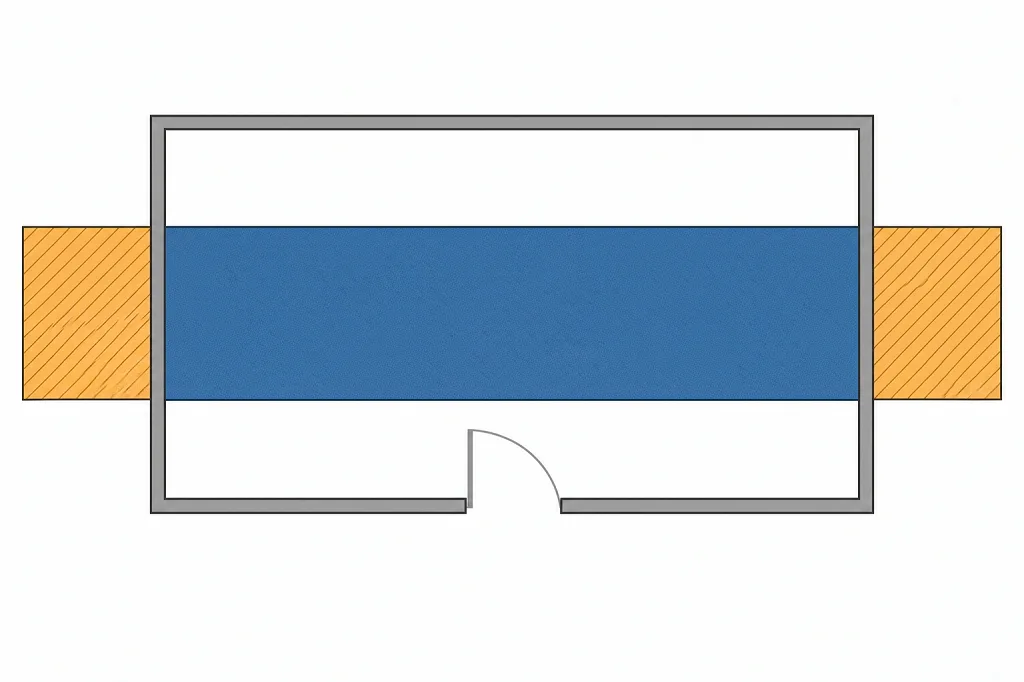
The arithmetic is simple once you see it. A bedroom four metres by four metres is sixteen square metres of floor. If the roll is four metres wide, one drop covers it and there is almost no waste. A room four and a half metres wide needs a second drop, and the extra half metre of width comes off a full-width piece, so you pay for close to double on that strip.
For a whole apartment, the figure is the sum of those room-by-room cuts rather than the apartment’s floor area. Two apartments with identical total areas can differ by several square metres of carpet depending on how the rooms are shaped and where the roll width falls.
That is why a measured quote and a floor-plan estimate are different numbers, and why we measure before quoting. Narrow corridors are the worst offenders, because a corridor a metre wide still comes off a roll three or four metres wide unless it can be planned alongside another cut.
Where Carpet Is and Is Not the Cheaper Choice
Carpet is among the cheapest floors to buy and fit per square metre, and that is not the whole cost. In a dusty climate it holds fine sand, it needs more frequent professional cleaning than a hard floor, and it is replaced sooner in a high-traffic room. A buyer choosing on headline price alone spends more over ten years in a hallway than they would on vinyl or SPC.
The ten-year arithmetic is where carpet loses and it is worth doing before you order. A budget broadloom in a busy hallway is replaced twice in a decade, with the cleaning in between. A hard floor in the same hallway is cleaned with a mop and is still there. On the headline figure carpet wins. On the decade, it does not.
Where carpet wins outright is where the floor is not taking that punishment and where what you want is warmth, quiet and softness underfoot. Bedrooms are the clearest case. A carpet in a bedroom is cheap to buy, lasts because nothing walks on it, and does the one thing a hard floor cannot do at any price.
So the honest split is by room rather than by budget. Carpet in bedrooms and principal rooms, hard flooring in hallways, entrances and anywhere that sees sand off the street. We will tell you that on the site visit even where it means selling you less carpet.
Carpet Cost FAQs
What is the cheapest carpet that still lasts?
A mid-weight polypropylene at the top of the budget band, around AED 60 to 80 per sqm (about AED 5.60 to 7.40 per sqft) supplied and fitted. Below that the saving comes out of pile weight, and a light carpet flattens along the traffic path within a year. Polypropylene resists staining and fading well, which is what makes it the value choice rather than the cheap one.
Is underlay included in a carpet price?
Yes, in ours. Underlay runs AED 10 to 40 per sqm (about AED 0.90 to 3.70 per sqft) depending on grade, and it sits inside the figures quoted rather than arriving as a separate line. Check this on any quote you compare, because dropping to a thin foam underlay is one of the commonest ways a cheaper quote is made to look cheaper without the carpet changing.
How much does it cost to carpet a bedroom?
A four by four metre bedroom is sixteen square metres, so a budget synthetic carpet supplied and fitted comes to roughly AED 480 to 1,280, and a mid-range nylon AED 1,280 to 2,880. Add a little for wastage if the room is wider than the roll. We measure before quoting, because room shape moves the figure more than people expect.
Why is stair carpet quoted differently from a room?
Because stairs are priced on labour rather than area. A flight is about four square metres of carpet and most of a day of skilled fitting, where the same area of bedroom takes twenty minutes. So a staircase is quoted on the staircase, by step count, material and whether it has winders, and runs AED 800 to 4,000 or more supplied and fitted.
Is carpet cheaper than vinyl or laminate?
On the headline figure carpet starts lower than most hard floors, and over ten years in a busy room it frequently does not, because it is cleaned more and replaced sooner. The full comparison across every material sits in the flooring cost guide rather than here.
How much carpet do I need for my room size?
More than the floor area, because carpet is cut from a roll of fixed width. Measure the longest and widest points of the room, including doorway recesses, then allow for the roll width: a room wider than the roll needs a second drop and the offcut is still paid for. We measure on the free site visit and quote the cut area.
Does a thicker carpet cost much more to fit?
A little, and far less than the carpet itself costs. A heavier carpet is harder to stretch and trim, so the labour rises slightly, and a thicker build-up can mean easing a door. The material is where the money goes. Going up a pile weight costs more in carpet than it ever does in fitting.
How long should a carpet last in Dubai?
Broadloom carpet runs seven to twelve years and carpet tiles ten to fifteen, which is where the ten-year arithmetic comes from. Traffic decides it more than price does: the same carpet lasts the upper end of that range in a bedroom and the lower end on a landing. Dust and frequent cleaning shorten it further in this climate.
Get a Measured Carpet Quote
Tell us the rooms and we will measure and quote the cut area on a free visit.
Get a Measured Carpet Quote · Ask About Carpet on WhatsApp · Call us on +971 56 689 9831

Junaid Rana is a content strategist with over 10 years of experience in the interior and fit-out industry, writing on flooring, finishes and fit-out across UAE homes and commercial spaces. His guides are reviewed for accuracy by Urban Flooring’s in-house experts.